
Internal Cold Mains Leak Detection in Rickmansworth
A cold mains leak in Rickmansworth was located using a damp meter, pressure testing, ground microphone, tracer gas, thermal imaging, and acoustic listening, with water mains leak detection confirming a pinhole failure on the cold water main beneath the bathroom floor screed. Found by engineer Danny O'Mahony.




The original leak detection company, est. 2011
Facts
| Location | Rickmansworth |
|---|---|
| County | Hertfordshire |
| Leak Type | Water Mains Leak Detection |
| Property Type | Residential property |
| Detection Method | Damp Meter, Pressure Testing, Ground Microphone, Tracer Gas, Thermal Imaging, Acoustic Listening |
| Outcome | Pinhole leak on cold water main beneath bathroom floor, repaired. |
Symptoms

At a property in WD3, the cold water mains pipework inside the building had developed a leak causing progressive and visible damage. The wooden flooring in the rear lounge had begun to lift and separate from the screed below, and had since been fully removed, exposing a wet screed floor beneath.
Dampness and water staining were also visible on the wall adjacent to the radiator in the same room.
The customer had established that the sound of running water stopped when the main stopcock in the kitchen cupboard was turned off. As a result, the customer had been isolating the supply at the stopcock to limit further damage, leaving the property without a continuous mains water supply.
With flooring already lifted and moisture spreading through the structure, internal leak detection was required to identify the precise source before any remediation or reinstatement work could proceed.
Methods Used

The investigation began with moisture meter readings taken across the ground floor bathroom and rear lounge, establishing the extent and distribution of damp within the floor and wall structures. Pressure testing confirmed a significant and active leak on the cold water pipework, with complete pressure loss recorded within a 5 to 10 minute window.
A ground microphone was then used to listen through the bathroom floor, where a gurgling noise was detected within the floor structure beneath.
Tracer gas was introduced after an air compressor had cleared water from the pipework, and gas was detected almost immediately at the corner of the bathroom floor where the hot and cold water pipes enter the screed beneath the corner unit. With the evidence pointing to a specific area, consent was obtained to open the floor.
This methodical approach, consistent with internal leak detection on concealed mains pipework, allowed the leak to be traced without unnecessary excavation across the wider floor area.
Damp Meter. Used to take moisture readings across the rear lounge floor and walls and the ground floor bathroom, identifying elevated and wet readings that mapped the spread of water through the structure.
Pressure Testing. A pressure test rig was connected to the cold water pipework via the garden tap backplate and tested at three bar standing mains pressure, confirming complete pressure loss within 5 to 10 minutes and establishing an active leak on the cold water mains.
Ground Microphone. Employed to listen through the bathroom floor, where a gurgling noise was detected within the floor structure, indicating water movement in the vicinity of the buried pipework.
Tracer Gas. Introduced into the cold water pipework after it had been cleared of water with an air compressor; escaping gas was detected almost immediately at the corner of the bathroom floor where the hot and cold pipes enter the screed beneath the corner unit.
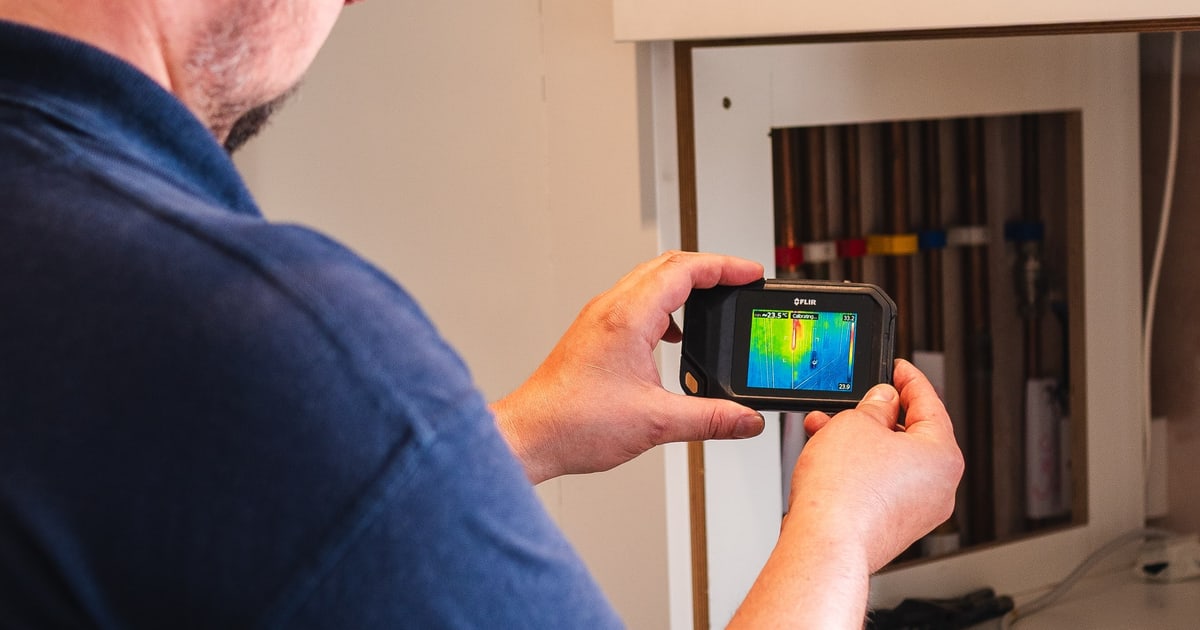
Thermal Imaging. Used during the investigation to assist in identifying temperature differentials and moisture patterns within the floor and wall structures consistent with an active water leak.
Acoustic Listening. Applied alongside the ground microphone to listen to the floor in the bathroom, helping to locate water movement noise within the concealed floor structure.
Investigation Process
-
1Moisture meter survey
Readings were taken across the ground floor bathroom and rear lounge. The rear lounge floor recorded elevated moisture throughout, with the highest readings near the radiator wall; elevated readings were also found on the lounge walls and on the bathroom walls at low level, with a notable reading near the basin pedestal.
-
2Pressure test conducted
The garden tap backplate was removed and a pressure test rig connected to the cold water pipework. A test at three bar standing mains pressure showed complete pressure loss within 5 to 10 minutes, confirming an active leak on the cold water mains.
-
3Ground microphone deployed
A ground microphone was used to listen through the bathroom floor, where a gurgling noise was detected within the floor structure, narrowing the suspected leak area.
-
4Pipework cleared and tracer gas introduced
An air compressor was used to clear water from the internal mains pipework. Tracer gas was then introduced, and escaping gas was detected almost immediately at the corner of the bathroom floor, at the point where the hot and cold water pipework enters the screed beneath the corner unit.
-
5Floor opened under consent
With the evidence presented to the customer and consent granted, the linoleum flooring was cut back, the cupboard removed, and the screed carefully broken out to access the identified area.
-
6Pipework traced and leak found
The hot and cold water pipework was found to run beneath the wall shared with the lounge, extending in front of the patio doors and stopping approximately halfway across. Further screed was removed and the leak was traced to a pinhole on the cold water main, where a previous solder repair over a mechanically damaged and slightly flattened section of pipe had failed as soon as it was disturbed.
-
7Pipe section replaced and tested
A section of pipe approximately 6 to 8 inches long was cut out and replaced with solid copper pipe, fittings, solder, and flux. The repair was pressure tested with an air compressor to 3.3 bar for 20 minutes with no measurable pressure loss, confirming the cold water mains pipework was sound.
Result & Outcome

The leak was traced to a pinhole failure on the cold water main pipework within the screed beneath the corner unit in the ground floor bathroom. The pipe at this location had sustained mechanical damage during original installation, leaving it slightly flattened and perforated. A lead solder repair had been applied over the perforation at some point previously, but this failed as soon as it was disturbed during the investigation, reopening the leak.
A section of pipe approximately 6 to 8 inches long was cut out and replaced with solid copper pipe using appropriate fittings, solder, and flux. Following completion of the repair, a post-repair pressure test at 3.3 bar held for 20 minutes with no measurable pressure loss, confirming the integrity of the cold water mains pipework throughout the property.
This outcome is a typical result for internal leak detection on concealed mains pipework — precise location achieved without unnecessary widespread excavation, followed by a targeted repair and verified pressure test. The customer has been advised to contact their insurer regarding drying out and remediation works, and has also been informed that the adjacent hot water pipe in the same location shows similar evidence of mechanical damage and should be considered for replacement when the floor is reinstated.
Suspect a leak at your property?
ADI Leak Detection specialists investigate leaks like this across the UK every day. No find, no fee terms apply on qualifying jobs.