
Underground Water Mains Leak Detection in Marlow
A underground mains leak in Marlow was located using tracer gas, acoustic listening, thermal imaging, and pressure testing, with water mains leak detection confirming two separate leak points concealed beneath the kitchen floor. The work was carried out by engineer James Hunter.




The original leak detection company, est. 2011
Facts
| Location | Marlow |
|---|---|
| County | Buckinghamshire |
| Leak Type | Water Mains Leak Detection |
| Property Type | Residential property |
| Detection Method | Tracer Gas, Acoustic Listening, Thermal Imaging, Pressure Testing |
| Outcome | Two leaks found and repaired beneath kitchen floor. |
Symptoms

The property in SL7 had been suffering from an undetected water leak for some time. The water board had already attended and been unable to locate the source, and had replaced the external mains as part of their investigation — yet the problem persisted.
The property is community fed rather than metered, which meant there was no way to monitor consumption or flow rate to gauge the severity of the leak.
On arrival, continuous running water could be heard throughout the property, a clear sign that a leak was active somewhere within the pipework. The extent of water damage visible at the property indicated the leak had been ongoing long enough to cause significant harm to the structure.
A water mains leak detection survey was the necessary next step to pinpoint what the water board had not been able to find.
Adding to the complexity, the supply feeds three properties, all tank fed, which would later present challenges during pressure testing. The tile floor covering the pipework also had to be lifted to gain access — and unfortunately the tiles broke in the process, with no replacements available, though this was unavoidable given the need to access and repair the leak.
Methods Used

The investigation began with tracer gas being introduced into the external mains pipework. This method is well suited to situations where acoustic listening alone is unlikely to isolate a precise point, particularly in a community-fed system with no metering to indicate leak rate.
The tracer gas quickly produced a signal in the kitchen area, directing attention to that zone and allowing floor access to be targeted rather than speculative.
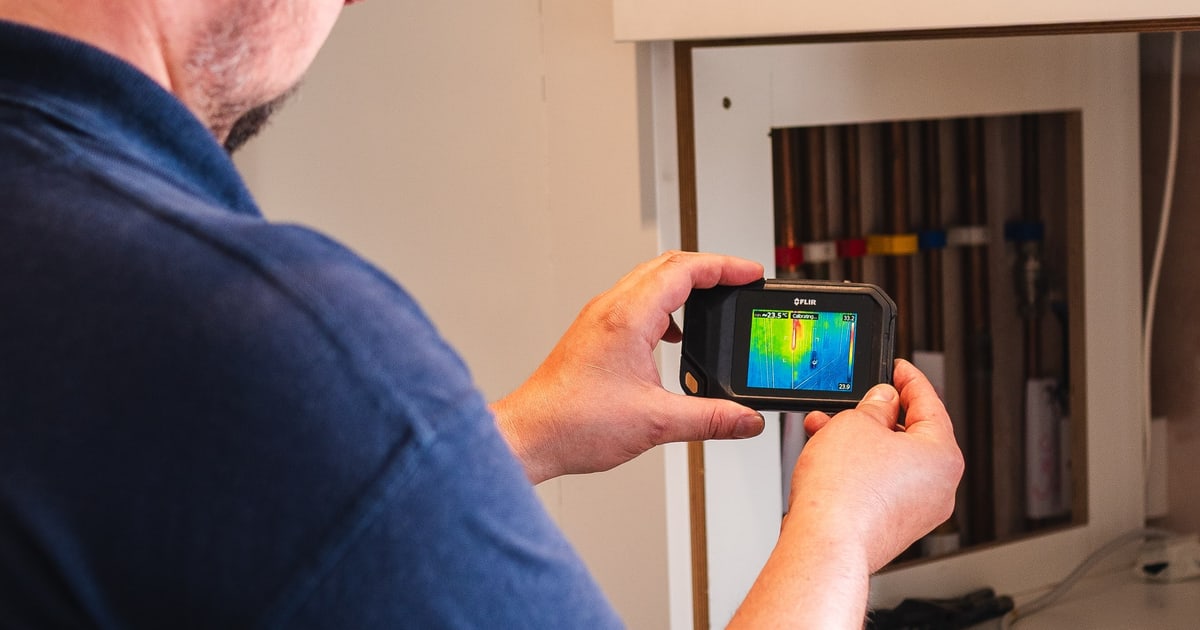
Thermal imaging and acoustic listening were used alongside the tracer gas work to build a complete picture of the pipework condition. Pressure testing was attempted but proved difficult to achieve meaningful results given that the supply feeds three properties, all of which are tank fed — this is a known limitation in water mains leak detection work on shared or community supplies.
Despite this constraint, the combination of tracer gas and acoustic detection was sufficient to locate and subsequently repair two discrete leak points beneath the kitchen floor.
Tracer Gas. Introduced into the external mains, tracer gas produced a clear signal at the kitchen floor, directing excavation to the correct area and avoiding unnecessary lifting across the property.
Acoustic Listening. Used on arrival and throughout the survey to detect the continuous sound of running water and narrow the source location within the property.
Thermal Imaging. Applied during the investigation to assist in identifying areas of moisture and temperature differential consistent with active leaking beneath the floor.
Pressure Testing. Attempted following repairs to verify integrity, though results were limited by the system feeding three tank-fed properties, which prevented a reliable pressure hold test.
Investigation Process
-
1Initial attendance and audible check
On entering the property, continuous running water was immediately audible, confirming an active leak was present. The property is community fed with no meter, so acoustic detection was the first tool used to assess the situation.
-
2Tracer gas introduced to external mains
Tracer gas was fed into the external mains pipework. A signal quickly appeared in the kitchen, identifying that area as the location of the leak.
-
3Kitchen floor lifted — first repair
With the customer's agreement, the kitchen floor tiles were lifted to access the pipework beneath. The tiles broke during this process and no replacements were available, but access was necessary to complete the repair. A compression joint in the floor was found to have failed and was causing the leak; this was repaired using 15mm copper pipe and fittings.
-
4Pressure testing attempted
A pressure test was conducted following the first repair, but due to the supply feeding three tank-fed properties it was not possible to obtain a reliable result.
-
5Second attendance — further leak identified
After the first repair the customer reported that issues were still apparent on some of the pipework. A second attendance was made, additional floor was dug out, and a second leak point was located and repaired.
-
6Second repair completed
The second leak was successfully repaired using 15mm copper pipe, fittings, and soldering equipment. No further leaks were identified following this repair.
Result & Outcome

Two separate leak points were located and repaired beneath the kitchen floor of the property in SL7. The primary source was a failed compression joint buried under the tiled floor — a type of fitting failure that is entirely concealed from the surface and would not have been detectable without tracer gas and floor access. The second leak was identified during a follow-up attendance after the customer noticed residual issues, requiring further excavation of the floor to expose and repair the affected pipework.
Both repairs were completed using 15mm copper pipe and fittings with soldered joints, replacing the compression fittings that had failed. This is the correct long-term resolution for pipework of this type buried beneath a floor, where compression joints are susceptible to movement and corrosion over time.
For a water mains leak detection case of this complexity — a community-fed system, no metering, two separate leak points, and limited pressure testing capability — the outcome is as thorough as the conditions allowed. The next steps recommended are to file documentation with the insurance company for the associated damage and repair work, and to submit a claim to the water board for a leak allowance on the water lost during the period the leak was active.
Suspect a leak at your property?
ADI Leak Detection specialists investigate leaks like this across the UK every day. No find, no fee terms apply on qualifying jobs.