
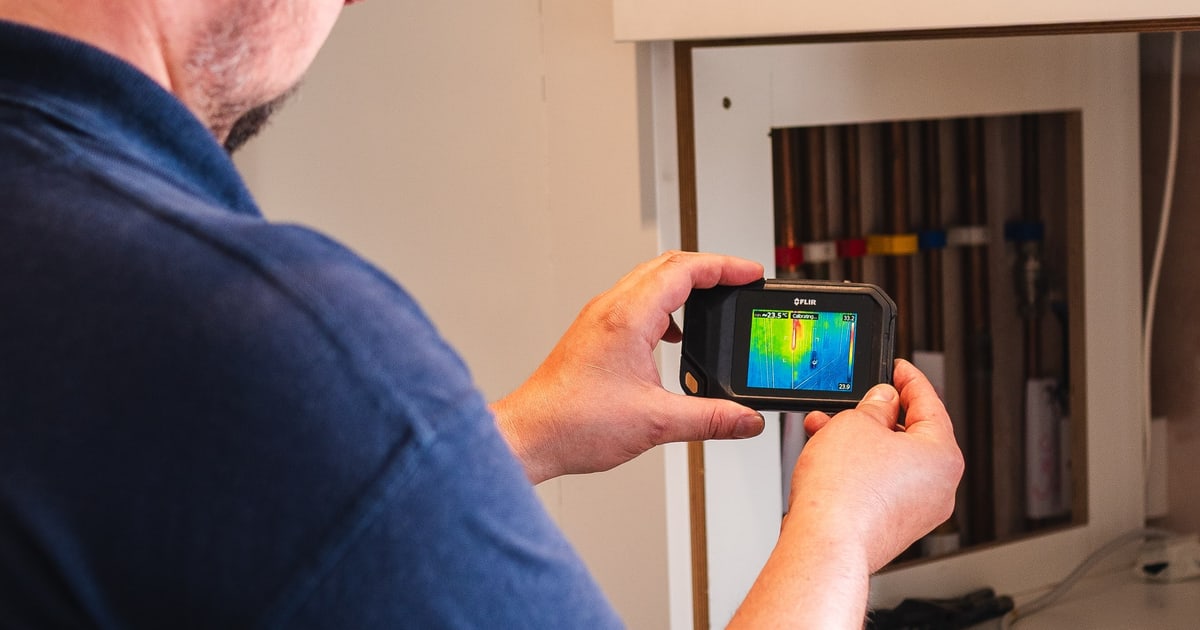
Internal Cold Mains Leak Detection in Flackwell Heath
A cold mains leak in Flackwell Heath was located using a damp meter, pressure testing, tracer gas, and acoustic listening as part of water mains leak detection beneath a concrete floor, identifying damage to the supply pipework running under a fixed fridge. The work was carried out by engineer Vincent Morgan.




The original leak detection company, est. 2011
Facts
| Location | Flackwell Heath |
|---|---|
| County | Buckinghamshire |
| Leak Type | Water Mains Leak Detection |
| Property Type | Residential property |
| Detection Method | Damp Meter, Pressure Testing, Tracer Gas, Acoustic Listening |
| Outcome | Leak found in pipework under concrete floor, pipe replaced. |
Symptoms

At a property in HP10, water could be heard running constantly even when no appliances or taps were in use. This persistent sound pointed strongly to a leak somewhere on the pipework, though the exact location was unknown.
A trace was required to establish where the leak was occurring before any repair could take place.
On arrival, the engineer was shown a kitchen area with a small hallway leading to the back door. Water damage was visible on the hallway wall, and skirting boards around the door areas showed clear signs of water ingress.
The laminate flooring in the area was also affected, with damp readings confirmed beneath it using a damp meter.
Pipework in the area ran beneath the concrete floor, which meant the leak source was not immediately accessible. Internal leak detection was the appropriate approach here — the damage pattern and the sound of running water in the structure made it clear the leak was concealed within the building fabric rather than at a visible fitting or appliance.
Methods Used

The investigation focused on the internal cold water supply pipework, which was known to pass through the concrete floor. A damp meter was used first to confirm and map the extent of moisture in the hallway wall, skirting areas, and beneath the laminate flooring.
With the damp pattern established, pressure testing was carried out on the internal cold water supply — a clear pressure loss was recorded, confirming an active leak on that circuit.
Tracer gas was then introduced into the pipework and specialised tracing equipment was used to pinpoint the leak position. This is a standard method in internal leak detection where pipework runs through solid floors and walls, and it allowed the engineer to identify the leak location precisely without unnecessary excavation.
The signal indicated the leak was beneath the fixed fridge, on pipework running under the concrete floor.
Damp Meter. Used to confirm moisture levels in the hallway wall, skirting areas, and beneath the laminate flooring, mapping the extent of water ingress before testing began.
Pressure Testing. Applied to the internal cold water supply pipework to confirm an active leak was present, with measurable pressure loss recorded during the test.
Tracer Gas. Introduced into the pressurised pipework so that the escaping gas could be detected at the point of the leak beneath the concrete floor.
Acoustic Listening. Used to detect the sound of running water within the structure, helping to confirm that pipework beneath the floor was the source of the leak.
Investigation Process
-
1Initial Assessment
The engineer inspected the kitchen and hallway, noting visible water damage on the wall and staining to the skirting boards around the back door area.
-
2Damp Meter Survey
A damp meter was used to confirm moisture in the affected wall, skirting areas, and beneath the laminate flooring, establishing the spread of water ingress.
-
3Pressure Testing
The internal cold water supply pipework was pressure tested; a clear pressure loss was recorded, confirming an active leak on that circuit.
-
4Tracer Gas Introduction
Tracer gas was introduced into the pipework and tracing equipment was used to follow the signal, which led to the area beneath the fixed fridge.
-
5Leak Located
The leak was identified as coming from the pipework running under the concrete floor beneath the fridge.
-
6Access and Excavation
The fridge was moved, the stained lino flooring was removed, and the concrete floor was broken out to expose the damaged pipework.
-
7Pipe Damage Identified
The exposed copper pipework showed damage caused by the concrete directly penetrating the cold water pipe.
-
8Repair Completed
The damaged section of 15mm copper pipe was cut out and replaced with a new section of 15mm copper installed with new fittings.
Result & Outcome

The leak was found on the cold water supply pipework running beneath the concrete floor under the fixed fridge. The pipe had been damaged by the concrete bearing directly onto it — a failure mode that is not visible without excavation and one that internal leak detection with tracer gas is well suited to locate precisely.
Once the fridge was moved and the lino and concrete were removed, the damaged section was clearly visible. The affected length of 15mm copper pipe was cut out and a new section was installed with new fittings, restoring the supply pipework to a sound condition.
For the occupants, the result is that the source of the constant running water sound has been eliminated, the cold water supply is restored, and no unnecessary excavation was carried out elsewhere in the floor — the tracer gas pinpointed the location before a single piece of concrete was lifted.
Suspect a leak at your property?
ADI Leak Detection specialists investigate leaks like this across the UK every day. No find, no fee terms apply on qualifying jobs.