
Internal Cold Mains Leak Detection in Beaconsfield
A cold mains leak in Beaconsfield was located using pressure testing, flow metering, thermal imaging, acoustic listening, and tracer gas, with water mains leak detection confirming a pinhole in the copper cold mains supply pipe concealed beneath the ground floor WC with no visible surface signs. Found by engineer Richard Poberezniuk.




The original leak detection company, est. 2011
Facts
| Location | Beaconsfield |
|---|---|
| County | Buckinghamshire |
| Leak Type | Water Mains Leak Detection |
| Property Type | Residential property |
| Detection Method | Pressure Testing, Flow Metering, Thermal Imaging, Acoustic Listening Equipment, Tracer Gas |
| Outcome | Pinhole in cold mains pipe under WC floor, located and repaired. |
Symptoms

The owner of a property in HP9 had not needed to top up the heating system or pressurised hot water cylinder for some time, which indicated the central heating circuit was holding pressure. However, a flow test carried out at the water meter showed a measurable flow that stopped as soon as the internal stopcock was closed, confirming that water was escaping somewhere on the cold mains supply inside the property.
This pointed clearly to an internal leak rather than anything on the heating side.
With no visible signs of water damage and no obvious source, internal leak detection was the appropriate course of action. The leak was not presenting itself at the surface, meaning it would need to be traced methodically through pressure testing, acoustic investigation, and tracer gas before any decision on excavation could be made.
The WC on the ground floor became the focus of attention during the investigation, though an isolation valve in that area was found to be non-functional, which complicated initial efforts to narrow down the source.
Methods Used

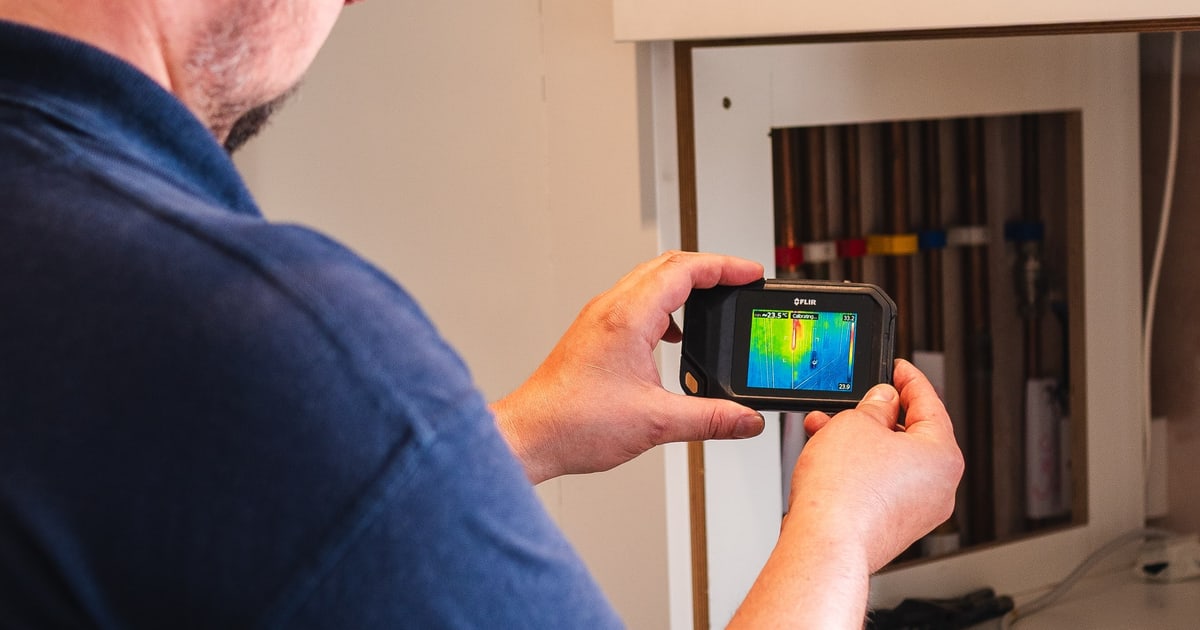
The investigation began with a pressure test on the internal cold mains, which failed at 3 bar within five minutes, confirming an active leak on the pipework. Thermal imaging was then used to map the route of the underfloor heating, ruling it out as a source and helping to distinguish heating pipework from the cold mains supply beneath the floor.
Acoustic investigation then identified a noise signature beneath boxing in the ground floor WC, adjacent to the toilet pan.
Because the WC isolation valve was not functioning, it was replaced before acoustic work could continue with the WC supply isolated. Even with the WC isolated, the acoustic noise persisted, so tracer gas was introduced to the pipework.
The gas reading was highest in the same location identified acoustically. Internal leak detection of this kind — combining acoustic, thermal, and tracer gas methods in sequence — builds a layered picture that narrows the suspect area before any excavation is agreed.
With consistent results from multiple methods pointing to the same spot, targeted excavation was carried out to expose and confirm the source.
Pressure Testing. A 3 bar pressure test was applied to the internal cold mains and failed within five minutes, confirming an active leak was present on that circuit.
Flow Metering. A flow test at the water meter showed ongoing flow that stopped when the internal stopcock was closed, establishing that the leak was on the internal cold mains supply.
Thermal Imaging. Thermal imaging was used to trace the route of the underfloor heating across the ground floor, allowing it to be discounted as a source and distinguishing it from the cold mains pipework.
Acoustic Listening Equipment. Acoustic investigation detected a leak noise beneath the boxing in the ground floor WC adjacent to the toilet pan, which persisted even after the WC supply was isolated.
Tracer Gas. Tracer gas was introduced to the pipework and produced a high reading directly in the same location identified by acoustic investigation, confirming the target area for excavation.
Investigation Process
-
1Flow test at water meter
A flow test was carried out at the water meter, which showed active flow. The flow stopped when the internal stopcock was turned off, confirming the leak was on the internal cold mains supply inside the property.
-
2Pressure test on cold mains
A pressure test was applied to the internal cold mains at 3 bar for five minutes. The test failed, confirming a leak was present on that circuit.
-
3Thermal imaging to map underfloor heating
Thermal imaging was carried out to establish the route of the underfloor heating across the ground floor, allowing it to be ruled out as a source and separated from the cold mains pipework.
-
4Acoustic investigation — initial findings
Acoustic investigation was carried out across the ground floor. A noise consistent with a leak was detected beneath boxing in the ground floor WC, adjacent to the toilet pan.
-
5Isolation valve replacement
An attempt was made to isolate the WC supply using the existing isolation valve, but it was found to be non-functional. The faulty valve was replaced to allow further testing with the WC isolated.
-
6Acoustic investigation — WC isolated
With the WC supply isolated, acoustic investigation was repeated. The noise was still present, indicating the leak was on the cold mains supply pipe rather than the WC fitting itself.
-
7Tracer gas investigation
Tracer gas was introduced to the pipework and readings taken across the suspect area. A high reading was recorded in the same location identified during acoustic investigation, under the boxing in the ground floor WC.
-
8Excavation and leak located
Following discussion with the customer, targeted excavation was carried out beneath the boxing in the ground floor WC. A pinhole was found in the 15mm copper cold mains supply pipe to the WC.
-
9Pipe repaired
The faulty section of 15mm copper pipe was replaced using two 15mm Hep20 couplings, one 15mm Hep20 elbow, approximately one metre of 15mm Hep20 pipe, and a new 15mm isolation valve.
Result & Outcome

Excavation beneath the boxing in the ground floor WC revealed a pinhole in the 15mm copper cold mains supply pipe serving the WC. The pinhole was the sole source of the flow registered at the meter throughout the investigation. The leak had been concealed beneath the floor with no visible surface signs, which is why internal leak detection — combining pressure testing, thermal imaging, acoustic investigation, and tracer gas — was needed to locate it precisely before any floor work was agreed.
The faulty section of copper pipe was cut out and replaced with approximately one metre of 15mm Hep20 pipe, jointed using two Hep20 couplings and one Hep20 elbow. The non-functional isolation valve serving the WC was also replaced as part of the repair, restoring proper isolation capability to that supply. The repair was carried out at the same visit once the leak location was confirmed.
The customer has been advised to monitor the water meter going forward to ensure no further flow is present when the property is not using water. With the pinhole repaired and the pipe replaced in that section, the cold mains supply is restored and the meter should now show no movement when all water is off.
Suspect a leak at your property?
ADI Leak Detection specialists investigate leaks like this across the UK every day. No find, no fee terms apply on qualifying jobs.