
Central Heating Leak Detection in Southam
A central heating leak in Southam was located using thermal imaging, acoustic listening, pressure testing, and a damp meter, with central heating leak detection pinpointing the fault to an unequal tee fitting beneath a tiled floor without the need for unnecessary excavation. Found by engineer Adam Regan.




The original leak detection company, est. 2011
Facts
| Location | Southam |
|---|---|
| County | Warwickshire |
| Leak Type | Central Heating Leak Detection |
| Property Type | Residential property |
| Detection Method | Thermal Imaging, Acoustic Listening Equipment, Pressure Testing, Damp Meter |
| Outcome | Leak found beneath tiled floor at unequal tee fitting, repaired. |
Symptoms
At a property in CV47, the heating system was found at 0.0 bar on arrival — completely without pressure. The system was an older oil boiler installation without a pressure switch, meaning there was no automatic alert when pressure dropped, and no indication of how long the system had been running in this condition or losing water.
The scale of the system added complexity: 28 radiators, a hot water cylinder, and the boiler, all connected on 22mm pipework. A system of this size holds a significant volume of water, and the extent of pressure loss pointed to an active and ongoing leak somewhere within it.
Central heating leak detection was clearly necessary to establish the source before any remedial work could be scoped.
The system was also found to be extremely dirty internally, consistent with an older installation that had not been chemically treated or flushed in some time. This made investigation more demanding, as contaminated water can obscure both acoustic and thermal signals.
Methods Used

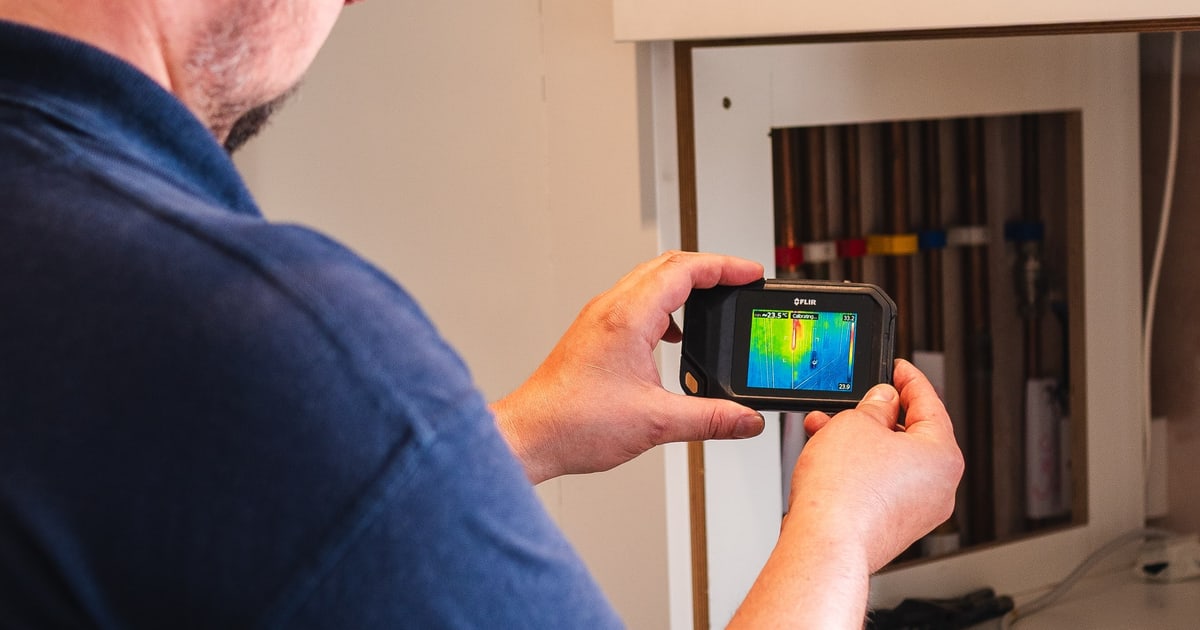
The investigation began with thermal imaging across the system to identify anomalies before any invasive work. A thermal anomaly was detected in the room adjacent to a well feature.
On closer inspection of that area, condensation was visible inside the well glass, dripping sounds were audible, water was running down the side of the well, and rust staining consistent with heating water was present. Water was also observed emerging from the floor at the point where two pipes exited — a second area of concern.
With those locations identified, the system was drained and pressure testing combined with acoustic methods were used to pinpoint the precise fault. This approach is standard in central heating leak detection where pipework runs beneath solid floors and visual inspection alone cannot confirm the source.
With the owner's permission, the tiled floor was lifted to expose dense concrete underneath, allowing direct access to the suspect section of pipework.
Thermal Imaging. Used to scan the system after pressurisation, identifying a thermal anomaly in the room adjacent to the well that directed the investigation to the correct area.
Acoustic Listening Equipment. Applied after the system was drained to pinpoint the exact location of the fault beneath the radiators and at the point where the pipes exited the floor.
Pressure Testing. Used to quantify the rate of pressure loss — a 1.0 bar drop within 30 minutes confirmed an active leak and helped isolate the affected section.
Damp Meter. Used during inspection to assess moisture levels in the surrounding materials and confirm the presence of water ingress consistent with the identified leak location.
Investigation Process
-
1System found at 0.0 bar
On arrival, the heating system was completely depressurised. The oil boiler had no pressure switch, so there had been no automatic shutdown or warning.
-
2System pressurised to 1.0 bar; thermal imaging conducted
Pressure was introduced and thermal imaging carried out across the system. An anomaly was identified in the room adjacent to the well. Pressure dropped back to 0.0 bar during this phase.
-
3System refilled to 2.0 bar and monitored
A 1.0 bar pressure drop was recorded within 30 minutes, confirming an active and significant leak.
-
4Physical anomalies identified at the well
Inspection of the thermal anomaly location revealed condensation inside the well glass, audible dripping, water running down the well wall, and rust staining consistent with escaping heating water.
-
5Water observed at floor pipe exits
Water was also seen emerging from the floor at the point where two pipes exited, identifying a second area of concern.
-
6System drained; pressure testing and acoustic methods applied
The system was drained and found to be extremely dirty. Pressure testing and acoustic listening were used to locate the anomaly precisely beneath the radiators and at the floor pipe exit point.
-
7Tiled floor exposed
With the owner's permission, the tiled floor was lifted, revealing dense concrete beneath and providing access to the affected pipework.
-
8Leak located and repaired
The fault was found at the leaking end of an unequal tee fitting. The pipe was cut, and a new connector was used to join the original pipe with a new section extending into the tee fitting.
-
9Inhibitor added; recommendations issued
Inhibitor was added to the system on completion. Recommendations were made regarding a full system clean and assessment of the expansion vessel's suitability for a system of this size.
Result & Outcome

The leak was located beneath the tiled floor at an unequal tee fitting, where pipework exits through the floor in the room adjacent to the well. The combination of thermal imaging, acoustic listening, and pressure testing allowed the fault to be pinpointed without unnecessary excavation across the wider floor area.
Once the floor was exposed, the leaking end of the tee fitting was confirmed as the source. The pipe was cut and a new connector used to tie the original pipework into a new section running into the fitting — a targeted repair that addressed the confirmed fault location directly. For a system of this scale, central heating leak detection using multiple methods was essential to avoid speculative and disruptive floor lifting across a much larger area.
Two further recommendations were made following the repair: the system requires a thorough chemical clean given its heavily contaminated condition, and the 24-litre expansion vessel should be assessed for adequacy across a 28-radiator system running primarily on 22mm pipework. Inhibitor was added at completion, but long-term protection cannot be confirmed until the system has been properly flushed and retreated.
Suspect a leak at your property?
ADI Leak Detection specialists investigate leaks like this across the UK every day. No find, no fee terms apply on qualifying jobs.