
Central Heating Leak Detection in Torquay
A central heating leak in Torquay was located using thermal imaging, tracer gas, visual inspection, and sectional isolation, with central heating leak detection confirming two concealed leak sources beneath the kitchen floor — one at tee connections feeding a decommissioned radiator position and one where the cold feed had been rubbing against the heating pipework. Found by engineer James Bexter.




The original leak detection company, est. 2011
Facts
| Location | Torquay |
|---|---|
| County | Devon |
| Leak Type | Central Heating Leak Detection |
| Property Type | Residential property |
| Detection Method | Thermal Imaging, Tracer Gas, Visual Inspection, Sectional Isolation |
| Outcome | Heating and cold feed leaks located in concrete beneath kitchen, repaired. |
Symptoms
At a property in TQ1, the owner of an 18-radiator central heating system had been forced to top up the system pressure repeatedly — sometimes as frequently as every three to four hours. An area of engineered wood flooring had already been lifted before the engineers arrived, and the floor was visibly damp in places, pointing to a leak somewhere beneath the surface.
The customer also noted that damp was showing on one side of a wall adjacent to the kitchen, where units had since been fitted over what was previously a radiator position. This suggested the leak could be related to redundant pipework running beneath the kitchen, though the full picture required a proper central heating leak detection investigation to establish the source with certainty.
With multiple potential leak points and pipework buried unprotected in concrete beneath the floor, pinpointing the exact location was not straightforward. The scale of pressure loss and the visible floor damp made clear this was not a minor seep but an active leak requiring systematic investigation.
Methods Used

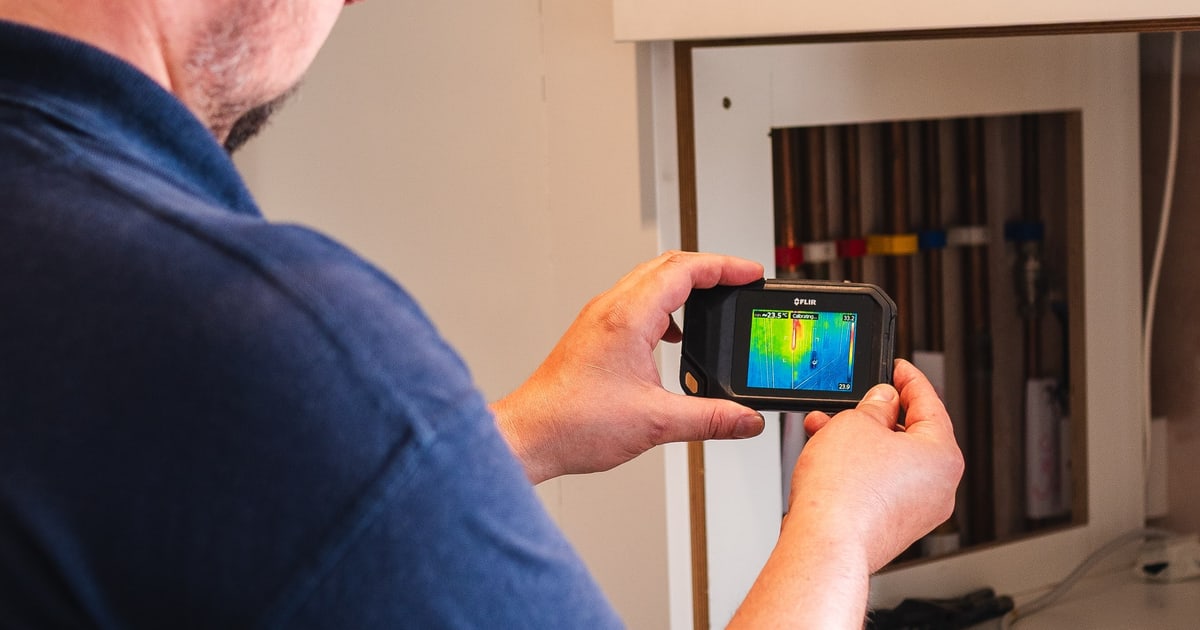
On arrival, the heating system was running, which allowed thermal imaging to be used immediately to trace the route of the heating pipework beneath the floor. Once the pipe routes had been mapped, the system was drained and tracer gas was introduced.
The gas was detected beneath the kitchen kick-boards after they were removed, and the pipework could be seen emerging from the concrete floor under the units, capped with compression stop ends — consistent with the decommissioned radiator position the customer had described.
Based on the thermal imaging results, the area on the other side of the wall was excavated to expose the pipework. This central heating leak detection process — combining thermal imaging for pipe tracing with tracer gas for pinpointing — allowed the engineers to work methodically from a wide area down to the specific section of pipe responsible.
During excavation it was also found that the internal cold feed was leaking where it had been rubbing against the heating pipework, and that all of this pipework had been laid unprotected in the concrete.
Thermal Imaging. Used while the heating was running to trace the route of the buried heating pipework through the floor and identify where it ran beneath the kitchen and through the wall.
Tracer Gas. Introduced to the drained heating system to pinpoint the leak location; gas was detected at the kick-boards beneath the kitchen units, confirming the area for excavation.
Visual Inspection. Used during excavation to identify exposed pipework, compression stop ends on decommissioned pipework, and physical signs of rubbing and wear between the cold feed and heating pipework.
Sectional Isolation. The heating system was drained down in full before tracer gas was introduced, isolating the circuit to allow accurate gas detection without interference from active flow.
Investigation Process
-
1Thermal imaging on arrival
With the heating system running on arrival, thermal imaging was used to trace the route of the buried heating pipework beneath the floor and through the wall adjacent to the kitchen.
-
2System drained and tracer gas introduced
The heating system was drained down and tracer gas was introduced to the circuit in preparation for pinpoint leak location.
-
3Tracer gas detected at kitchen kick-boards
The kitchen kick-boards were removed and tracer gas was detected beneath the units. Pipework was also visible coming up through the concrete floor with compression stop ends fitted, consistent with a previously removed radiator.
-
4Excavation of pipework run
With the customer's permission, the area on the other side of the wall — identified by thermal imaging as carrying the pipework — was excavated to expose the buried pipes.
-
5Cold feed leak found, gas pipe identified
Excavation revealed that the internal cold feed was also leaking where it had been rubbing against the heating pipework. A redundant gas pipe was found running above the cold feed; as neither engineer was Gas Safe registered, the customer arranged a Gas Safe engineer to attend and carry out a tightness test before any cuts were made.
-
6Gas pipe section removed, cold feed repaired
Once the Gas Safe engineer confirmed the pipe was safe and completed the tightness test, a section of the redundant gas pipe was removed to allow access, and the damaged section of cold feed was cut out and replaced.
-
7Redundant heating tees removed and pipework protected
The tee connections feeding the old radiator position were cut out and a new section of copper pipework was soldered in. All exposed pipework in the excavated area was then protected before reinstating.
-
8Immersion boss leak noted on unvented cylinder
While packing down, a very slight leak was observed at the immersion boss on the unvented cylinder. This was reported to the customer to be addressed by their plumber during the boiler service later that week.
Result & Outcome

Two leak sources were located and repaired at the property in TQ1. The primary heating system leak was at the tee connections feeding a decommissioned radiator position, where pipework had been left live beneath the kitchen in unprotected concrete. The cold feed was also found to be leaking at the point where it had been in contact with and rubbing against the heating pipework — both issues concealed under the floor with no prior indication of their location beyond the damp floor and pressure loss.
The repairs involved cutting out the redundant tees and installing new copper pipework, and replacing the damaged section of cold feed. The involvement of a Gas Safe engineer to check and tightness-test the redundant gas pipe running alongside ensured the repair could be completed safely. All repaired pipework in the excavated area was protected before reinstatement. As a central heating leak detection outcome, the pressure loss issue has been directly resolved at its source rather than managed through repeated top-ups.
A separate minor leak was noted at the immersion boss on the unvented cylinder and reported to the customer for their plumber to address. The customer has also indicated they intend to have the downstairs pipework re-piped, as a significant amount of it remains unprotected in the concrete — a sensible precaution given what was found during this investigation.
Suspect a leak at your property?
ADI Leak Detection specialists investigate leaks like this across the UK every day. No find, no fee terms apply on qualifying jobs.