
Central Heating Leak Detection in Market Deeping
A central heating leak in Market Deeping was located using pressure testing, tracer gas, a damp meter, and thermal imaging, confirming central heating leak detection beneath the affected area. Found by engineer Scott Hardcastle.




The original leak detection company, est. 2011
Facts
| Location | Market Deeping |
|---|---|
| County | Lincolnshire |
| Leak Type | Central Heating Leak Detection |
| Property Type | Residential property |
| Detection Method | Pressure Testing, Tracer Gas, Damp Meter, Thermal Imaging |
| Outcome | Leaking 15mm heating pipe located beneath hallway floor, repaired. |
Symptoms

A slight damp spot remained visible in the previously disturbed area, and various design radiators were installed throughout the property. The ongoing pressure loss and the presence of moisture pointed strongly to an active leak within the heating system, making central heating leak detection the appropriate course of action to pinpoint the fault before any reinstatement work could proceed.
Methods Used

Tracer gas was introduced and the floor area scanned, but no gas was detected at the surface. This initially made pinpointing difficult.
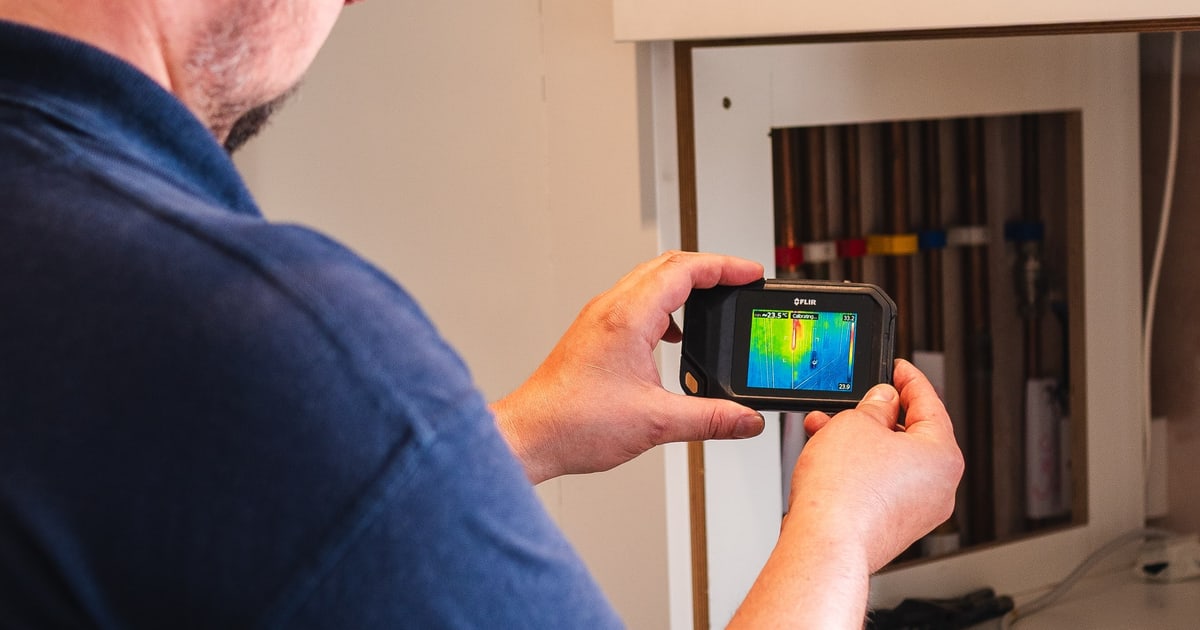
A damp meter was used across the hallway floor and returned a reading of 999 at one specific location. Thermal imaging was also carried out and showed some abnormalities, though nothing conclusive.
Given all the indirect evidence converging on the previously excavated area, and with the customer's agreement, the decision was made to open that section of floor further — which exposed the leak directly.
Pressure Testing. Compressed air was introduced into the drained heating system to detect a pressure drop; after multiple vacuum cycles, a very small but measurable drop was confirmed over 30 minutes, establishing that an active leak was present.
Tracer Gas. Tracer gas was injected into the system and the floor surface scanned, but no gas was detected — later found to be because the pipe was encased in a plastic cover that prevented gas from migrating to the surface.
Damp Meter. Used across the hallway floor, the damp meter returned a reading of 999 at one specific point, identifying the area of highest moisture concentration and helping direct the investigation.
Thermal Imaging. Thermal imaging was carried out across the suspect area and showed some abnormalities in the floor, though the results were not conclusive enough on their own to confirm the leak location.
Investigation Process
-
1System drained and vacuumed
The heating system was fully drained and residual water vacuumed out to allow clean air pressure testing without interference from standing water in the pipework.
-
2Compressed air introduced
Compressed air was introduced into the system. An initial pressure test showed no drop, so further vacuum cycles were carried out to remove more residual water.
-
3Pressure drop confirmed
After additional vacuum cycles, a very small pressure drop was recorded over a 30-minute period, confirming the presence of an active leak within the heating system.
-
4Tracer gas scan carried out
Tracer gas was introduced and the floor surface scanned across the area, but no gas was detected — the pipe's plastic casing was preventing gas from reaching the surface.
-
5Damp meter reading of 999 in hallway
A damp meter was used across the hallway floor and returned the maximum reading of 999 at one specific point, identifying the most moisture-affected location.
-
6Thermal imaging performed
Thermal imaging was carried out and showed some abnormalities in the floor area, though the results were not conclusive on their own.
-
7Further excavation carried out
With the customer's permission, the previously disturbed area of floor was excavated further, exposing the concealed 15mm heating pipe beneath.
-
8Leaking pipe located
The excavation revealed a leaking 15mm heating pipe encased in a plastic cover. The surrounding ground was heavily saturated, consistent with a leak that had been ongoing for several months.
-
9Pipe repaired
A new section of 15mm copper pipe and fittings was fitted, and a small piece of denso tape was applied to protect the pipe.
Result & Outcome

Before the floor can be re-screeded and tiled, the exposed area will need thorough drying given the extent of saturation. A flush of the heating system is also recommended, as the system was found to be significantly dirty — a condition that, left unaddressed, risks causing further problems with the pipework and components over time.
Suspect a leak at your property?
ADI Leak Detection specialists investigate leaks like this across the UK every day. No find, no fee terms apply on qualifying jobs.