
Central Heating Leak Detection in Budleigh Salterton
A central heating leak in Budleigh Salterton was located using thermal imaging, a damp meter, tracer gas, acoustic listening, and an endoscope camera, with central heating leak detection confirming the source inside kitchen boxing where a pipe fitting had come apart. Found by engineer James Bexter.




The original leak detection company, est. 2011
Facts
| Location | Budleigh Salterton |
|---|---|
| County | Devon |
| Leak Type | Central Heating Leak Detection |
| Property Type | Residential property |
| Detection Method | Thermal Imaging, Damp Meter, Tracer Gas, Acoustic Listening Equipment, Endoscope Camera |
| Outcome | Leak found inside kitchen boxing, failed fitting replaced. |
Symptoms

A barn conversion in EX9 with an oil-fired system boiler, unvented cylinder, three bathrooms, a WC, twelve radiators and towel rails, and one underfloor heating circuit was losing pressure from its central heating system. On arrival, the boiler pressure gauge was reading zero, indicating a sustained loss of water from the system over time.
The scale of the property and the variety of heat emitters meant there were numerous possible leak locations across the ground floor and beyond. With a pressurised system sitting at zero, central heating leak detection was necessary to identify where water was escaping before any further damage could occur.
No obvious external signs pointed to a specific area. The system needed to be methodically tested using a combination of equipment to narrow down the location of the fault.
Methods Used

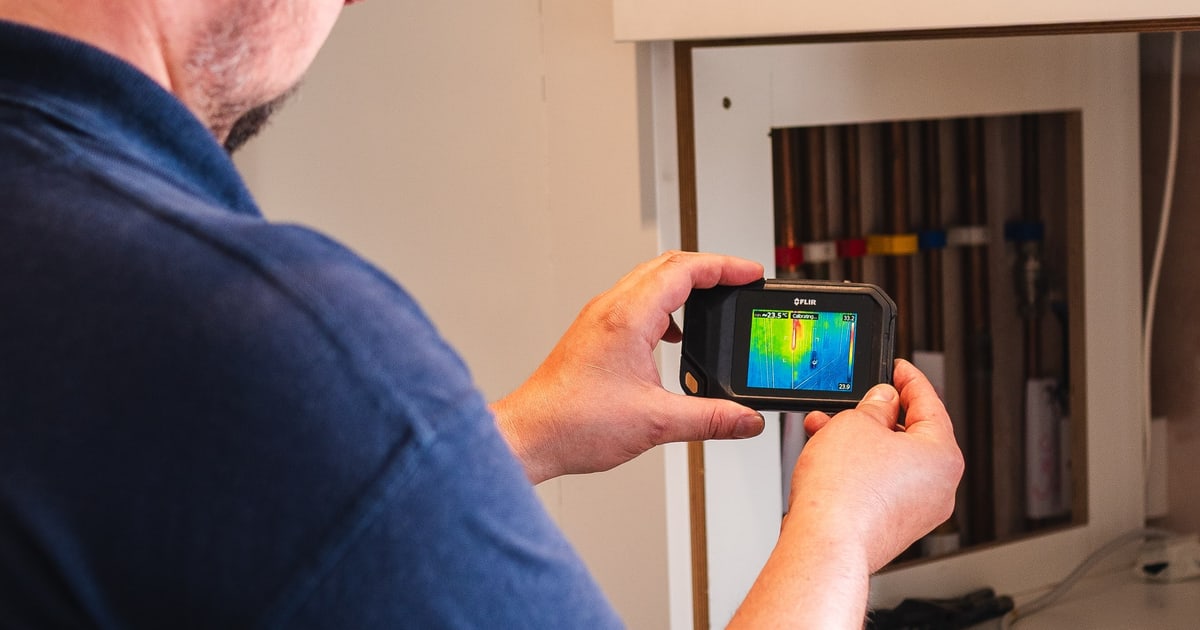
The investigation began with the system pressurised and running, allowing initial checks on the PRV and a damp meter survey across the ground floor. Thermal imaging was used once the system reached operating temperature to map pipe runs beneath the floor and within the structure.
The system was then drained and cleared with a compressor before tracer gas was introduced at 2 bar for a detailed search.
Initial gas readings near the kitchen sink were intermittent and not conclusive enough to justify excavation. Pressure was increased to 2.4 bar and the search was focused on a section of kitchen boxing containing a soil pipe and central heating pipework.
An endoscope camera confirmed the presence of pipework inside the boxing, and gas readings at a small access point confirmed the leak location. This structured approach — standard practice in central heating leak detection — avoided unnecessary damage to the floor and fabric of the building until the location was confirmed with confidence.
Thermal Imaging. Used once the system reached operating temperature to identify the pipe runs beneath the ground floor and within the building structure.
Damp Meter. Used across the ground floor to identify any areas of elevated moisture that might indicate water ingress from the heating system.
Tracer Gas. Introduced into the drained system at 2 bar, then raised to 2.4 bar, to locate escaping gas at the source of the leak within the kitchen boxing.
Acoustic Listening Equipment. Applied in the kitchen area where initial gas readings were inconclusive, though results were also inconclusive at this stage.
Endoscope Camera. Fed through a small hole knocked into the kitchen boxing to visually confirm that central heating pipework was present inside before cutting it open.
Investigation Process
-
1System pressurised and heating activated
On arrival the boiler was topped up and the heating turned on. A bag was placed over the PRV to check whether it was discharging water.
-
2Damp meter survey — ground floor
A damp meter was used throughout the ground floor. A few areas registered as worth monitoring but none returned high readings.
-
3Thermal imaging survey
Once the system reached operating temperature, a thermal imaging camera was used to identify pipe runs within the floor and structure.
-
4System drained and cleared
The system was drained down and cleared of as much water as possible using a compressor to prepare for tracer gas introduction.
-
5Tracer gas introduced at 2 bar
Tracer gas was introduced at 2 bar and an extensive search carried out. Intermittent readings were detected near the kitchen sink but were not conclusive enough to excavate.
-
6Acoustics applied in kitchen area
Acoustic equipment was used in the kitchen area where the intermittent gas readings had been found, but results were inconclusive.
-
7Tracer gas pressure raised to 2.4 bar
Gas pressure was increased to 2.4 bar and a further search focused on the kitchen led to a section of boxing containing a soil pipe and central heating pipework.
-
8Endoscope camera confirms pipework
A small previously filled hole was opened and an endoscope camera confirmed pipework inside the boxing. Gas sniffer readings at the hole were positive immediately.
-
9Boxing opened and leak identified
With the customer's permission the boxing was cut open, revealing a fitting that had come apart on one of the central heating pipes.
-
10Repair carried out
The failed fitting was removed, the pipework cleaned up and cut back, new inserts installed, and a replacement fitting fitted.
Result & Outcome

The leak was found inside a section of kitchen boxing, where a central heating pipe fitting had come apart. The location was only accessible after raising the tracer gas pressure to 2.4 bar and using an endoscope camera to confirm pipework was present before any cutting took place. This avoided unnecessary damage to the floor or wider structure.
Once the boxing was opened, the failed fitting was removed, the pipework cleaned back and cut to a clean end, new inserts fitted, and a replacement fitting installed. The repair was completed on the same visit. Central heating leak detection in a property of this size and complexity — with multiple heat emitters, mixed floor types, and concealed pipework — requires a systematic approach, and the combination of tracer gas and endoscope work here pinpointed the fault without guesswork.
A separate recommendation was made to flush the system and introduce fresh inhibitor, as the system water was found to be heavily contaminated. Dirty system water accelerates corrosion and fitting failure, and a power flush would help protect the repaired and existing pipework going forward.
Suspect a leak at your property?
ADI Leak Detection specialists investigate leaks like this across the UK every day. No find, no fee terms apply on qualifying jobs.