
Internal Cold Mains Leak Detection in Waltham Forest
A cold mains leak in Waltham Forest was located using thermal imaging, tracer gas, acoustic listening, damp meter, and visual inspection, with water mains leak detection confirming the exact source beneath a kitchen unit on a concrete floor before any cutting or excavation took place. The work was carried out by engineer Vincent Morgan.




The original leak detection company, est. 2011
Facts
| Location | Waltham Forest |
|---|---|
| Leak Type | Water Mains Leak Detection |
| Property Type | Residential property |
| Detection Method | Thermal Imaging, Tracer Gas, Acoustic Listening Equipment, Damp Meter, Visual Inspection |
| Outcome | Leak found at damaged tee joint beneath kitchen unit, pipe replaced. |
Symptoms

The occupants of a property in E4 had received an unusually high water bill, prompting concern about a potential leak within the internal pipework. On inspection, water damage was visible on the skirting board and carpet in the lounge, suggesting water had been escaping for some time and tracking across the floor structure.
A previously removed floorboard was lifted, which revealed water running beneath the suspended floor, originating from the wall separating the lounge and kitchen.
The source was not immediately visible from above, and the extent of the leak path made it clear that a thorough internal leak detection investigation would be needed to pinpoint the exact point of failure without unnecessary disruption to the property. The hot water supply pipework was identified as the system involved, narrowing the scope of the investigation to the pipework serving that area.
Methods Used

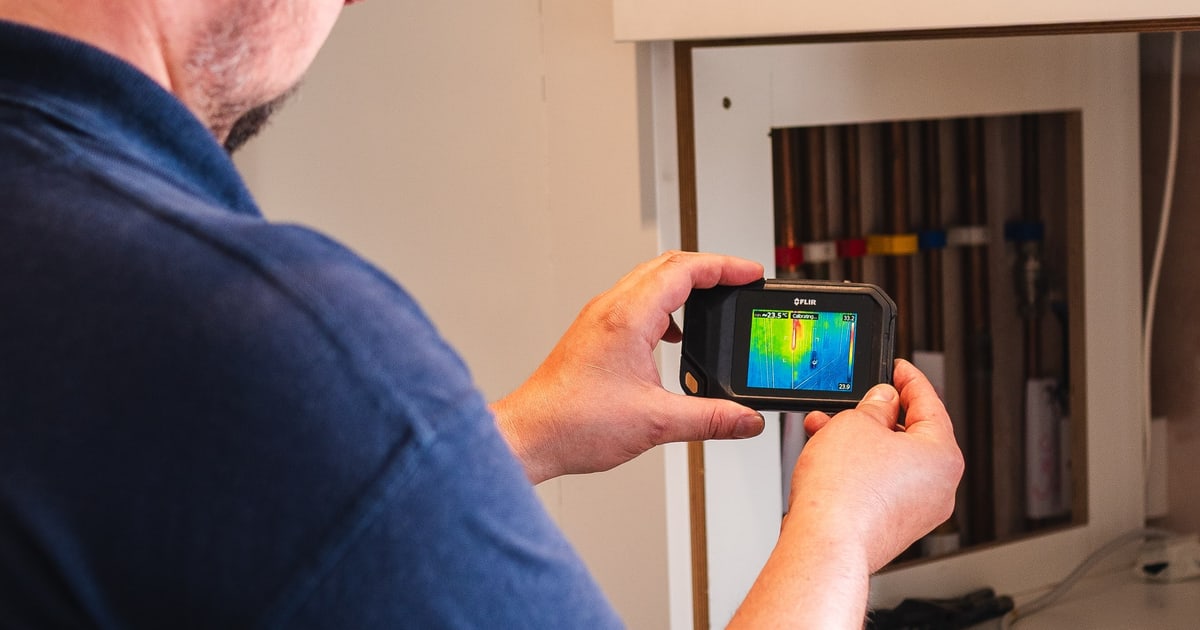
The investigation followed a structured, multi-method approach suited to internal leak detection where the pipework runs beneath a concrete floor and is concealed by kitchen units. Thermal imaging was deployed first, providing a non-invasive means of identifying heat signatures from the leaking hot water supply pipework beneath the kitchen unit and concrete floor.
This gave a clear indication of the general area before any intrusive work was undertaken.
Tracer gas was then introduced into the pipework, and specialist detection equipment was used to trace its path and identify the strongest point of escape — directly beneath the kitchen unit. Acoustic testing was applied as a further confirmation method, corroborating the location identified by the tracer gas.
Only once all three methods had converged on the same location was access work carried out: the base of the kitchen unit was carefully cut away and the concrete floor beneath was exposed, allowing a direct visual inspection of the pipework.
Thermal Imaging. Used to detect heat signatures from the leaking hot water pipework beneath the kitchen unit and concrete floor, identifying the affected area without excavation.
Tracer Gas. Introduced into the hot water supply pipework to trace the leak path, with specialist detection equipment pinpointing the strongest gas escape directly beneath the kitchen unit.
Acoustic Listening Equipment. Applied to the suspected leak area to provide acoustic confirmation of the leak location identified by thermal imaging and tracer gas.
Damp Meter. Used to assess moisture levels in the affected areas, including the skirting board and floor structure in the lounge.
Visual Inspection. Carried out once the kitchen unit base was cut away and the concrete floor exposed, allowing direct examination of the pipework and confirmation of the damaged tee joint.
Investigation Process
-
1Initial assessment
On arrival at the property in E4, water damage was observed on the skirting board and carpet in the lounge. A previously removed floorboard was lifted, revealing water running beneath the suspended floor from the wall between the lounge and kitchen.
-
2Hot water supply identified
The hot water supply pipework was identified as the system responsible for the leak, focusing the investigation on that pipework running beneath the kitchen area.
-
3Thermal imaging deployed
Thermal imaging was used to scan beneath the kitchen unit and concrete floor, detecting heat signatures consistent with leaking hot water pipework and indicating the general area of the fault.
-
4Tracer gas introduced
Tracer gas was introduced into the pipework and specialist tracing equipment was used to follow its path, producing a strong indication of the leak directly beneath the kitchen unit.
-
5Acoustic testing confirmed location
Acoustic testing was carried out over the suspected area and confirmed the leak location identified by the thermal imaging and tracer gas, providing a high-confidence target before any access work began.
-
6Access gained to pipework
The base of the kitchen unit was carefully cut away and the concrete floor beneath was exposed, allowing direct access to the pipework at the confirmed leak location.
-
7Leak confirmed and repaired
Visual inspection of the exposed pipework confirmed the leak was originating from a damaged tee joint. A new section of pipework and new fittings were installed to replace the faulty joint.
Result & Outcome

The leak was confirmed to be originating from a damaged tee joint in the hot water supply pipework, located beneath the kitchen unit on a concrete floor. The combination of thermal imaging, tracer gas, and acoustic testing allowed the exact location to be established with confidence before any cutting or excavation took place, limiting the extent of access work required.
Once exposed, a new section of pipework and new fittings were installed to replace the damaged tee joint, resolving the source of the leak. As is often the case with internal leak detection involving pipework beneath concrete floors, the reinstatement of the kitchen unit base and concrete floor will require separate remedial works, and a builder should be engaged to assess and carry out that work.
The affected pipework in this area should be monitored going forward. The cause of the high water bill and the water damage tracking through to the lounge has now been fully accounted for and addressed at source.
Suspect a leak at your property?
ADI Leak Detection specialists investigate leaks like this across the UK every day. No find, no fee terms apply on qualifying jobs.