
Internal Cold Mains Leak Detection in Eastleigh
An internal cold mains leak in Eastleigh was located using pressure testing, tracer gas, acoustic listening, thermal imaging, and a damp meter, with water mains leak detection confirming the precise point of failure within the 15mm copper pipe. Found by engineer Mark Jones.




The original leak detection company, est. 2011
Facts
| Location | Eastleigh |
|---|---|
| County | Hampshire |
| Leak Type | Water Mains Leak Detection |
| Property Type | Residential property |
| Detection Method | Pressure Testing, Tracer Gas, Acoustic Listening Equipment, Thermal Imaging, Damp Meter |
| Outcome | Leak found on 15mm copper pipe in en-suite wall. |
Symptoms

An initial meter test confirmed a leak rate of approximately 10 litres per hour, and incoming water pressure was measured at 7.0 bar — well above typical domestic levels. The spread of damage across multiple surfaces made pinpointing the source complex, and internal leak detection was required to trace the leak to its precise origin without unnecessary structural disruption.
Methods Used
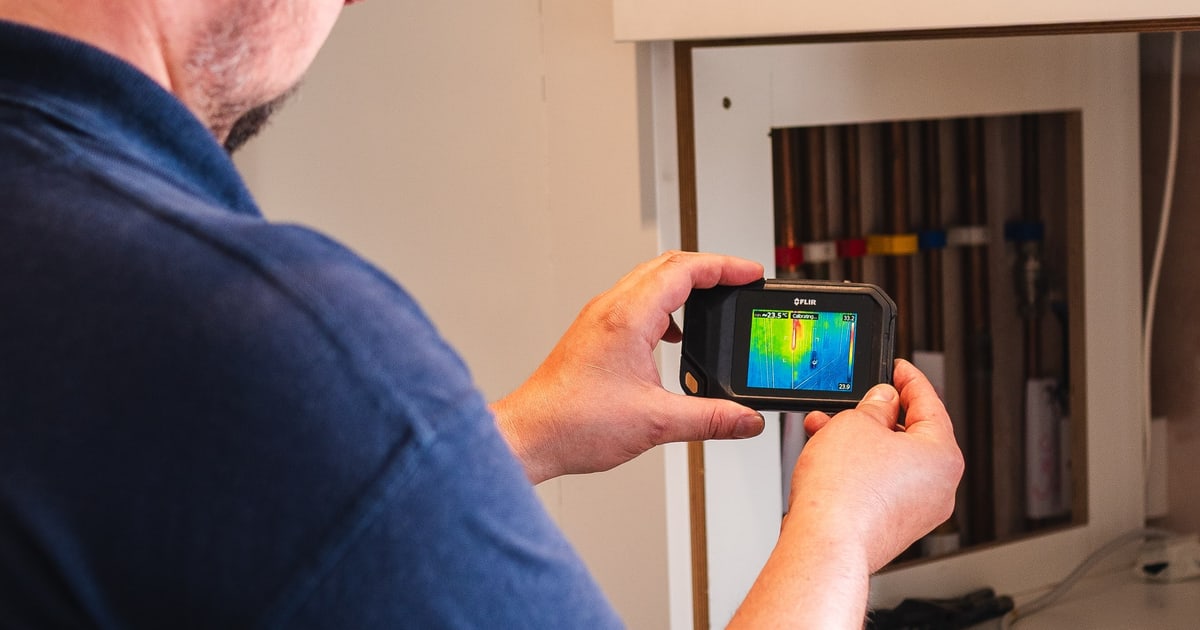
Thermal imaging of the wall confirmed pipes were embedded within the plaster rather than running through a cavity. This ruled out straightforward access and made internal leak detection through targeted, informed exposure the only viable approach.
Ceramic tiles were removed and a section of very thick plaster was broken open to expose the pipe run. The leaking pipe was found positioned behind both the shower and basin waste pipes within the wall, requiring those waste pipes to be cut out before the leak could be accessed directly.
Pressure Testing. Used to establish a leak rate of approximately 10 litres per hour at 7.0 bar incoming pressure, confirming the scale of the leak before investigation began.
Tracer Gas. Hydrogen tracer gas was introduced into the system at 7.0 bar; a positive reading was detected beneath the en-suite basin, narrowing the leak location to that section of wall.
Acoustic Listening Equipment. An acoustic signal was detected in the same area as the tracer gas response beneath the en-suite basin, corroborating the identified leak zone.
Thermal Imaging. Thermal imaging of the wall confirmed that pipes were embedded within the plaster, determining that the leak source was within the wall structure rather than an accessible void.
Damp Meter. Used to assess moisture levels across the affected surfaces including the living room ceiling, cloakroom, stairwell, and en-suite wall to map the extent of water ingress.
Investigation Process
-
1Initial inspection
The leak area was inspected on arrival, with water damage noted across the living room ceiling, cloakroom ceiling and wall, stairwell wall and woodwork, and the en-suite shower room wall.
-
2Meter and pressure test
An initial meter test confirmed a leak rate of approximately 10 litres per hour, and incoming water pressure was recorded at 7.0 bar.
-
3Cold feed isolation
The cold feed to the first floor was isolated using a lever valve to allow tracer gas to be safely introduced into the system.
-
4Tracer gas introduction
Hydrogen tracer gas was introduced into the system at 7.0 bar. Both an acoustic signal and a tracer gas reading were detected beneath the en-suite basin.
-
5Living room ceiling opened
A small hole was made in the living room ceiling to inspect the void, but no pipes were found in that space.
-
6Thermal imaging of wall
Thermal imaging confirmed that pipes were embedded within the en-suite wall rather than running through an accessible void.
-
7Wall opened and leak exposed
Ceramic tiles were removed and a section of very thick plaster was broken open, exposing the pipe run within the wall.
-
8Waste pipes cut out
The shower and basin waste pipes were cut out to gain access to the leaking pipe, which was positioned directly behind them within the wall.
-
9Leak located
A leak was confirmed on a 15mm copper pipe embedded within the en-suite wall behind the shower and basin waste pipes.
Result & Outcome

With the leak pinpointed and the pipe now accessible, the repair can be carried out directly to the 15mm copper pipe. The damage to the living room ceiling, cloakroom, stairwell, and en-suite wall can now be addressed with confidence that the source has been found and will not continue to cause further deterioration.
Suspect a leak at your property?
ADI Leak Detection specialists investigate leaks like this across the UK every day. No find, no fee terms apply on qualifying jobs.