
Underground Water Mains Leak Detection in Liverpool
A water mains leak in Liverpool was located using a damp meter, thermal imaging, pressure testing, and tracer gas, with water mains leak detection tracing the fault to an incorrectly crimped internal stop cock that was replaced on the same visit. Found by engineer Matthew Barron.




The original leak detection company, est. 2011
Facts
| Location | Liverpool |
|---|---|
| County | Merseyside |
| Leak Type | Water Mains Leak Detection |
| Property Type | Residential property |
| Detection Method | Damp Meter, Thermal Imaging, Pressure Testing, Tracer Gas |
| Outcome | Leak found at internal stop cock, compression ring replaced. |
Symptoms

The occupant of a property in L25 had already called a plumber prior to this visit after noticing water damage in the home. That plumber had investigated and simply tightened the fittings on the internal stop cock without identifying the root cause.
The problem persisted, prompting a specialist water mains leak detection visit to properly locate and confirm the source of the leak.
On arrival, the customer indicated the area of visible water damage. Moisture readings taken across the kitchen and laundry room floors revealed elevated levels concentrated in the laundry room, suggesting active or recent water ingress in that area.
The integrity of the mains supply — an old lead sleeve with copper pipe — was also noted as a concern from the outset.
A water mains leak detection job like this, where a previous repair attempt has failed and damage is already present, requires a methodical approach to confirm whether the leak is on the internal pipework, the mains supply, or both.
Methods Used

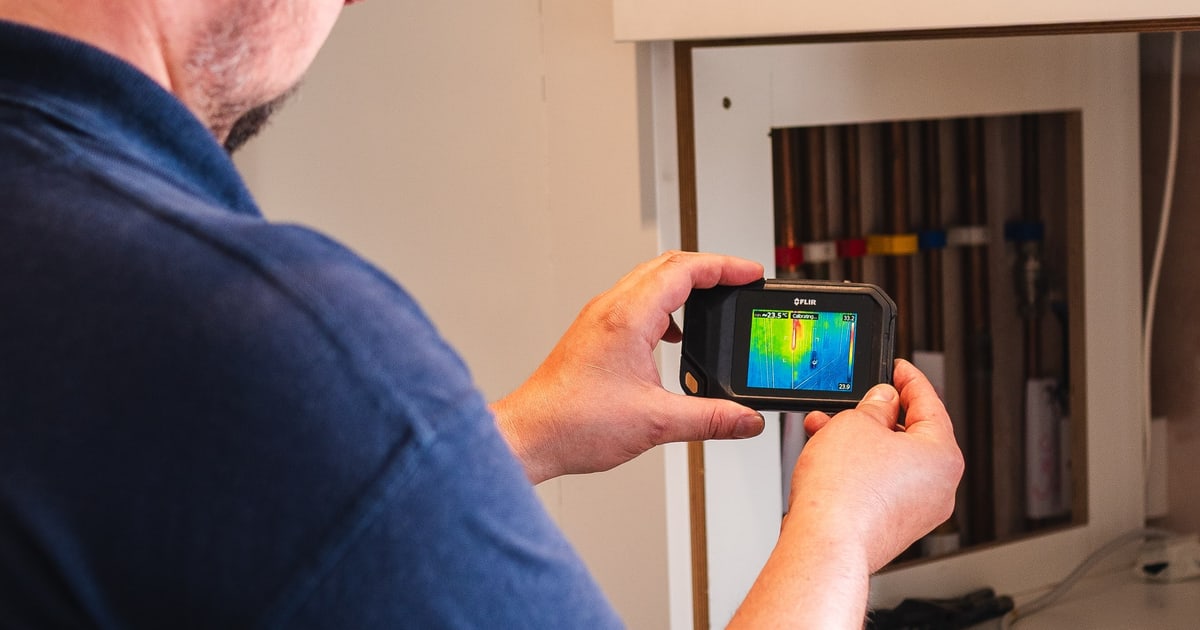
The investigation began with moisture mapping across the kitchen and laundry room floors using a damp meter, which identified high moisture readings in the laundry room. Thermal imaging of the laundry room floor followed, revealing cold anomalies consistent with water migration beneath the surface.
A pressure test was then carried out to confirm whether the internal pipework was holding — it was not, with a significant pressure drop recorded.
Tracer gas was introduced to the system and the property was inspected throughout. Gas was detected at two points: the kitchen mixer tap and the internal stop cock.
The kitchen mixer was isolated and a second tracer gas test was run, which confirmed tracer gas was still escaping from the internal stop cock. Physical investigation of the stop cock revealed the cause — a previous plumber had over-tightened the fitting, crimping the compression ring incorrectly and allowing water to escape.
This multi-stage approach, combining pressure testing, thermal imaging, and tracer gas, is standard practice in water mains leak detection where the leak source is not immediately visible.
Damp Meter. Used to take moisture readings across the kitchen and laundry room floors, identifying elevated levels concentrated in the laundry room.
Thermal Imaging. A thermal CCTV survey of the laundry room floor revealed cold anomalies indicating water present beneath the surface.
Pressure Testing. A pressure test at 2.4 bar held for 15 minutes dropped to 1.4 bar, confirming a leak on the internal pipework; a post-repair test at 2.4 bar held for 20 minutes with no pressure drop.
Tracer Gas. Tracer gas was introduced to the system and detected escaping from both the kitchen mixer and the internal stop cock, allowing each source to be isolated and confirmed individually.
Investigation Process
-
1Initial Assessment and Moisture Mapping
On arrival, the customer indicated the area of water damage. Moisture readings were taken across the kitchen and laundry room floors, with high levels detected in the laundry room.
-
2Thermal Imaging of Laundry Room Floor
A thermal CCTV survey was carried out on the laundry room floor. Cold anomalies were identified, consistent with water present beneath the surface.
-
3First Pressure Test
A pressure test was conducted at 2.4 bar for 15 minutes. Pressure dropped to 1.4 bar, confirming an active leak on the internal pipework.
-
4First Tracer Gas Test
Tracer gas was introduced and the property inspected. Gas was detected at the kitchen mixer tap and at the internal stop cock.
-
5Kitchen Mixer Isolated and Second Tracer Gas Test
The kitchen mixer was isolated and a further tracer gas test was carried out. Tracer gas was again detected at the internal stop cock, confirming it as a leak point.
-
6Investigation of Internal Stop Cock
Physical inspection of the stop cock revealed the previous plumber had over-tightened the fitting, crimping the compression ring incorrectly and allowing water to escape.
-
7Repair Carried Out
The copper compression rings and the internal stop cock were replaced with new components.
-
8Post-Repair Pressure Test
A pressure test was conducted at 2.4 bar for 20 minutes. Pressure held at 2.4 bar with no drop, confirming the repair was successful.
-
9Mains Supply Condition Noted
The mains supply was inspected and found to be an old lead sleeve with copper pipe. Replacement was recommended to prevent future leaks, along with drying works for the laundry room floor and restoration of the boxing concealing the pipework.
Result & Outcome

The leak was traced to the internal stop cock. The compression ring had been incorrectly crimped by a previous plumber who over-tightened the fitting, creating a path for water to escape. Tracer gas pinpointed the location precisely, and the stop cock and copper rings were replaced on the same visit. A post-repair pressure test at 2.4 bar held for 20 minutes with no pressure loss confirmed the repair was sound.
The laundry room floor returned high moisture readings and thermal imaging showed cold anomalies beneath the surface. A drying and restoration contractor has been recommended to address the residual moisture in the floor. The boxing concealing the pipework also requires reinstatement.
For a water mains leak detection case involving an older mains supply, the engineer also flagged that the existing lead sleeve and copper pipe supply from the street to the internal stop cock is not fully reliable. Replacement of the full mains supply to the property is recommended to prevent further issues. The current stop cock is holding but its long-term integrity cannot be guaranteed.
Suspect a leak at your property?
ADI Leak Detection specialists investigate leaks like this across the UK every day. No find, no fee terms apply on qualifying jobs.