
Internal Cold Mains Leak Detection in Hertford
An internal cold mains leak in Hertford was located using pressure testing, tracer gas, acoustic correlation, thermal imaging, damp meter readings, and visual inspection, confirming water mains leak detection to a precise point beneath the kitchen floor on the drinking supply line running to the fridge freezer. Found by engineer Ferenc Gulyas.
 CIPHE accredited
 WIAPS member


Facts
| Location | Hertford |
|---|---|
| County | Hertfordshire |
| Leak Type | Water Mains Leak Detection |
| Property Type | Residential property |
| Detection Method | Damp Meter, Pressure Testing, Tracer Gas, Acoustic Correlation, Thermal Imaging, Visual Inspection |
| Outcome | Leak found on copper pipework beneath kitchen floor, repaired. |
Symptoms
The property had underfloor heating running throughout the downstairs, with hot, cold, and heating system pipework all running beneath floor level. A hot water cylinder was located in an upstairs cupboard, and the internal stopcock was in a separate boiler room outside the main building.
The combination of multiple buried pipework systems and the extent of the visible water damage made it essential to isolate each system methodically before identifying the source.
Methods Used
The hot water and recirculation pipework was isolated at the cylinder and pressure tested — the test passed. The softened cold feed was pressure tested separately — that also passed.
The hard water supply, coming directly from the street, failed its pressure test, confirming it as the leaking system. Tracer gas was then introduced into the hard water pipework to confirm the leak zone as the kitchen area, and acoustic equipment was used to pinpoint the location to directly in front of the kitchen sink unit.
Because the units were too large to get the acoustic equipment beneath them, the bottom board of the adjacent unit was cut away to expose the concrete and identify the pipework route before the floor was opened.
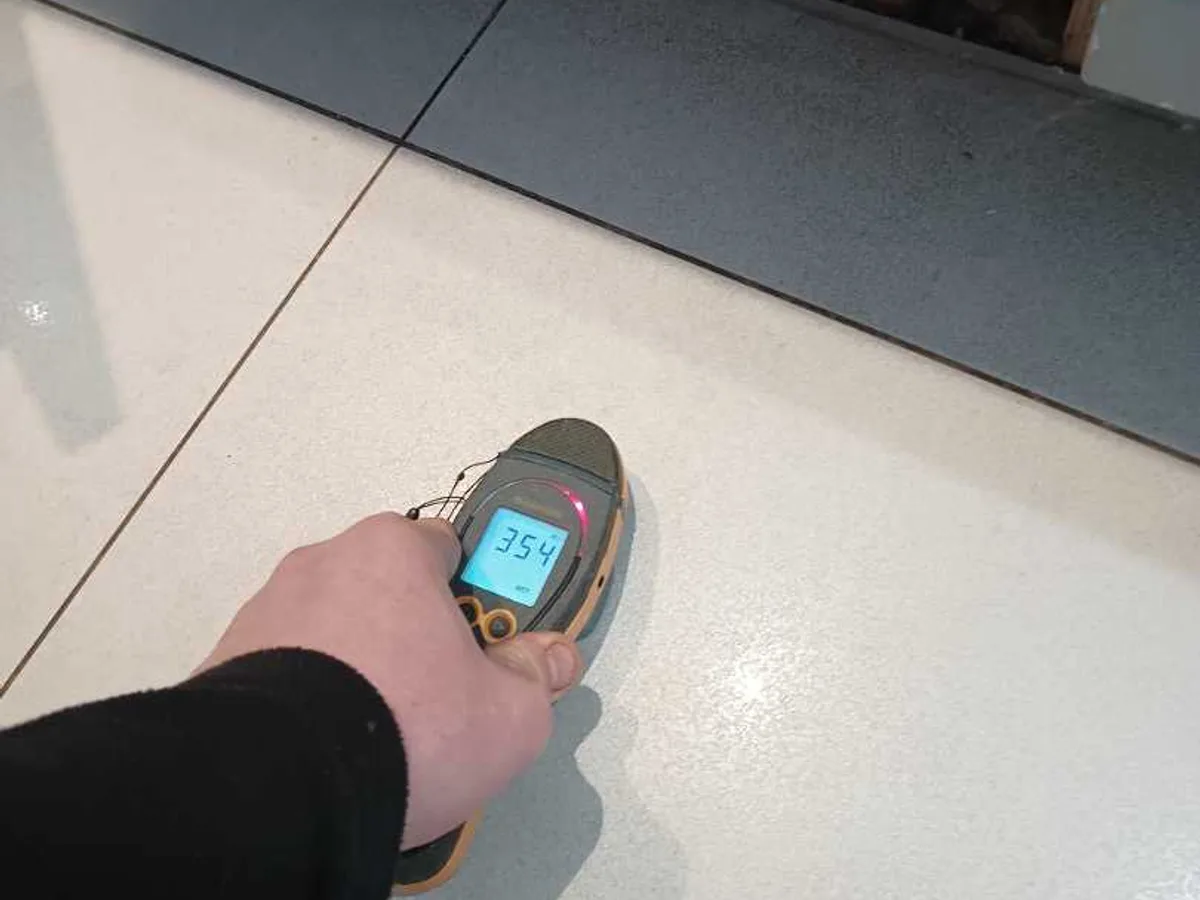
Damp Meter. Used to survey the kitchen and guest toilet area, returning very high readings throughout and confirming significant moisture presence beneath floor level.
Pressure Testing. Applied individually to the hot feed, the softened cold feed, and the hard water supply — the hard water circuit failed, isolating it as the source of the leak.
Tracer Gas. Introduced into the confirmed leaking hard water pipework to verify that the leak was located within the kitchen area before acoustic equipment was deployed.
Acoustic Correlation. Used to reduce the leak location within the kitchen, pinpointing the leak to directly in front of the kitchen sink unit on the hard water copper pipework.
Thermal Imaging. Used as part of the investigation to assist in identifying anomalies within the floor and wall surfaces in the affected areas.
Visual Inspection. Carried out on arrival, identifying water damage on the skirting boards, audible leak noise from the sink unit, and water visible between floor tiles.
Investigation Process
-
1Visual Inspection on Arrival
The engineer carried out a visual inspection of the property. Massive water damage was found on the skirting in the kitchen next to the fridge, a leak noise was audible from the sink unit, and water was visible between floor tiles.
-
2Damp Meter Survey
A damp meter investigation was carried out across the kitchen and guest toilet area. Very high readings were identified throughout, consistent with significant water presence beneath the celotex insulation of the underfloor heating.
-
3Hot Water and Recirculation Isolated and Tested
The hot water and hot water recirculation pipework was isolated at the cylinder. With these isolated, the leak noise was still audible, and a pressure test on this circuit passed — confirming no leak on the hot water system.
-
4Softened Cold Feed Pressure Tested
The internal cold feed pipework, supplied via the water softener, was pressure tested. The test passed, eliminating this circuit from the investigation.
-
5Hard Water Supply Pressure Test Failed
The hard water supply — the drinking water line coming directly from the street — was pressure tested. The test failed, confirming a leak on this pipework circuit.
-
6Tracer Gas Investigation
Tracer gas was introduced into the hard water system. The detector identified the kitchen area as the location of the leak, focusing the investigation.
-
7Acoustic Equipment Deployed
Acoustic equipment was used to narrow down the leak location within the kitchen. The equipment pinpointed the leak to directly in front of the kitchen sink unit.
-
8Floor Opened to Expose Pipework
Because the kitchen units were too large to position the acoustic equipment beneath them, the bottom board of the adjacent unit was cut away to expose the concrete and clarify the pipework route. The tiling and concrete floor in front of the sink unit were then opened.
-
9Leak Identified and Repaired
A single large leak was found on a section of 15mm copper pipework serving the fridge freezer. The leaking section was replaced with new copper pipework, which was then lagged to protect it.
-
10Hard Water System Retested
A pressure retest was carried out on the hard water cold feed pipework. The test passed, confirming no further leaks on the system.
-
11Boiler Room — Automatic Air Vents Replaced
The customer had also reported the heating system losing a little pressure weekly. A leaking automatic air vent was identified in the boiler room; both automatic air vents were replaced and isolation valves fitted beneath them.
-
12Outside Tap Valve Replaced
A 15mm lever ball valve on the outside tap pipework was found to be slowly but constantly dripping and was replaced. Water pressure was restored to working order throughout and the site was cleaned up.
Result & Outcome

The internal leak detection process identified a single large leak on a section of 15mm copper pipework beneath the kitchen floor, directly in front of the sink unit. The leaking section was on the hard water drinking supply line running to the fridge freezer. The failed pressure test on the hard water circuit, confirmed by tracer gas and pinpointed by acoustic equipment, gave a precise location that allowed the floor to be opened in a targeted area rather than speculatively.
Suspect a leak at your property?
ADI Leak Detection specialists investigate leaks like this across the UK every day. No find, no fee terms apply on qualifying jobs.