
Underground Water Mains Leak Detection in Sudbury
A underground mains leak in Sudbury was located using pressure testing, tracer gas, thermal imaging, a damp meter, and visual inspection, with water mains leak detection confirming the source at the joint where the internal stopcock connects to the incoming mains pipework beneath the kitchen units. Found by engineer Grant Corney.




The original leak detection company, est. 2011
Facts
| Location | Sudbury |
|---|---|
| County | Suffolk |
| Leak Type | Water Mains Leak Detection |
| Property Type | Residential property |
| Detection Method | Pressure Testing, Tracer Gas, Thermal Imaging, Damp Meter, Visual Inspection |
| Outcome | Leak found at stopcock joint under kitchen units, nut tightened. |
Symptoms

The occupants of a property in CO10 had been experiencing higher than expected water bills and suspected a leak on the incoming water mains supply. The water meter is located on the public driveway, and with the internal stopcock — situated under the kitchen sink — turned off, the meter was still visibly turning.
This confirmed water was being lost somewhere on the supply between the meter and the stopcock, though the route of the mains through the property was not immediately clear, with the pipe potentially running through the garden or around the side of the building.
Concrete floors throughout the property made any underground leak particularly difficult to identify without specialist equipment, as there were no obvious signs of wet ground or lifted flooring to guide the search. A water mains leak detection job in this kind of setting — solid floors, concealed pipework, no visible external escape — requires a methodical approach to isolate the section at fault before any invasive work is considered.
The combination boiler in the kitchen was checked and the heating circuit pressure was normal, ruling out the heating system as a contributing factor. The issue was clearly isolated to the incoming cold water mains supply.
Methods Used

The investigation began at the internal stopcock under the kitchen sink, using that connection point for both pressure testing and tracer gas introduction. A pressure drop on the incoming mains during testing confirmed a leak was present on that section of pipework.
Tracer gas was then introduced through the same connection, and a hissing sound was immediately audible from beneath the kitchen units. Removing the kickboard revealed gas escaping from the joint where the stopcock connects to the black plastic pipework, and a further sleeve layer over that pipe running into a duct was also identified.
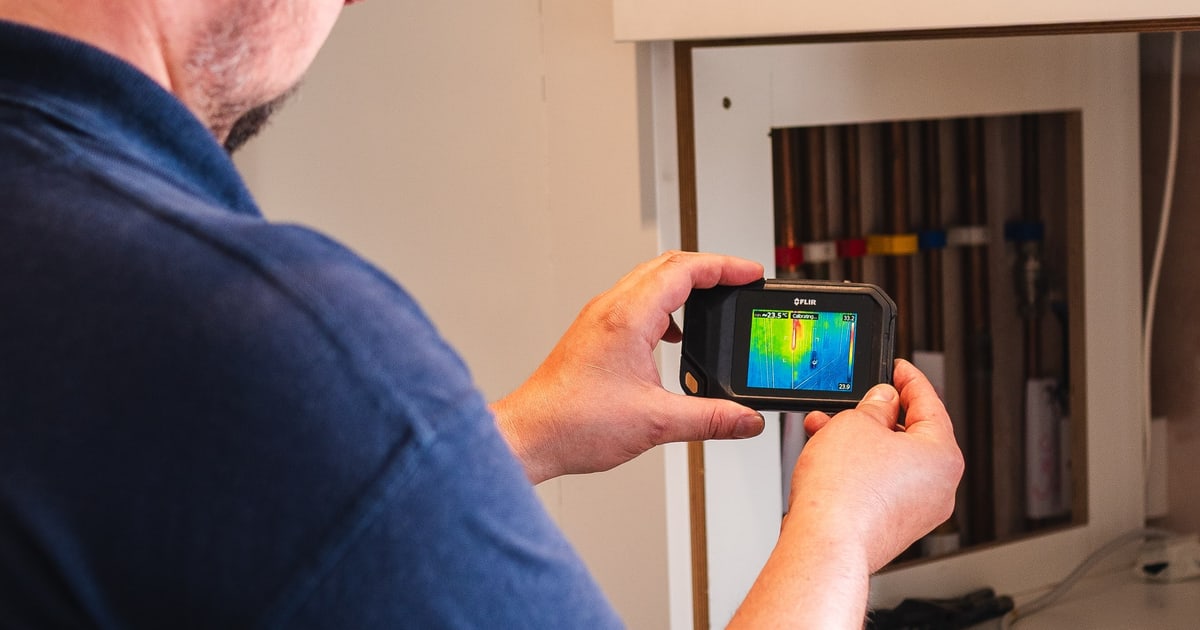
Damp readings were taken from the concrete floor beneath the units using a damp meter, and thermal imaging confirmed a cold patch in the same area — consistent with standing water on a concrete surface. To visually verify the active leak before any repair, the supply was turned back on at the meter.
This immediately showed a continuous stream of water running down the pipe inside the duct before it entered the ground — a path that would have made the leak entirely invisible under normal circumstances. Water mains leak detection using this combination of pressure testing, tracer gas and thermal imaging allowed the precise source to be identified without any excavation or significant disruption.
Pressure Testing. Connected under the kitchen sink to the incoming mains, pressure testing confirmed a drop indicating an active leak on that section of supply.
Tracer Gas. Introduced through the same connection under the kitchen sink, tracer gas produced an immediate audible hiss that directed attention to the joint beneath the kitchen units.
Thermal Imaging. Used on the concrete floor beneath the kitchen units, the thermal camera identified a cold patch consistent with water pooling on the slab surface.
Damp Meter. Applied to the concrete floor under the kickboard, the damp meter returned elevated readings confirming moisture accumulation at the base of the kitchen units.
Visual Inspection. With the supply turned back on at the meter, a continuous stream of water was observed running down the pipe inside the duct, visually confirming the leak point before repair.
Investigation Process
-
1Meter and stopcock checked
The water meter on the public driveway was confirmed to be turning with the internal stopcock under the kitchen sink closed, isolating the fault to the incoming mains supply.
-
2Pressure test carried out
A pressure test was connected at the stopcock under the kitchen sink and pressure drop was recorded on the incoming water mains, confirming an active leak.
-
3Tracer gas introduced
Tracer gas was introduced through the same connection and an immediate hissing sound was heard from beneath the kitchen units, directing attention to the area behind the kickboard.
-
4Kickboard removed and leak point identified
With the kickboard removed, gas was found escaping from the joint where the stopcock connects to the black plastic pipework; a second sleeve layer over the pipe running into a duct was also noted.
-
5Damp meter and thermal camera used
Visible water was found sitting on the concrete floor beneath the units; the damp meter confirmed elevated moisture and the thermal camera showed a cold patch in the same location.
-
6Supply turned back on to verify
The supply was restored at the meter and a continuous stream of water was observed running down the pipe inside the duct before entering the ground, visually confirming the active leak point.
-
7Nut tightened and leak resolved
The joint nut was tightened, the connection was confirmed completely dry, and the meter stopped moving — indicating the loose joint was the sole cause of the water loss.
-
8System restored and confirmed
All connections were returned to their original state and the system was left fully operational before leaving the property.
Result & Outcome

The leak was located at the joint where the internal stopcock connects to the black plastic incoming mains pipework, beneath the kitchen units. The connection had been knocked — most likely by accidental contact under the units — causing the nut to loosen sufficiently for water to escape. Because the pipe continues from that joint into a duct and then into the ground, the leak was directing water straight into the slab in a way that would never have been visible without removing the kickboard and testing the pipework under pressure.
No materials were required. Tightening the existing nut restored a completely dry joint, and the meter immediately stopped turning, confirming this was the only source of the elevated bills. For a water mains leak detection job on a property with concrete floors and concealed pipework, this is a straightforward but important result — the leak was fixed at the point of access without any excavation or damage to the floor or units.
The recommendation left with the customer is to consider replacing the existing stopcock with a lever valve positioned slightly higher, making it less susceptible to being knocked and easier to operate. No further action is required on the mains supply itself.
Suspect a leak at your property?
ADI Leak Detection specialists investigate leaks like this across the UK every day. No find, no fee terms apply on qualifying jobs.