
Internal Cold Mains Leak Detection in Farnham
A cold mains leak in Farnham was located beneath the kitchen units using visual inspection, pressure testing, tracer gas, an endoscope camera, thermal imaging, and a damp meter, with water mains leak detection confirming the source at a tee piece in the pipework. Found by engineer James Hunter.




The original leak detection company, est. 2011
Facts
| Location | Farnham |
|---|---|
| County | Surrey |
| Leak Type | Water Mains Leak Detection |
| Property Type | Residential property |
| Detection Method | Visual Inspection, Pressure Testing, Tracer Gas, Endoscope Camera, Thermal Imaging, Damp Meter |
| Outcome | Leak found at tee piece beneath kitchen unit, repaired same day. |
Symptoms

The occupant of a property in GU9 had been noticing small amounts of water appearing beneath the kitchen floor. A drainage engineer had already attended and inspected the property but was unable to identify the source.
With no clear explanation for where the water was coming from, internal leak detection was arranged to properly investigate the issue.
Water was visibly coming up through the flooring in the kitchen, which pointed to a leak somewhere beneath the surface. Because the drainage engineer had drawn a blank, there was no working theory about the pipe route or leak location before the engineer arrived.
The cause remained unknown until a systematic detection process was carried out.
Methods Used

The investigation began with a visual check of the water meter, which showed no movement — no active usage was registering at that point. The engineer then worked to determine the pipe routes beneath the kitchen floor and established there were no hot or cold water pipes running under that area.
Pressure testing was then carried out, and within six minutes a drop of approximately one and a half bar was recorded, confirming an active leak somewhere in the system.
With a confirmed pressure loss, tracer gas was introduced into the pipework. Using a gas analyser, readings were detected beneath the kitchen units, narrowing the location significantly.
An endoscope camera was then fed underneath the unit, which revealed a tee piece that was visibly dripping. This combination of equipment is what makes internal leak detection effective in confined, hard-to-access spaces where physical inspection alone cannot reach.
Visual Inspection. Used to assess the water meter at the start of the job — no movement was recorded, ruling out continuous active flow at that moment.
Pressure Testing. Applied to the pipework to confirm an active leak; pressure dropped by approximately one and a half bar within six minutes of testing.
Tracer Gas. Introduced into the pipework after pressure loss was confirmed; gas readings from the analyser concentrated beneath the kitchen units, directing the search.
Endoscope Camera. Fed beneath the kitchen unit to visually confirm the source once the tracer gas had narrowed the area — the dripping tee piece was clearly visible on camera.
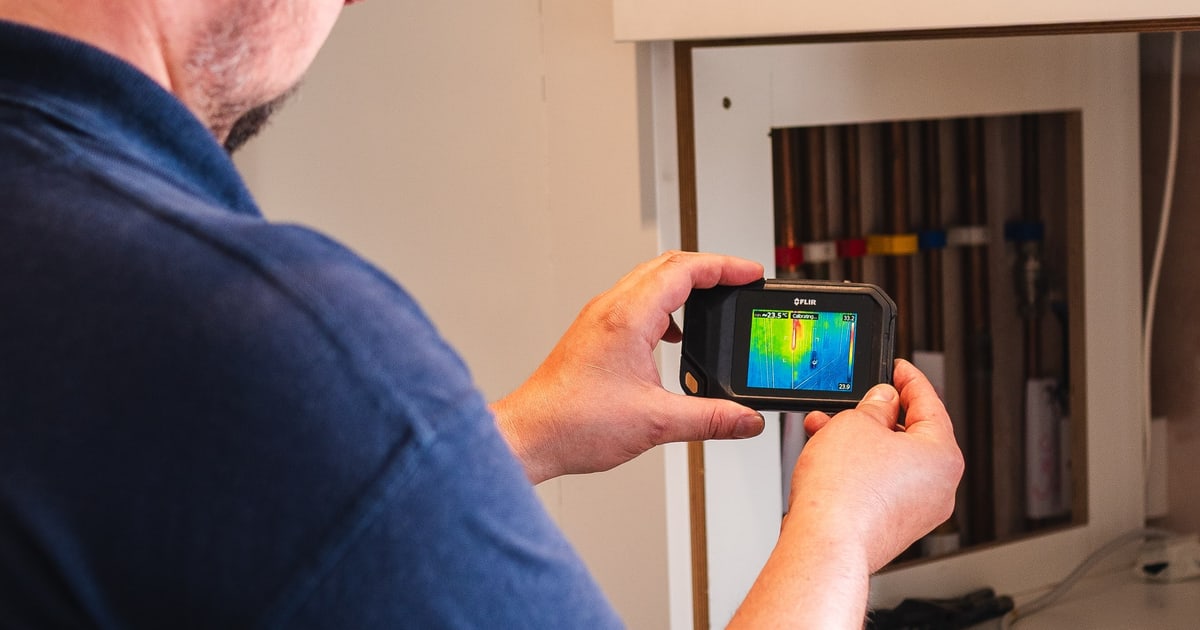
Thermal Imaging. Used during the investigation to assist in identifying temperature variations that could indicate moisture or water movement beneath the floor.
Damp Meter. Used to assess moisture levels in the affected area of the kitchen floor during the inspection process.
Investigation Process
-
1Visual inspection of water meter
The engineer started by checking the water meter for any signs of movement or usage. The meter showed no active flow at the time of inspection.
-
2Pipe route assessment
The engineer worked to determine whether hot or cold water pipes ran beneath the kitchen floor. It was established that no such pipes were present in that area.
-
3Pressure testing carried out
Pressure testing was applied to the system. Within six minutes, pressure had dropped by approximately one and a half bar, confirming an active leak.
-
4Tracer gas introduced
Tracer gas was added to the pipework and a gas analyser was used to scan the area. Readings concentrated beneath the kitchen units, pinpointing the zone of interest.
-
5Endoscope camera deployed
An endoscope camera was fed beneath the kitchen unit. A tee piece was visible on camera and was clearly dripping, confirming the leak source.
-
6Findings presented to customer
The engineer showed the customer the findings. The customer agreed to remove the shelving units and gave permission for the back of the cupboard to be cut out to access the pipe.
-
7Access gained and repair completed
The back of the cupboard was cut out, providing clear access to the pipework. The leaking tee piece was repaired using 15mm pipe, a 15mm tee, two 15mm couplings, and pipe inserts.
-
8Post-repair pressure test
A final pressure test was carried out following the repair. The test confirmed no further leaks were present in the property.
Result & Outcome
The leak was located beneath the kitchen units at a tee piece in the pipework, which was found to be dripping. Access was gained by removing the shelving units and cutting out the back of the cupboard. The repair was completed on the same visit using 15mm pipe, a 15mm tee, two 15mm couplings, and pipe inserts, along with the necessary cutting and cleaning materials.
A post-repair pressure test confirmed the system was holding correctly with no further leaks present anywhere in the property. The precision of the internal leak detection process meant the area of intrusion was kept to a minimum — only the cupboard back required cutting, rather than lifting floor coverings across a wider area.
The customer has been advised to have the back of the cupboard repaired once the area has dried out, and to run a dehumidifier in the property to draw out residual moisture from the floor and surrounding materials.
Suspect a leak at your property?
ADI Leak Detection specialists investigate leaks like this across the UK every day. No find, no fee terms apply on qualifying jobs.