
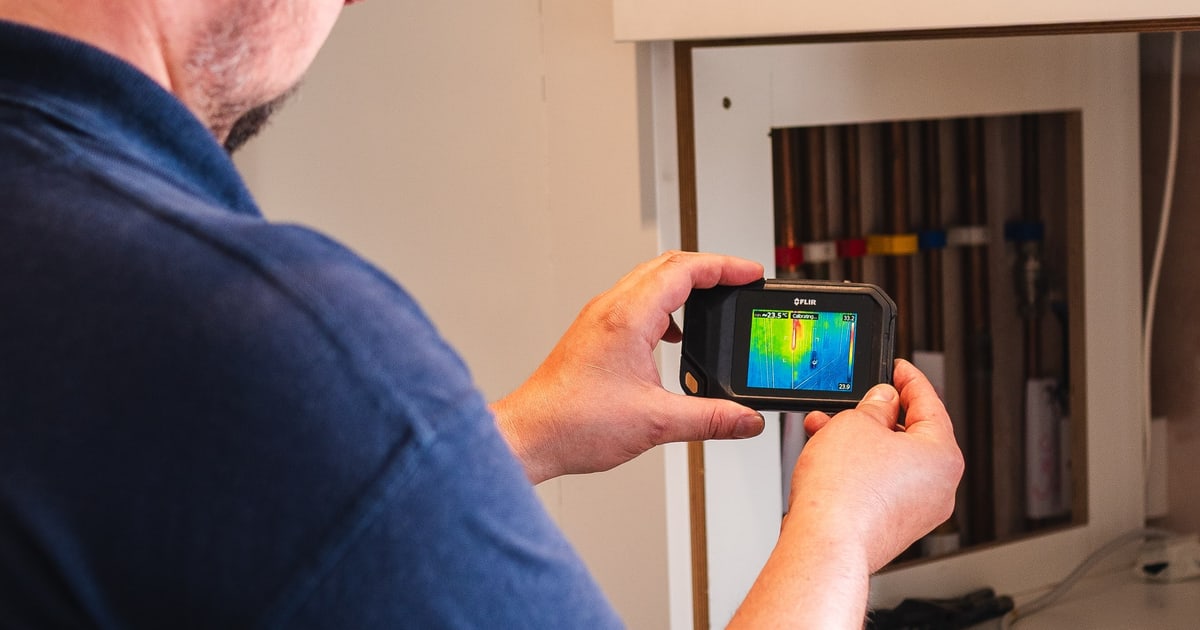
Internal Cold Mains Leak Detection in Burpham
A cold mains leak in Burpham was located using a damp meter, tracer gas, acoustic listening, an endoscope camera, and pressure testing as part of a water mains leak detection investigation into concealed below-floor pipework. The work was carried out by engineer Vincent Morgan.




The original leak detection company, est. 2011
Facts
| Location | Burpham |
|---|---|
| County | Surrey |
| Leak Type | Water Mains Leak Detection |
| Property Type | Residential property |
| Detection Method | Damp Meter, Tracer Gas, Acoustic Listening Equipment, Endoscope Camera, Pressure Testing |
| Outcome | Leak found on cold water supply pipe beneath cupboard floor, pipe replaced. |
Symptoms

At a property in GU4, the audible sound of water leaking could be heard from within the building, pointing to a fault on the internal pipework. A cupboard off a hallway housed a hot water cylinder and associated pipework, and the noise was clearly present in that area.
Internal leak detection was needed to establish exactly where the fault lay before any repair work could begin.
Methods Used

The investigation combined several methods to narrow the leak from the general area to a precise point. A damp meter confirmed elevated moisture readings beneath the hallway and cupboard floor tiling, establishing that water had been tracking into the floor structure.
The external water meter was then monitored with all outlets closed, and continuous movement of the dial confirmed an active leak rather than residual historic dampness.
Tracer gas was introduced to the pipework and detection equipment picked up escaping gas at the point where the pipework enters the concrete floor inside the cupboard. Acoustic equipment was used to corroborate the same location.
This multi-method approach, typical of a thorough internal leak detection investigation, produced a confident result before any floor surface was broken.
Damp Meter. Measured moisture levels beneath the hallway and cupboard floor tiling, confirming water had saturated the floor structure in the area of the suspected leak.
Tracer Gas. Introduced to the pipework and detected escaping from the point where the cold water supply pipe enters the concrete floor in the cupboard, pinpointing the leak location.
Acoustic Listening Equipment. Used to listen for leak noise through the floor structure, independently corroborating the area identified by the tracer gas.
Endoscope Camera. Available on site to assist with visual inspection of concealed pipework or voids if required during the investigation.
Pressure Testing. Available to assess the integrity of the pipework system and confirm the presence of an active leak under pressure.
Investigation Process
-
1Initial inspection of cupboard
On arrival, a cupboard off the hallway was inspected. It contained the hot water cylinder and associated pipework, and the sound of leaking water was clearly audible.
-
2Damp meter survey
A damp meter was used across the hallway and cupboard floor tiling. Readings were significantly elevated, indicating water had penetrated the floor structure beneath the tiles.
-
3Water meter monitored
The external water meter was observed with no water in use anywhere in the property. The meter continued to register flow, confirming an active leak on the internal pipework.
-
4Tracer gas introduced
Tracer gas was introduced to the pipework. Detection equipment identified gas escaping from the area in the cupboard where the pipework passes into the concrete floor.
-
5Acoustic detection
Acoustic equipment was deployed to listen for leak noise through the floor, confirming the same location identified by the tracer gas.
-
6Area exposed and leak found
The floor area was opened up and the leaking section of 22mm cold water supply copper pipework was found exactly where the investigation had indicated, at the point it enters the concrete floor.
-
7Repair completed
A new section of 22mm copper pipework was installed with new fittings, reinstating the cold water supply.
Result & Outcome

Once exposed, the leaking 22mm copper pipework was found exactly where the investigation indicated. A new section of copper pipe was installed with new fittings, directly resolving the fault. For a job of this nature — internal leak detection on a concealed below-floor pipe — having a pinpoint location before any breaking out avoids unnecessary damage to the surrounding floor structure.
The continuous water meter movement that had confirmed the active leak would, following the repair, return to zero with all outlets closed, providing a straightforward way to verify the fix.
Suspect a leak at your property?
ADI Leak Detection specialists investigate leaks like this across the UK every day. No find, no fee terms apply on qualifying jobs.