
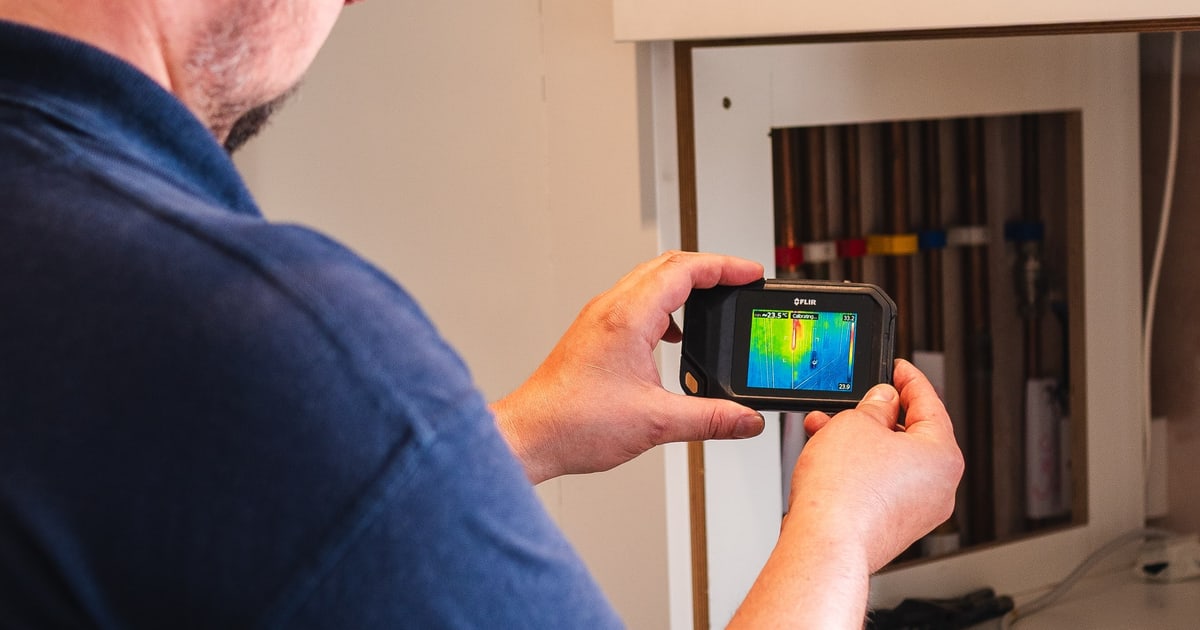
Underfloor Heating Leak Detection in Pewsey
An underfloor heating leak in Pewsey was located using pressure testing, acoustic listening, and visual inspection, with underfloor heating leak detection confirming the source within pipework buried beneath an office floor. Found by engineer James Bexter.




The original leak detection company, est. 2011
Facts
| Location | Pewsey |
|---|---|
| Leak Type | Underfloor Heating Leak Detection |
| Property Type | Residential property |
| Detection Method | Pressure Testing, Acoustic Listening Equipment, Visual Inspection |
| Outcome | Leak found in buried PEX pipework, corner of office room. |
Symptoms

The underfloor heating system at a property in SN9 developed a leak that required investigation. On arrival, the UFH circuit had already been isolated, with oil-fired underfloor heating serving the ground floor and radiators running from the same boiler upstairs.
The system was losing pressure, and the source of that loss needed to be traced before any repair could be considered.
This type of underfloor heating leak detection job is complicated by the fact that plastic pipework is buried within a screed or subfloor, making visual inspection alone useless. The leak could have been anywhere along the circuit, and without pinpointing it accurately, any attempt at repair would have meant unnecessary and extensive excavation.
Methods Used

With the UFH circuit isolated, the pipework was disconnected and a compressor was introduced at 2 bar to pressurise the system with air. The pressure dropped immediately — there was no retention whatsoever — and audible air escape was detected through the wall from the test point.
This gave a directional indication of where the leak was occurring, which was then refined using acoustic equipment.
Acoustic detection is well-suited to underfloor heating leak detection precisely because it can identify the leak point without requiring the floor to be broken up across a wide area. By listening along the floor surface, the equipment pinpointed the location to a specific corner of the office room, allowing a targeted and minimal excavation rather than a speculative one.
Pressure Testing. A compressor was applied to the disconnected UFH pipework at 2 bar; the immediate and total pressure loss confirmed a significant breach and allowed the escaping air to be heard audibly through the wall.
Acoustic Listening Equipment. Acoustic equipment was used to follow the sound of escaping air and pinpoint the exact leak location beneath the floor, narrowing it to a specific corner of the office room.
Visual Inspection. Once the ground was exposed in the identified corner, the pipework was visually examined and the leak and the condition of the 22mm Speedfit PEX pipe were directly assessed.
Investigation Process
-
1System isolated on arrival
The underfloor heating circuit had been isolated before the engineer arrived. The system was confirmed as an oil-fired boiler supplying UFH on the ground floor and radiators upstairs.
-
2Pipework disconnected and pressurised
The UFH pipework was disconnected and a compressor was connected, introducing air at 2 bar. The system held no pressure at all.
-
3Audible air escape located through wall
The sound of air escaping was clearly audible on the other side of the wall from the test point, giving an initial directional indication of the leak area.
-
4Acoustic equipment deployed
Acoustic detection equipment was used to follow and refine the signal, pinpointing the leak to a specific corner of the office room.
-
5Ground exposed and leak found
The floor was opened in the identified corner and the leak was found in the 22mm Speedfit PEX pipework buried in the ground.
-
6Temporary repair carried out
A temporary repair was made to the plastic pipework at the leak point. John Guest do not recommend permanent fittings on this type of buried plastic pipe, so the repair was completed on that basis with the customer's full understanding.
-
7Remainder of pipework replaced in copper
The section of pipework running back through the wall to the garage was replaced in copper, protected, at the customer's request.
-
8Boiler flow temperature adjusted
The boiler flow temperature was turned down, and the need for automatic air vents on the high points near the boiler was noted, as the existing vent had been capped off.
Result & Outcome

The leak was located in a corner of the office room, within the 22mm Speedfit PEX pipework buried in the ground. The acoustic approach used during this underfloor heating leak detection job meant that excavation was limited to the specific area where the leak had been confirmed, rather than opening up large sections of floor speculatively.
A temporary repair was carried out at the leak point. John Guest do not recommend permanent push-fit fittings on buried plastic pipework in this application, and the customer was made fully aware that the repair cannot be warranted on that basis. The section of pipework from the repair back through the wall to the garage was replaced in copper at the customer's request, providing a more durable solution for that part of the circuit.
The longer-term recommendation is to re-pipe the flow and return to the manifold in copper, though this would be a significant undertaking. In the meantime, the boiler flow temperature has been reduced to limit stress on the existing plastic pipework. Automatic air vents should also be fitted at the high points near the boiler, as the current vent on the boiler itself has been capped for an unknown reason.
Suspect a leak at your property?
ADI Leak Detection specialists investigate leaks like this across the UK every day. No find, no fee terms apply on qualifying jobs.