
Hot Water System Leak Detection in Hoo
A hot water system leak in Hoo was located using thermal imaging, tracer gas, and pressure testing, with hot water leak detection confirming the source inside a concealed void behind a sink without unnecessary opening up of the building fabric. Found by engineer Grant Corney.




The original leak detection company, est. 2011
Facts
| Location | Hoo |
|---|---|
| County | Kent |
| Leak Type | Hot Water Leak Detection |
| Property Type | Residential property |
| Detection Method | Thermal Imaging, Damp Meter, Pressure Testing, Tracer Gas, Acoustic Listening |
| Outcome | Pinhole leak found behind disability-adapted sink, pipe replaced. |
Symptoms

A property in ME3 was showing significant water damage across the kitchen utilities and bathroom walls, with water visibly coming up through the lino flooring in the bathroom. The water could be seen emerging from behind the sink, but all the pipework ran behind the tiles and was not accessible without investigation.
The property has concrete flooring throughout with lino laid on top, a combination that allowed water from a hidden leak to spread widely before surfacing.
The property is served by a pressurised heat system with a megaflow boiler in the garage, supplying four upstairs bathrooms and two downstairs. The water meter at the front of the property on the grass verge was observed moving slowly with nothing in use, a clear indication that a live leak was present somewhere on the system.
Hot water leak detection was the primary focus given the nature of the damage and the system configuration.
The bathroom affected is specially adapted for disability use, which added complexity to accessing the area and required careful handling throughout the investigation.
Methods Used

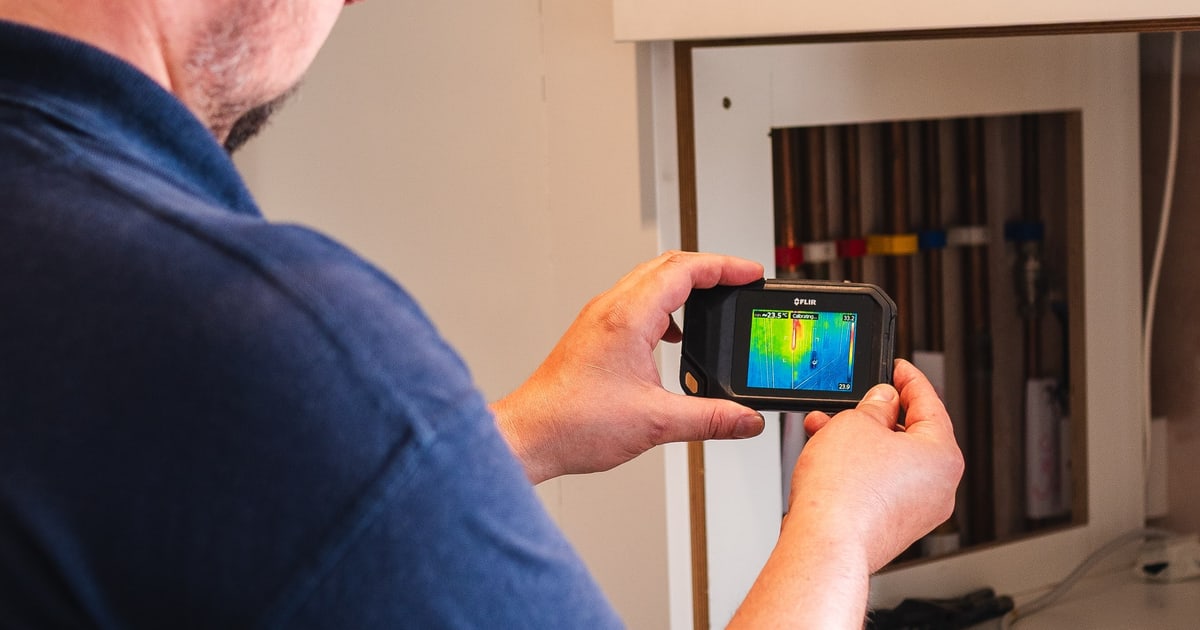
The investigation began with damp meter readings across the bathroom and utility floors and walls to map the extent of moisture ingress. A thermal imaging camera was then used to identify a cold patch behind the toilet and sink, pinpointing the area where the pipework runs inside a concealed void.
This directed the investigation to a specific zone without requiring unnecessary opening up of the building fabric.
Pressure testing was connected under the utility sink, and the hot supply was observed dropping steadily. Tracer gas was then introduced into the pipework, and both audible leak noise and high gas readings were detected behind the specialised adapted sink.
This multi-method approach, which is standard practice in hot water leak detection, confirmed the precise location before any access work began. The tile at the pipe entry point was carefully cut out to expose the pipework directly.
Thermal Imaging. The thermal camera identified a cold patch behind the toilet and sink, locating the area of the concealed void where the leaking pipework was running.
Damp Meter. Damp readings were taken across the bathroom and utility floors and walls to establish the extent and pattern of moisture damage throughout the property.
Pressure Testing. The system was pressure tested connected under the utility sink, confirming a slow drop on the hot supply that indicated an active leak on that circuit.
Tracer Gas. Tracer gas introduced into the hot supply pipework produced both audible leak noise and high gas readings directly behind the specialised adapted sink, confirming the precise leak location.
Acoustic Listening. Acoustic listening confirmed the leak noise behind the wall when tracer gas was running, corroborating the thermal and gas findings before any access was made.
Investigation Process
-
1Meter check and initial assessment
The water meter at the front of the property was inspected and observed moving slowly with nothing in use, confirming a live leak. Visible water damage to the kitchen utilities and bathroom walls was noted, along with water coming up through the lino flooring.
-
2Damp meter survey
Damp meter readings were taken across the bathroom and utility floors and walls, identifying elevated moisture levels and mapping where water had spread along the concrete subfloor.
-
3Thermal imaging scan
The thermal camera was used to scan the bathroom area and detected a cold patch behind the toilet and sink, identifying the void where the pipework was located as the focus of the leak.
-
4Pressure testing on hot supply
Pressure testing was connected under the utility sink. The hot supply pressure was observed dropping slowly, confirming the leak was on the hot circuit.
-
5Tracer gas introduction and detection
Tracer gas was introduced through the hot supply pipework. Both audible leak noise and high gas readings were detected behind the specialised adapted sink, pinpointing the leak location precisely.
-
6Sink removal and tile access
The specialised disability-adapted sink was carefully removed from the wall with assistance and laid safely on timber supports. The tile where the pipes came through the wall was carefully cut out to gain direct access to the pipework.
-
7Leak identified and repaired
A pinhole leak was visible on the hot supply pipe inside the void. The leaking section was cut out and replaced with 15mm copper pipework.
-
8Post-repair pressure test and system reinstatement
Pressure testing was carried out on the repaired system and pressure held, confirming no further active leaks. The system was fully reinstated and confirmed in working order before the engineer left site.
Result & Outcome

The leak was located behind the wall of the disability-adapted bathroom at the property in ME3, originating from a pinhole failure on the hot supply pipe running inside a concealed void behind the sink. The combination of thermal imaging, tracer gas, and pressure testing identified the precise location without unnecessary opening up of the building fabric, allowing a targeted tile cut to expose only the affected section of pipework.
The leaking section was cut out and replaced with 15mm copper pipe on site. A final pressure test confirmed the system was holding correctly with no further leaks present. This is the repair outcome that hot water leak detection is designed to achieve — finding a hidden failure point precisely so the repair is focused and the disruption is minimised.
With the leak now stopped, the spread of water damage along the concrete floor will halt. A drying out process has been strongly recommended, and a specialist contractor has been referred to contact the customer directly to carry out remediation work on the affected floors and walls.
Suspect a leak at your property?
ADI Leak Detection specialists investigate leaks like this across the UK every day. No find, no fee terms apply on qualifying jobs.