
Central Heating Leak Detection in Titchfield
A central heating leak in Titchfield was located using thermal imaging, a damp meter, tracer gas, pressure testing, and visual inspection, with central heating leak detection confirming two faults — a faulty service valve hidden within boxed pipework in the downstairs bathroom and a second leak at the drain-off valve on the entrance radiator. Found by engineer Gabor Weber.




The original leak detection company, est. 2011
Facts
| Location | Titchfield |
|---|---|
| County | Hampshire |
| Leak Type | Central Heating Leak Detection |
| Property Type | Residential property |
| Detection Method | Thermal Imaging, Damp Meter, Tracer Gas, Pressure Testing, Visual Inspection |
| Outcome | Two leaks found and repaired; system held 2 bar pressure test. |
Symptoms

The heating system at a property in PO14 was losing pressure, indicating an uncontrolled loss of water from the sealed system. Pressure loss of this kind points to a breach somewhere in the pipework, at a valve, or at a connection — but without further investigation, the exact location remained unknown.
The system serves the full property including an extension, which added complexity to the investigation scope.
Central heating leak detection was required to systematically eliminate potential areas and pinpoint the source without unnecessary disruption to the structure. Given the extent of the pipework and the presence of boxed-in sections, a multi-method approach was needed from the outset.
Methods Used

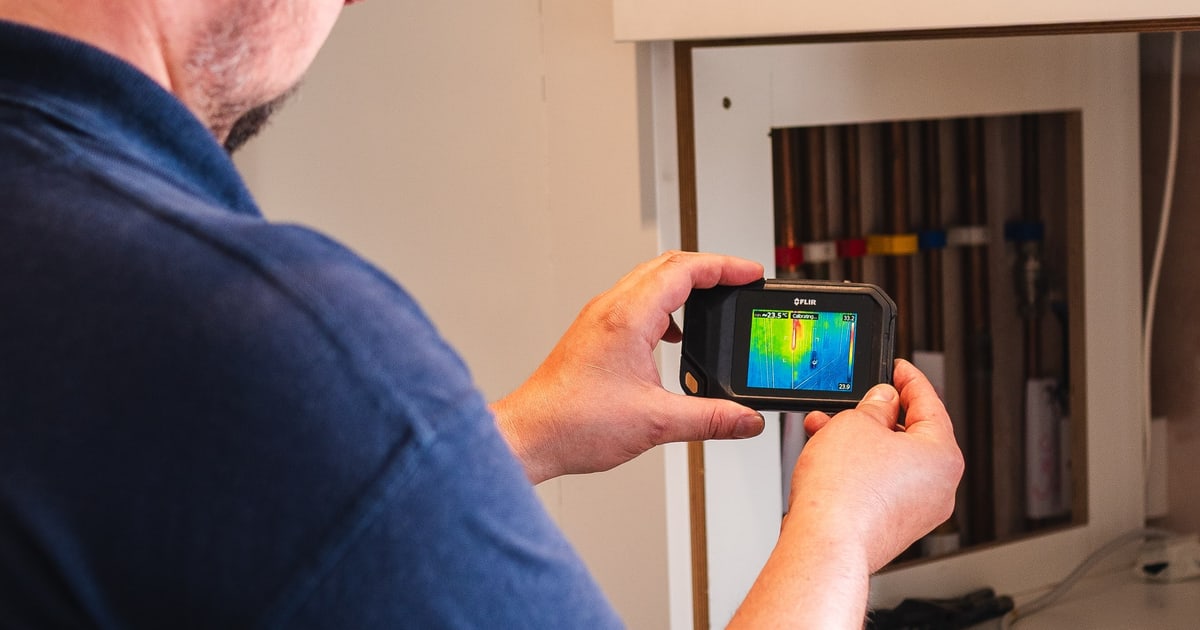
The central heating leak detection investigation began with thermal imaging across the visible pipe runs to identify any anomalies consistent with escaping water. No thermal irregularities were detected, ruling out obvious surface-level faults and directing attention to concealed areas.
A damp meter was then used to probe the structure, revealing elevated moisture readings on the kitchen floor at the junction between the extension and the main house — a common stress point in extended properties.
With the leak confined to a non-visible area, the heating system was drained using an air compressor to purge all water, then recharged with tracer gas. Detection equipment identified a strong gas presence beneath the boxed pipework in the downstairs bathroom.
Tiles and plasterboard were carefully removed to expose the pipework, confirming two distinct faults. The damp meter also flagged elevated moisture in a bedroom floor frame; that area was opened up and inspected, but no visual evidence of a leak was found at that location.
Thermal Imaging. Used to map the heating pipework across the property; no thermal anomalies were identified along the visible pipe runs.
Damp Meter. Identified elevated moisture readings on the kitchen floor at the extension junction and flagged a secondary area of concern on the bedroom floor frame.
Tracer Gas. Injected into the drained heating system to locate concealed leaks; a strong gas signal was detected beneath the boxed pipework in the downstairs bathroom.
Pressure Testing. Used after repairs to verify the integrity of the entire heating system; the system held 2 bar for 2 hours confirming a successful fix.
Visual Inspection. Carried out after exposing the bathroom boxing and the bedroom floor area to confirm the source of leaks and rule out additional faults.
Investigation Process
-
1Thermal Imaging Survey
Thermal imaging was carried out across the heating pipework throughout the property. No thermal anomalies indicative of a leak were found along any visible pipe runs.
-
2Damp Meter Survey
A damp meter was used across the floors and structure. Elevated moisture readings were recorded on the kitchen floor where the extension meets the main house, and separately on the bedroom floor frame.
-
3System Drained and Charged with Tracer Gas
The heating system was drained using an air compressor to remove all water, then refilled with tracer gas in preparation for leak detection.
-
4Tracer Gas Detection
Detection equipment identified a strong gas presence in the downstairs bathroom, concentrated beneath the thermostatic radiator valve within the boxed pipework.
-
5Boxing Exposed — Leaks Confirmed
Tiles and plasterboard boxing were carefully removed to access the pipework. A leaking 15mm service valve and a separate leak at the drain-off valve on the entrance radiator were identified.
-
6Bedroom Floor Investigated
The concrete floor in the bedroom was carefully opened up to investigate the elevated damp meter readings. No visual evidence of a leak was found in this area.
-
7Repairs Carried Out
The faulty 15mm service valve in the downstairs bathroom and the leaking drain-off valve on the entrance radiator were both replaced.
-
8Pressure Test
A full pressure test was conducted on the entire heating system. The system held 2 bar for 2 hours, confirming the repairs were successful and the pipework was sound.
Result & Outcome

Two leaks were located and repaired at the property in PO14. The primary leak was a faulty 15mm service valve beneath the thermostatic radiator valve within the boxed pipework in the downstairs bathroom — only accessible after tracer gas directed investigation to that specific area and the boxing was carefully removed. A second leak was found at the drain-off valve on the entrance radiator. Both components were replaced.
Following the repairs, a full pressure test confirmed the system held 2 bar for 2 hours without loss, validating the integrity of the heating pipework across the entire property. The damp readings on the bedroom floor frame were investigated by exposing the concrete floor; no active leak was found, and those elevated readings are likely residual moisture rather than an ongoing fault.
As a central heating leak detection outcome, this result gives the customer a fully pressure-tested, verified system. One recommendation remains outstanding: the heating water was observed to be discoloured and contaminated with sludge. A power flush is strongly advised to clear debris, protect the boiler, and reduce the risk of future component failures.
Suspect a leak at your property?
ADI Leak Detection specialists investigate leaks like this across the UK every day. No find, no fee terms apply on qualifying jobs.