
Central Heating Leak Detection in Cricklade
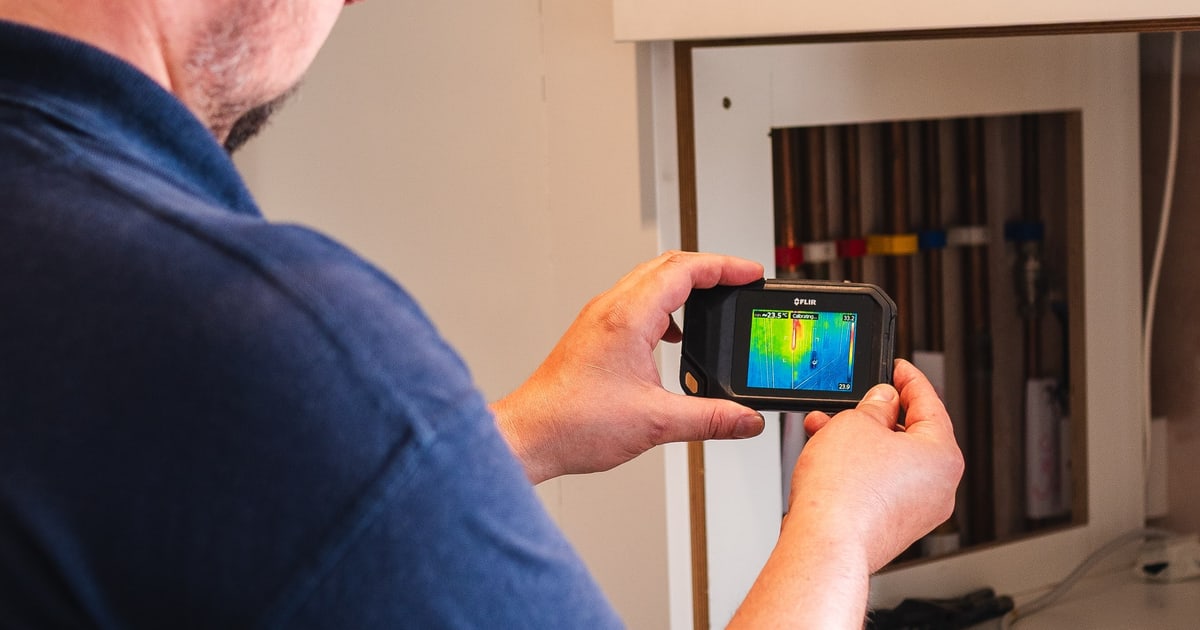
A central heating leak in Cricklade was located using sectional isolation, tracer gas, and an endoscope camera to confirm the exact leak point within a wall void, completing central heating leak detection without unnecessary opening up. Found by engineer Richard Poberezniuk.




The original leak detection company, est. 2011
Facts
| Location | Cricklade |
|---|---|
| County | Wiltshire |
| Leak Type | Central Heating Leak Detection |
| Property Type | Residential property |
| Detection Method | Pressure Testing, Tracer Gas, Endoscope Camera, Sectional Isolation |
| Outcome | Redundant pipe behind kitchen hob unit found leaking and capped. |
Symptoms

Central heating leak detection was clearly needed, but pinpointing the source was not straightforward. The system included both underfloor heating circuits and a radiator circuit, meaning the leak could have been anywhere across a relatively complex layout.
Systematic isolation was required before any trace work could begin.
Methods Used

Endoscope investigations were carried out at low level in the wall adjacent to the hob, where a leaking redundant heating pipe was identified. A section of wall was removed to allow further endoscope work, which indicated the actual leak point was behind the hob unit itself.
Following agreement with the customer, the hob unit area was exposed to access the pipe. This approach — methodical isolation followed by tracer gas and camera work — is standard practice in central heating leak detection where the leak cannot be located by pressure testing alone.
Pressure Testing. Used to confirm the overall system leak, and then applied to each underfloor circuit individually to eliminate them as the source before focusing on the radiator circuit.
Tracer Gas. Injected into the drained radiator circuit; produced a high reading in the kitchen and an audible bubbling noise that directed investigation to the wall adjacent to the hob.
Endoscope Camera. Deployed at low level in the kitchen wall to visually identify the leaking redundant pipe, and used again after partial wall removal to confirm the leak was positioned behind the hob unit.
Sectional Isolation. Applied to each underfloor heating circuit in turn to systematically eliminate them and confirm the leak was isolated to the radiator circuit.
Investigation Process
-
1System refilled and pressure loss confirmed
The heating system was refilled to 1 bar. Pressure dropped to zero within ten minutes, confirming an active leak.
-
2Underfloor circuit #1 isolated and tested
The first underfloor heating circuit was isolated and a separate pressure test carried out. The result was the same — pressure dropped to zero within ten minutes.
-
3Underfloor circuit #2 isolated and tested
The second underfloor heating circuit was isolated and pressure tested with the same outcome, eliminating both underfloor circuits as the source of the leak.
-
4Radiator circuit drained and tracer gas applied
With both underfloor circuits ruled out, the radiator circuit was drained and tracer gas investigations were carried out. A high gas reading was detected in the kitchen and a bubbling noise could be heard.
-
5Endoscope investigation in kitchen wall
An endoscope camera was used at low level in the wall adjacent to the hob. A leaking redundant heating pipe was identified within the wall void.
-
6Wall opened and further endoscope work carried out
A section of the wall was cut away to allow further endoscope investigation, which indicated the actual leak point was behind the hob unit.
-
7Area behind hob exposed
Following discussion with the customer, further exposure was agreed to access the leaking 15mm copper pipe located behind the hob unit.
-
8Leaking pipe identified and cause established
The 15mm copper pipe was found to be in contact with a sharp stone, which had been cutting into the pipe wall. The stone was removed.
-
9Pipe cut and capped
The leaking redundant section of 15mm copper pipe was cut short and capped off to seal the circuit.
-
10Pressure test passed and system refilled
A pressure test at 2 bar held for 20 minutes with no drop, confirming the repair. The heating system was refilled and six radiators were vented.
Result & Outcome

For central heating leak detection jobs of this type — where the system spans multiple circuits and the leak is concealed within a wall void — systematic isolation and tracer gas work are essential to avoid unnecessary exposure. In this case, the combination of sectional isolation, tracer gas, and endoscope camera work meant the exact leak point was confirmed before any significant opening up was agreed with the customer.
Suspect a leak at your property?
ADI Leak Detection specialists investigate leaks like this across the UK every day. No find, no fee terms apply on qualifying jobs.