
Central Heating Leak Detection in Burnham
A central heating leak in Burnham was located using thermal imaging, tracer gas, damp meter readings, and pressure testing, with central heating leak detection confirming the exact fault position within a screed floor before any lifting took place. Found by engineer Mark Jones.




The original leak detection company, est. 2011
Facts
| Location | Burnham |
|---|---|
| County | Buckinghamshire |
| Leak Type | Central Heating Leak Detection |
| Property Type | Residential property |
| Detection Method | Thermal Imaging, Tracer Gas, Damp Meter, Pressure Testing |
| Outcome | Leak found in screed floor under kitchen, pipe replaced. |
Symptoms

The property in SL1 is a detached two-storey house with heating and hot water supplied by a combination boiler. A central heating leak was suspected, prompting the call for central heating leak detection to locate the source before any further damage could occur.
Leaks concealed within screed floors or beneath floor coverings are particularly difficult to identify without specialist equipment. There were no obvious signs of a major failure at surface level, making it essential to trace the pipe runs precisely and test the system methodically rather than rely on visual inspection alone.
Left unaddressed, a leak of this kind can cause progressive damage to floor screed, subflooring, and surrounding structure, as well as continued pressure loss in the heating system.
Methods Used

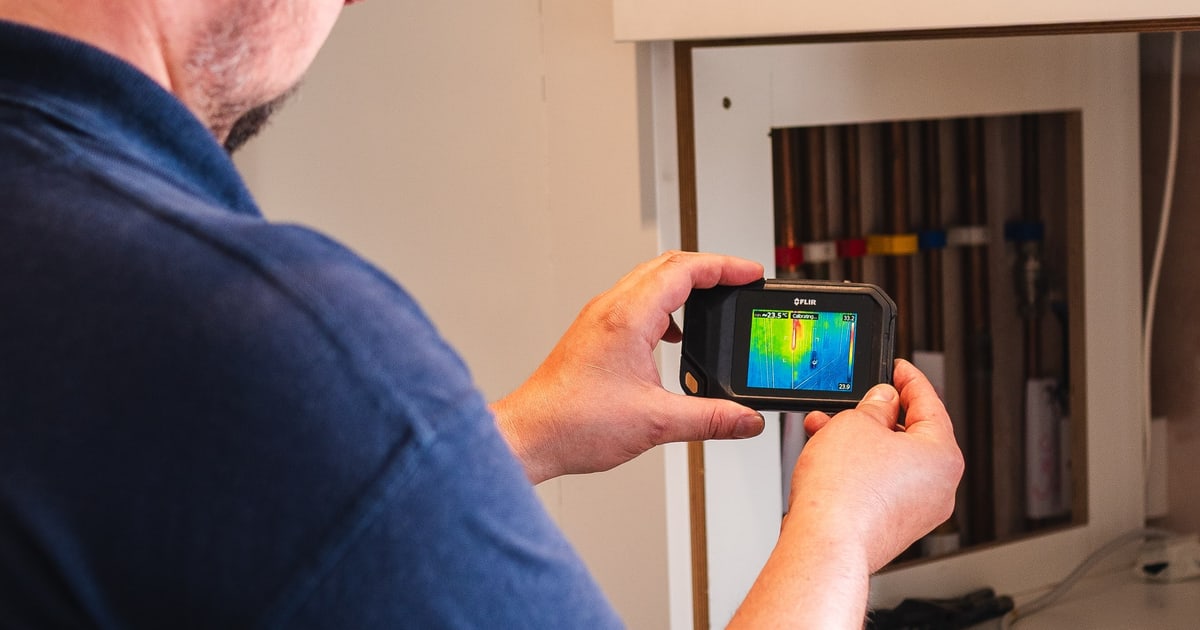
On arrival at the property in SL1, thermal imaging was used first to map the pipe runs across both floors, giving a clear picture of the system layout before any invasive work began. The system was then drained and hydrogen tracing gas introduced.
Within approximately 10 minutes a strong gas signal was detected under the kitchen floor. The gas was left to circulate through the rest of the system for a further 40 minutes before the remainder of the property was tested, with no additional leak points indicated.
For central heating leak detection in a property like this, combining tracer gas with thermal imaging and a damp meter allows the leak to be pinpointed precisely before any floor coverings are disturbed. Thermal imaging confirmed a retained heat spot directly in the area where the gas signal was strongest, and the damp meter recorded a slight but measurable increase in moisture content at the same location.
This gave sufficient confidence to lift only the materials directly above the leak site.
Thermal Imaging. Used on arrival to map the pipe runs beneath the floors and subsequently to confirm a retained heat spot at the suspected leak location under the kitchen floor.
Tracer Gas. Introduced into the drained system and detected as a strong signal under the kitchen floor within approximately 10 minutes, then allowed to circulate for 40 minutes to confirm no further leak points elsewhere in the property.
Damp Meter. Used at the identified area to measure a slight but measurable increase in moisture content in the kitchen floor, corroborating the gas and thermal imaging findings.
Pressure Testing. The repaired system was pressure tested at 2.0 bar following the repair to confirm no further leaks were present before the system was refilled.
Investigation Process
-
1Thermal imaging survey
On arrival, thermal imaging was carried out across the property to map the pipe runs through both floors before any further work began.
-
2System drained and tracer gas introduced
The central heating system was drained down and hydrogen tracing gas was introduced throughout.
-
3Gas signal detected under kitchen floor
Within approximately 10 minutes, a strong gas signal was detected beneath the kitchen floor, indicating a leak in that area.
-
4Remainder of property tested
The gas was allowed to circulate through the rest of the system for approximately 40 minutes. Testing across the rest of the property showed no further leaks.
-
5Thermal imaging and damp meter confirmation
Thermal imaging confirmed a retained heat spot at the suspected leak location, and the damp meter recorded a slight increase in moisture content in the same area.
-
6Floor coverings lifted
Laminate tiles, several sections of skirting board, and the floor screed were taken up above the identified area to expose the pipework beneath.
-
7Leak located and pipe replaced
A failed pipe was found embedded in the screed floor. A short section of 22mm copper pipe was installed using two new-to-old copper fittings and a slip coupling to replace the failed section.
-
8System pressure tested and recommissioned
The repaired system was pressure tested at 2.0 bar with no further leaks indicated. Inhibitor was reinstated, the system refilled, and it was run for approximately 30 minutes with no leaks or faults present.
Result & Outcome

The leak was found on a failed pipe embedded in the screed floor beneath the kitchen. The combination of tracer gas, thermal imaging, and damp meter readings allowed the exact location to be identified before any lifting took place, limiting the amount of floor material that needed to be removed to only what was directly above the fault.
The failed section was replaced with a short length of 22mm copper pipe, connected using two new-to-old copper fittings and a slip coupling. Following the repair, the system was pressure tested at 2.0 bar and held without issue. The system inhibitor was reinstated, the heating was refilled, and a 30-minute run confirmed no further leaks or faults.
For any central heating leak detection job where the pipework runs through screed, precise location before excavation is critical to keeping remedial work to a minimum. One additional note from the visit: the auto air vent on the boiler has been isolated and may require replacing in due course.
Suspect a leak at your property?
ADI Leak Detection specialists investigate leaks like this across the UK every day. No find, no fee terms apply on qualifying jobs.