
Central Heating Leak Detection in Macclesfield
A central heating leak in Macclesfield was located using thermal imaging, a damp meter, acoustic listening, a ground microphone, and pressure testing, with central heating leak detection pinpointing the fault to a tee joint beneath the kitchen floor before any excavation took place. Found by engineer Paul Hope.




The original leak detection company, est. 2011
Facts
| Location | Macclesfield |
|---|---|
| County | Cheshire |
| Leak Type | Central Heating Leak Detection |
| Property Type | Residential property |
| Detection Method | Thermal Imaging, Damp Meter, Acoustic Listening, Pressure Testing, Ground Microphone |
| Outcome | Leak found at tee joint beneath kitchen floor, repaired with press fittings. |
Symptoms
A property in SK10 had a brand new combi boiler fitted that was unable to hold pressure. Despite the installation being recent, the system kept losing pressure, pointing to a leak somewhere in the pipework rather than a fault with the boiler itself.
The boiler was isolated as the source and attention turned to the buried or concealed pipework throughout the property.
The kitchen floor was identified as the area of concern early on, with damp readings on the protimeter reaching maximum wet levels across the kitchen floor and up the wall to worktop height. This level of moisture in a newly fitted system indicated the leak had likely been present from or shortly after commissioning.
A central heating leak detection survey was arranged to locate the precise fault point without unnecessary excavation.
Methods Used
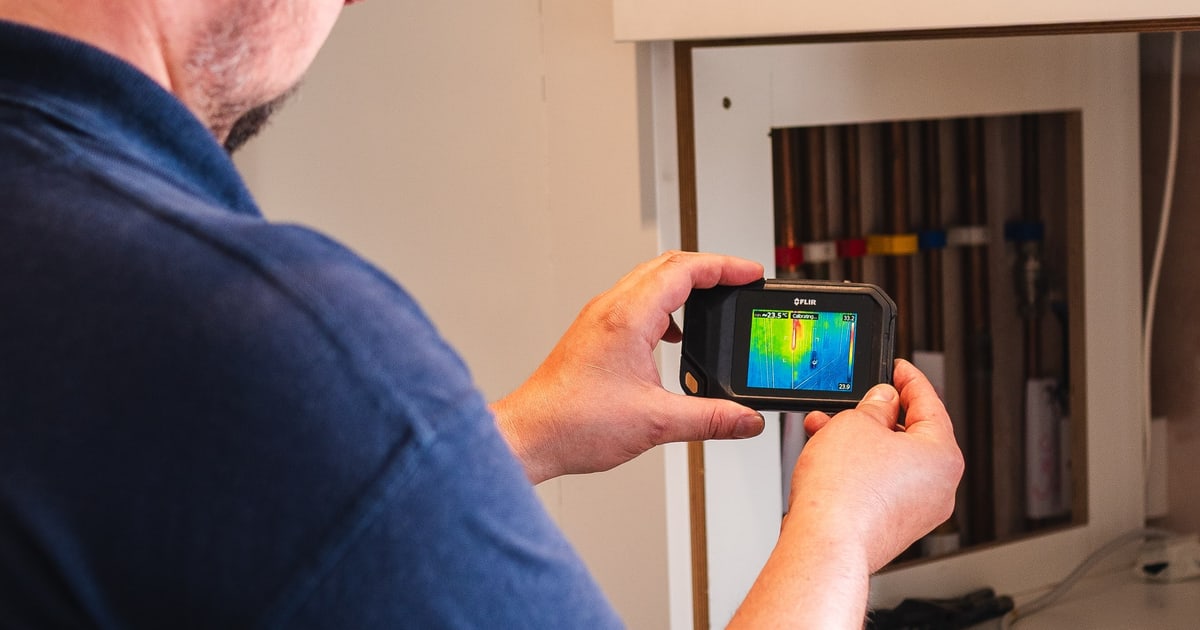
The central heating leak detection investigation used a staged approach, beginning with non-invasive surveys before moving to pressure testing to confirm and pinpoint the fault. Thermal imaging was carried out first, identifying a high temperature anomaly in the kitchen floor.
The pipe routes were then tracked throughout the property and no further anomalies were found. A protimeter damp survey corroborated the thermal findings, with the highest moisture readings concentrated in the same area.
Acoustic listening was then used and produced strong leak signals at the boiler and kitchen radiator. The system was drained and a compressor connected to feed 3 bar into the isolated pipework.
Pressure dropped quickly, confirming an active leak. A ground microphone survey was then conducted, which returned a clear acoustic profile in the same location as the thermal anomaly, giving a precise target point for excavation.
Thermal Imaging. Detected a high temperature reading on the kitchen floor and was used to track pipe routes throughout the property, revealing no anomalies elsewhere.
Damp Meter. Protimeter readings reached maximum wet levels across the kitchen floor and up the wall to worktop height, corroborating the thermal imaging findings.
Acoustic Listening. Produced strong leak signals at the boiler and kitchen radiator during the initial survey prior to pressure testing.
Pressure Testing. 3 bar was fed into the system with the boiler isolated; pressure dropped quickly, confirming an active leak in the pipework.
Ground Microphone. Used after pressure was applied to the isolated system, returning a clear acoustic profile directly over the same location as the thermal high temperature reading.
Investigation Process
-
1Thermal Imaging Survey
A thermal imaging survey was conducted across the property. A high temperature reading was identified on the kitchen floor, and pipe routes were tracked throughout the house with no other anomalies detected.
-
2Protimeter Damp Survey
Damp meter readings were taken and showed maximum wet levels at the kitchen floor, with elevated readings continuing up the wall to worktop height.
-
3Acoustic Listening Survey
An acoustic survey was performed and returned strong leak signals at the boiler and kitchen radiator.
-
4System Drained and Pressure Test Applied
The system was drained down, the boiler isolated, and a compressor used to feed 3 bar into the pipework. Pressure dropped quickly, confirming an active leak.
-
5Ground Microphone Survey
A second acoustic survey using the ground microphone was conducted under pressure and produced a clear leak profile in the same location as the thermal anomaly on the kitchen floor.
-
6Customer Excavation and Leak Found
The customer excavated the identified area himself. The leak point was found to be at a tee joint in the pipework beneath the kitchen floor.
-
7Repair and Pressure Test
The affected section of pipe was cut out and repaired using press fittings. The repair was pressure tested at 2 bar and held with no pressure loss over 45 minutes.
-
8System Refilled and Commissioned
The system was refilled, bled, and the heating turned on. An inhibitor was noted as needing to be added to the system.
Result & Outcome
The leak was located beneath the kitchen floor at a tee joint in the central heating pipework. All survey methods — thermal imaging, damp meter, acoustic listening, and the ground microphone under pressure — converged on the same point, giving a precise and confident target before any excavation took place. The customer carried out the excavation himself, exposing the faulty joint exactly where indicated.
The defective pipe section was cut out and replaced using press fittings. A pressure test at 2 bar held for 45 minutes with no drop, confirming the repair was sound. The system was then refilled, bled, and the heating run successfully.
For a property in SK10 dealing with a new boiler that couldn't hold pressure, this central heating leak detection survey resolved the fault with minimal disruption — the dig was targeted to a single location and the repair was completed the same visit. One outstanding recommendation remains: inhibitor needs to be added to the system to protect the pipework going forward.
Suspect a leak at your property?
ADI Leak Detection specialists investigate leaks like this across the UK every day. No find, no fee terms apply on qualifying jobs.