
Central Heating Leak Detection in Beith
A central heating leak in Beith was located using pressure testing, tracer gas, acoustic listening, thermal imaging, a damp meter, and an endoscope camera, with central heating leak detection confirming that rodents had chewed through pipe fittings in the bedroom radiator area, causing significant pressure loss alongside a passing PRV and dripping filling loop. Found by engineer Hamaad Janjua.




The original leak detection company, est. 2011
Facts
| Location | Beith |
|---|---|
| County | Ayrshire |
| Leak Type | Central Heating Leak Detection |
| Property Type | Residential property |
| Detection Method | Pressure Testing, Tracer Gas, Acoustic Listening Equipment, Thermal Imaging, Damp Meter, Endoscope Camera |
| Outcome | Leak found at bedroom radiator fittings chewed by rodents, repaired. |
Symptoms

The property in KA15 is a two-storey building heated by an oil boiler. The customer reported that the central heating system was losing pressure within five to seven hours, pointing to a leak somewhere in the system.
With no visible signs of water escaping at the surface, the source of the pressure loss was not immediately apparent, and a full central heating leak detection investigation was required.
Methods Used

Given the absence of any obvious surface leak, a structured central heating leak detection process was carried out across the property. Pressure testing was used to confirm that the system was indeed failing, establishing a baseline before equipment-led investigation began.
Gas detection and acoustic listening were then deployed to narrow down the location of the fault, with thermal imaging used to support findings in suspect areas.
Pressure Testing. Confirmed a system failure, establishing that the pressure loss was not simply a calibration or gauge issue but a genuine leak in the circuit.
Tracer Gas. Indicated a positive result at the bedroom radiator, directing attention to that specific area of the property.
Acoustic Listening Equipment. Produced readings consistent with the tracer gas findings at the bedroom radiator, reinforcing the identified leak location.
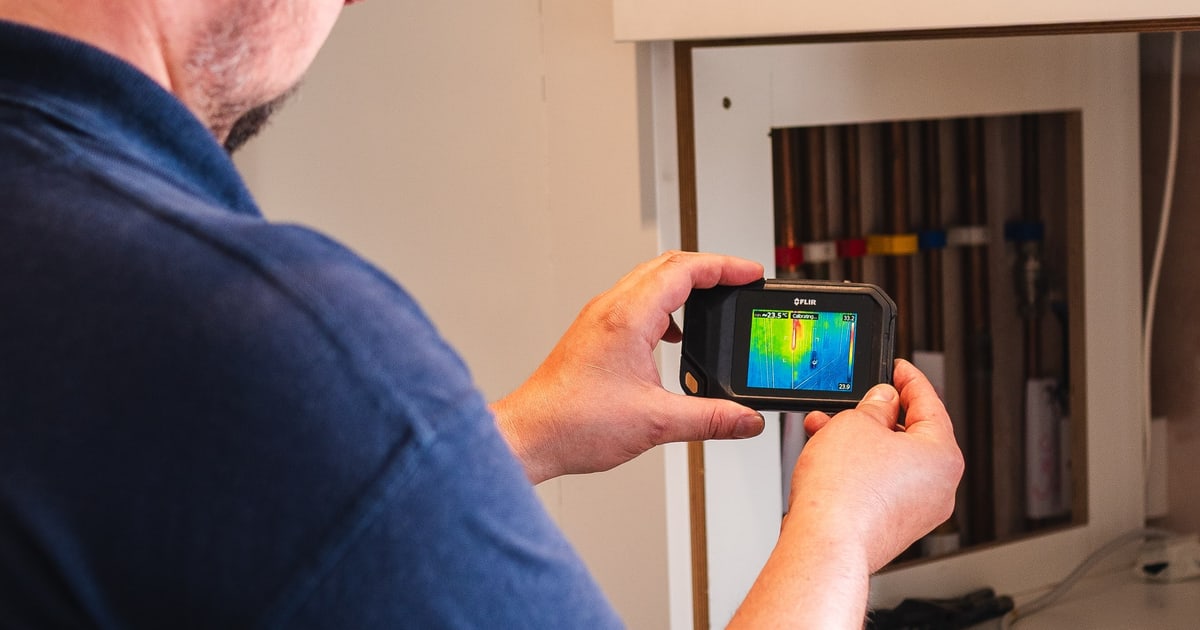
Thermal Imaging. Used to scan the suspect area and provide additional supporting evidence during the investigation around the bedroom radiator.
Damp Meter. Applied during the investigation to assess moisture levels in the structure around the affected area.
Endoscope Camera. Available to inspect confined or concealed spaces where direct visual access was not otherwise possible.
Investigation Process
-
1Initial Assessment
The property in KA15 was assessed and the customer's report of rapid pressure loss was noted. No visible leak was apparent, confirming that further investigation was needed.
-
2PRV and Filling Loop Inspection
The PRV was found to be slightly passing, and the filling loop had a small drip. Both were identified as contributing factors but not sufficient to account for the reported rate of pressure loss.
-
3Pressure Testing
A pressure test was carried out on the system and confirmed a failure, validating that a leak was present within the central heating circuit.
-
4Tracer Gas Detection
Gas detection equipment was used across the property and returned a positive result at the bedroom radiator, focusing the investigation on that area.
-
5Acoustic Listening
Acoustic readings were taken in the bedroom radiator area and were consistent with the tracer gas findings, further confirming the leak location.
-
6Thermal Imaging
Thermal imaging was applied in the identified area to provide additional supporting evidence ahead of access being made.
-
7Access and Discovery
With the customer's permission, access was made at the bedroom radiator location, where it was found that fittings had been chewed through by rodents.
-
8Repair Carried Out
The damaged fittings were cut back and repaired using appropriate fittings and inserts to restore the integrity of the pipework.
-
9Retest Confirmed Resolution
A successful retest was completed following the repair, confirming the system was holding pressure and the leak had been resolved.
Result & Outcome

The leak was traced to the bedroom radiator area, where rodents had chewed through pipe fittings. This was the primary cause of the significant pressure loss the system had been experiencing. The PRV passing and the filling loop drip were secondary issues identified alongside the main fault.
Suspect a leak at your property?
ADI Leak Detection specialists investigate leaks like this across the UK every day. No find, no fee terms apply on qualifying jobs.