
Water Mains Leak Detection in Wokingham
A cold mains leak in Wokingham was located using thermal imaging, tracer gas, a damp meter, and pressure testing, with water mains leak detection pinpointing the exact failure point at the kitchen wall so that excavation was kept to only the area required. Found by engineer Darren Smith.




The original leak detection company, est. 2011
Facts
| Location | Wokingham |
|---|---|
| County | Berkshire |
| Leak Type | Water Mains Leak Detection |
| Property Type | Residential property |
| Detection Method | Thermal Imaging, Tracer Gas, Damp Meter, Pressure Testing |
| Outcome | Leak found at kitchen wall, pipe renewed and pressure tested. |
Symptoms
A property in RG40 was showing clear signs of a water leak, with damp found throughout the kitchen floor and water damage to the lower 300mm of the walls. The laminate flooring was wet on arrival, pointing to an ongoing leak that had been present long enough to cause visible structural damage to the surrounding surfaces.
The water meter confirmed continuous usage with no water being drawn deliberately, and closing the internal stopvalve brought the meter to a halt. This isolated the source to the internal pipework rather than any external supply.
Internal leak detection was the appropriate course of action given the confined, finished nature of the kitchen environment and the need to pinpoint the fault before any unnecessary excavation.
Methods Used
Before any intrusive work was carried out, the hot water and heating system was isolated — an isolation valve was fitted on the supply to the feed and expansion cistern and the cold water storage cistern — so that the internal mains supply pipework could be tested in isolation. The pipework was then charged with tracer gas and a systematic sweep of the kitchen was carried out to identify where the gas was escaping.
Internal leak detection in a property with finished flooring and wall linings requires a methodical approach to avoid unnecessary disruption. A damp meter helped narrow the area of interest before the tracer gas pinpointed the specific location, allowing excavation to be targeted rather than exploratory.
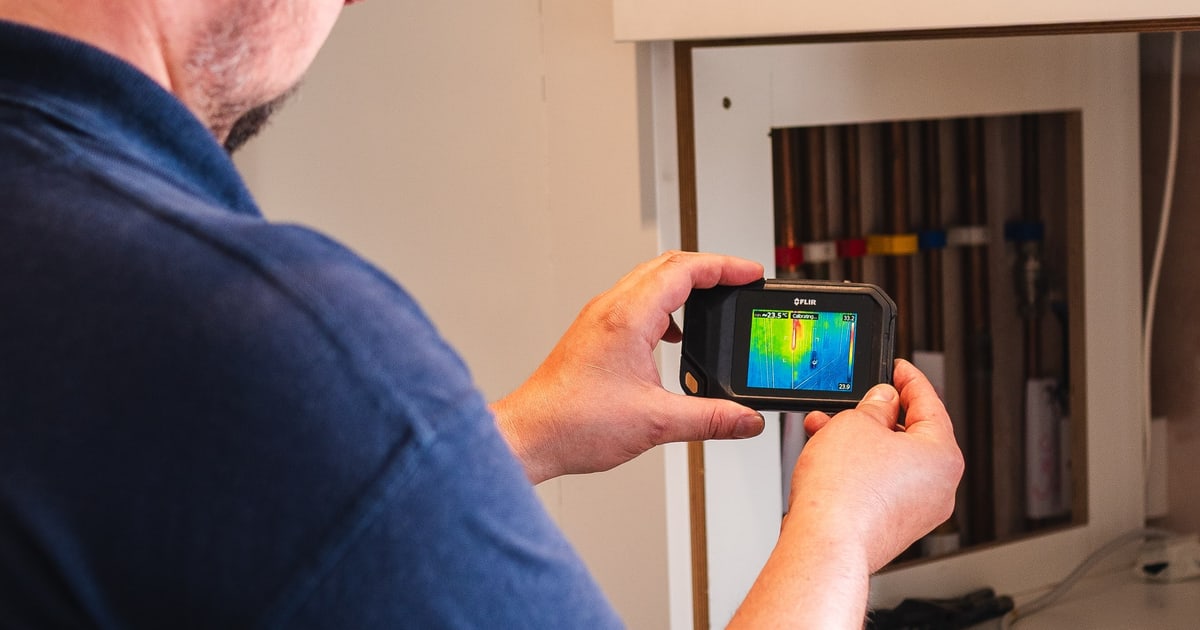
Thermal Imaging. Applied to the kitchen floor and walls to detect temperature differentials caused by escaping water, supporting the identification of the affected zone.
Tracer Gas. Introduced into the isolated mains supply pipework and detected at the right-hand wall of the kitchen, precisely locating the leaking section supplying the kitchen sink.
Damp Meter. Used to measure moisture levels across the kitchen floor and lower walls, confirming the extent of water ingress prior to excavation.
Pressure Testing. Applied to the mains supply pipework at 3 bar for 30 minutes both before the repair — confirming the leak — and after, confirming no further pressure loss and a sound repair.
Investigation Process
-
1Initial assessment
On arrival, the kitchen laminate floor was found to be wet and the lower 300mm of the walls showed water damage. The water meter was registering continuous usage.
-
2Stopvalve isolation test
The internal stopvalve was closed and the meter usage stopped, confirming the leak was within the internal pipework rather than the external supply.
-
3System isolation
Isolation valves were fitted to the supply lines serving the feed and expansion cistern and the cold water storage cistern, taking the hot water and heating system out of the equation and leaving the mains supply pipework ready for testing.
-
4Tracer gas pressure test
The internal mains supply pipework was charged with tracer gas. A leak was confirmed, and the gas was detected at the right-hand wall of the kitchen.
-
5Excavation and leak found
The area at the right-hand wall was excavated, exposing a leaking section of pipework that supplies the kitchen sink.
-
6Repair carried out
The leaking section was cut out and renewed using a 15mm coupling, a 15mm isolation valve, and 1 metre of 15mm tube.
-
7Post-repair pressure test
The repaired mains was pressure tested at 3 bar for 30 minutes with no loss of pressure recorded, confirming the repair was sound.
-
8Reinstatement
The water supply was reinstated and the pipework was flushed through to clear any residual tracer gas or debris.
Result & Outcome
The leak was located at the right-hand wall of the kitchen, where a section of pipework supplying the kitchen sink had failed. Tracer gas detection identified the precise point, meaning excavation was limited to the area that needed it rather than speculative opening-up of the floor across a wider zone.
The damaged section was cut out and replaced with new 15mm pipework, fittings, and an isolation valve. A 30-minute pressure test at 3 bar with no pressure drop confirmed the integrity of the repair before the supply was restored.
For a property in RG40 with this level of floor and wall damage, a precise internal leak detection outcome like this matters — the leak source was confirmed, the repair was contained to a defined area, and the installation was verified under pressure before work was signed off.
Suspect a leak at your property?
ADI Leak Detection specialists investigate leaks like this across the UK every day. No find, no fee terms apply on qualifying jobs.