
Internal Cold Mains Leak Detection in Lofthouse
A cold mains leak in Lofthouse was located using thermal imaging, a damp meter, pressure testing, tracer gas, and an endoscope camera, with water mains leak detection confirming the source as a push-fit tap connector in the ceiling void beneath the bathroom floor. The work was carried out by engineer Matthew Barron.




The original leak detection company, est. 2011
Facts
| Location | Lofthouse |
|---|---|
| County | West Yorkshire |
| Leak Type | Water Mains Leak Detection |
| Property Type | Residential property |
| Detection Method | Thermal Imaging, Damp Meter, Pressure Testing, Tracer Gas, Endoscope Camera |
| Outcome | Leak found at push fit connector in ceiling void, repaired. |
Symptoms

The occupant of a property in WF3 noticed water dripping from the ceiling near the entrance of the property. Visible water damage had developed in that area, and the customer directed the engineer to the affected zone on arrival.
Notably, the boiler was showing no loss of pressure, which helped narrow the source away from the heating circuit and pointed toward a cold water supply issue.
With water actively dripping from the ceiling and no obvious external cause, internal leak detection was required to trace the origin of the moisture through what was evidently a concealed section of pipework above the entrance area.
Methods Used

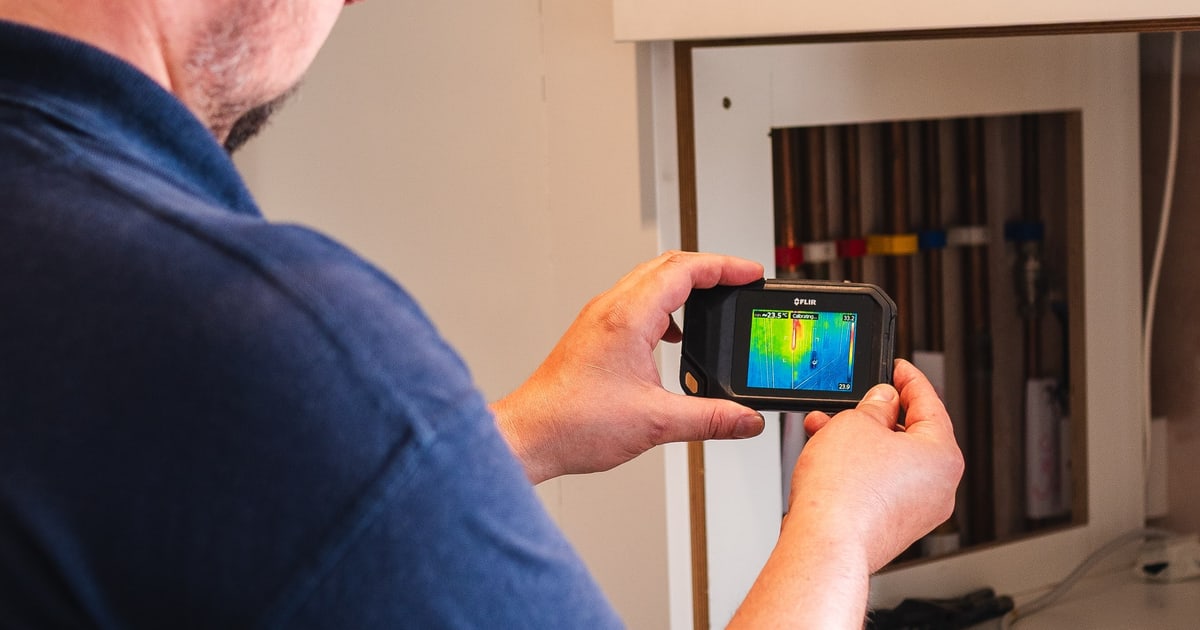
The investigation began with a thermal imaging survey of the water-damaged area to identify cold anomalies within the structure. Moisture readings were then taken across the ceiling and walls at the entrance, returning high levels of moisture in both surfaces.
A pressure test was carried out on the internal pipework, which failed, prompting a tracer gas test across the internal system. Tracer gas was detected in the bathroom directly above the area of water damage, concentrating the search in that zone.
An endoscope camera was then used to inspect the ceiling cavity from below. Water escape was identified and recorded on video at a push fit tap connector in that void.
This sequence — standard practice in internal leak detection — allowed the leak to be confirmed visually before any access was made, ensuring that both ceiling and subfloor openings were targeted precisely.
Thermal Imaging. Used to survey the damaged area and identify cold anomalies in the ceiling and wall surfaces near the entrance.
Damp Meter. Taken across the ceiling and walls by the entrance, returning high moisture readings that confirmed active water saturation.
Pressure Testing. Applied to the internal pipework to assess integrity; the test failed, indicating a breach somewhere on the internal supply.
Tracer Gas. Introduced to the internal pipework after the pressure test failure; gas was detected in the bathroom above the water damage, pinpointing the area of the leak.
Endoscope Camera. Inserted into the ceiling cavity to inspect for water escape; the leak at the push fit tap connector was located and recorded on video.
Investigation Process
-
1Initial Assessment
On arrival, the customer showed the engineer the water-damaged area and the water dripping from the ceiling near the entrance. The customer confirmed there had been no pressure loss on the boiler.
-
2Thermal Imaging Survey
A thermal CCTV survey was carried out across the area of water damage. Cold anomalies were identified within the structure.
-
3Moisture Readings
Damp meter readings were taken across the ceiling and walls at the entrance. High levels of moisture were recorded in both surfaces.
-
4Internal Pressure Test
A pressure test was conducted on the internal pipework. The test failed, confirming a breach on the internal system.
-
5Tracer Gas Test
Following the failed pressure test, tracer gas was introduced to the internal pipework. Gas was detected in the bathroom directly above the area of water damage.
-
6Endoscope Camera Inspection
The endoscope camera was used to inspect the ceiling cavity. Water escape was found and recorded on video at a push fit tap connector.
-
7Access and Repair
Access was made to the ceiling at the entrance and to the subfloor in the bathroom above. A new 3/4 to 22mm push fit tap connector, 50cm in length, was installed to complete the repair.
Result & Outcome

The leak was traced to a push fit tap connector located in the ceiling void beneath the bathroom floor, directly above the entrance area where water damage had been presenting. The connector was recorded on video via the endoscope camera before any physical access was taken, confirming the precise location and avoiding unnecessary disruption elsewhere in the property.
Access was made to the ceiling at the entrance and to the subfloor in the bathroom above. The faulty connector was replaced with a new 3/4 to 22mm push fit tap connector, 50cm in length, completing the repair at source.
As an outcome of this internal leak detection job, the engineer noted that wood rot had been identified as part of the water damage present. A full investigation and remediation of all affected materials is recommended to prevent structural deterioration — the repair to the pipework alone does not address the damage already sustained by the surrounding structure.
Suspect a leak at your property?
ADI Leak Detection specialists investigate leaks like this across the UK every day. No find, no fee terms apply on qualifying jobs.