
Internal Cold Mains Leak Detection in Abingdon
A cold mains leak in Abingdon was located using thermal imaging, a damp meter, tracer gas, pressure testing, acoustic listening, and visual inspection, confirming water mains leak detection on ageing internal pipework that had leaked on two separate occasions, with a full replacement recommended given the realistic prospect of further failures. Found by engineer Gabor Weber.




The original leak detection company, est. 2011
Facts
| Location | Abingdon |
|---|---|
| County | Oxfordshire |
| Leak Type | Water Mains Leak Detection |
| Property Type | Residential property |
| Detection Method | Thermal Imaging, Damp Meter, Tracer Gas, Pressure Testing, Acoustic Listening Equipment, Visual Inspection |
| Outcome | Cold feed pipe leak found and repaired beneath bathroom floor. |
Symptoms

With moisture present in the corridor and no obvious visible source, internal leak detection was the appropriate course of action to systematically identify which circuit was responsible and precisely where the leak was occurring. The age of the pipework — approximately 40 years old — made a pipe failure a credible cause from the outset.
Methods Used

With damp present in two areas, the heating system was drained and pressurised with tracer gas introduced to test for escapes at the damp locations — none were detected. Pressure tests were then carried out separately on the hot feed, the heating circuit, and the cold feed.
The hot feed and heating circuit both held pressure, but the cold feed failed its pressure test. Acoustic equipment was then deployed over the bathroom floor, where an anomaly was detected, guiding the decision to open the floor at that specific point.
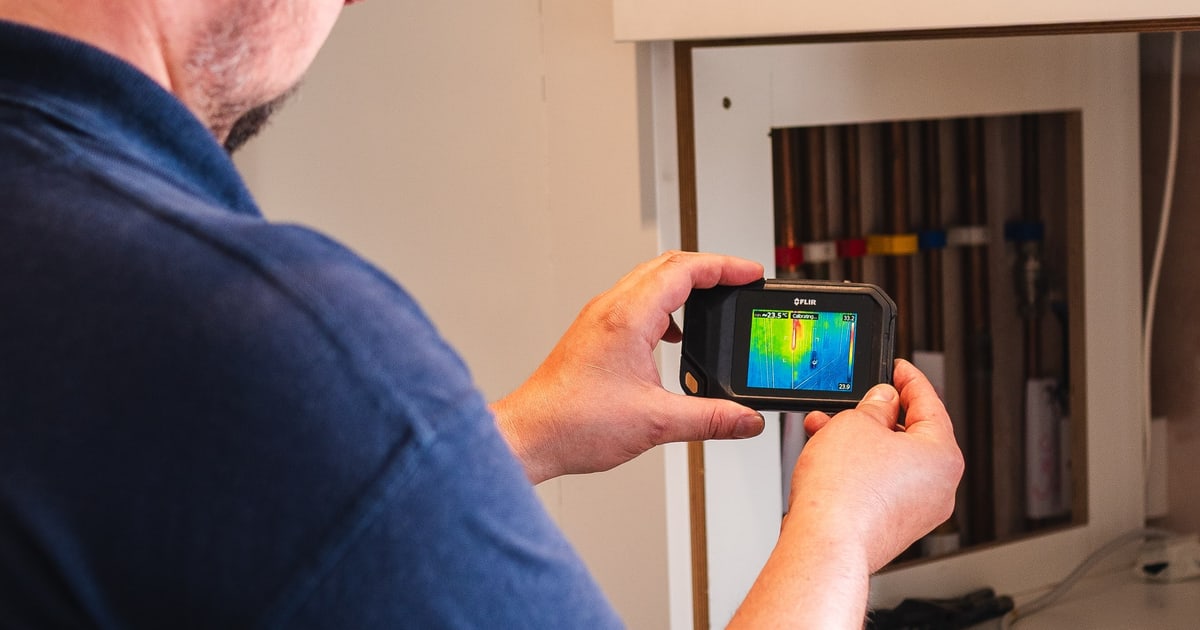
Thermal Imaging. Used to trace pipework runs beneath the floor and identify a thermal anomaly on the corridor floor that indicated abnormal heat or moisture distribution.
Damp Meter. Used to take readings at the thermal anomaly on the corridor floor and on the bathroom floor, confirming high moisture levels in both areas.
Tracer Gas. Introduced into the drained heating system and used to test whether gases escaped at the damp areas on the corridor and bathroom floors — no detection was recorded.
Pressure Testing. Applied separately to the hot feed, heating circuit, and cold feed to isolate which circuit was leaking — the cold feed failed, indicating that circuit as the source.
Acoustic Listening Equipment. Used over the bathroom floor after the cold feed failed pressure testing, detecting an acoustic anomaly that confirmed the precise location of the leak beneath the tiles.
Visual Inspection. Carried out after excavation of the bathroom tiles and concrete floor to directly identify and assess the leaking section of 15 mm copper pipe.
Investigation Process
-
1Initial assessment
Upon arrival, the engineer was informed of dampness on the corridor wooden floor. Thermal imaging was carried out to map pipework runs and identify any thermal anomalies beneath the floor.
-
2Thermal anomaly and damp meter readings
A thermal anomaly was detected on the corridor floor. High damp meter readings were recorded at that anomaly and also on the bathroom floor.
-
3Tracer gas test
The heating system was drained, an air compressor was used to clear it, and tracer gas was introduced. No gas was detected at the damp areas, ruling out the heating circuit as the source.
-
4Pressure test — hot feed
A pressure test was carried out on the hot feed pipework. The test passed, indicating no leak on that circuit.
-
5Pressure test — heating system
A pressure test was carried out on the heating system circuit. The test passed, indicating no leak on that circuit.
-
6Pressure test — cold feed
A pressure test was carried out on the cold feed. The test failed, confirming a leak was present on the cold feed pipework.
-
7Acoustic detection
Acoustic equipment was deployed over the bathroom floor. An acoustic anomaly was detected, identifying the precise area where the leak was located beneath the floor.
-
8Floor excavation and leak found
Bathroom tiles and the concrete floor were opened up. A leaking 15 mm copper pipe was found beneath the bathroom floor.
-
9Repair carried out
The leaking section of 15 mm copper pipe was replaced using new copper pipe and fittings.
-
10Post-repair pressure test
On completion of the repair, the pipework was pressure tested at 4 bar for 20 minutes. The test passed, indicating no further leaks at the time of testing.
Result & Outcome

The engineer noted that the pipework is approximately 40 years old and has now leaked on two separate occasions. A recommendation was made to replace the pipework in full, as further failures on pipework of this age are a realistic prospect.
Suspect a leak at your property?
ADI Leak Detection specialists investigate leaks like this across the UK every day. No find, no fee terms apply on qualifying jobs.