
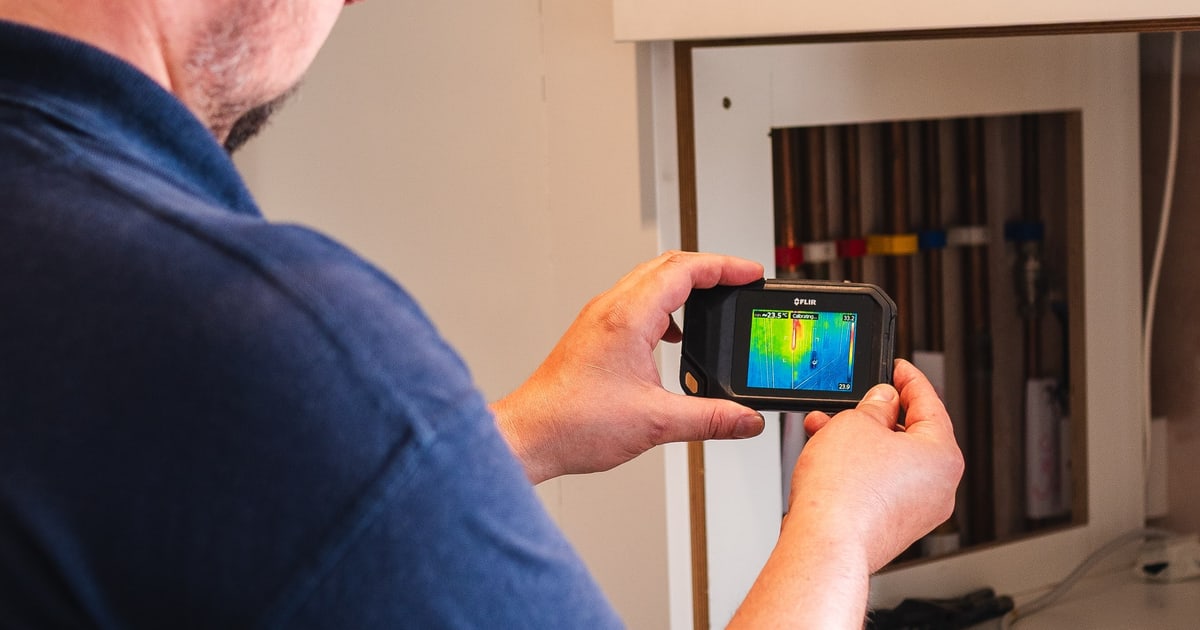
Underground Water Mains Leak Detection in Wilmslow
A underground mains leak in Wilmslow was located using endoscope camera, pressure testing, tracer gas, acoustic listening, and visual inspection, confirming water mains leak detection beside the external water meter at the front of the property. Found by engineer Phillip Whitehouse.




The original leak detection company, est. 2011
Facts
| Location | Wilmslow |
|---|---|
| County | Cheshire |
| Leak Type | Water Mains Leak Detection |
| Property Type | Residential property |
| Detection Method | Endoscope Camera, Pressure Testing, Tracer Gas, Acoustic Listening Equipment, Visual Inspection |
| Outcome | Leak found beside external meter, cross-threaded fitting replaced. |
Symptoms
The property in SK9 is a detached house fitted with an unvented cylinder and multiple stop taps — one internal stop tap in the garage, one behind the cloakroom basin, and an external stop tap on the front driveway. A suspected leak on the incoming water mains had already been investigated on a prior visit, but that inspection returned no conclusive results, prompting a second visit to carry out a more thorough assessment.
The property's pipework layout added complexity to the investigation. The incoming mains ran beneath the hallway floor and it appeared likely that the two supply points were joined together under the concrete kitchen floor — a section of pipework that could not be directly accessed or visually inspected.
This made it impossible to pinpoint the fault through observation alone.
For a water mains leak detection job like this — where the pipe route runs through inaccessible voids and under concrete — pressure testing combined with tracer gas provides the most reliable path to a confirmed result. That approach was adopted for this visit.
Methods Used

The investigation began by removing the downstairs cloakroom basin to access the secondary stop tap located behind it, then using an endoscope camera to trace the route of the incoming mains beneath the hallway floor. A floorboard was lifted to expose the pipe, but the tee-in point could not be located, pointing toward a junction concealed under the concrete kitchen floor.
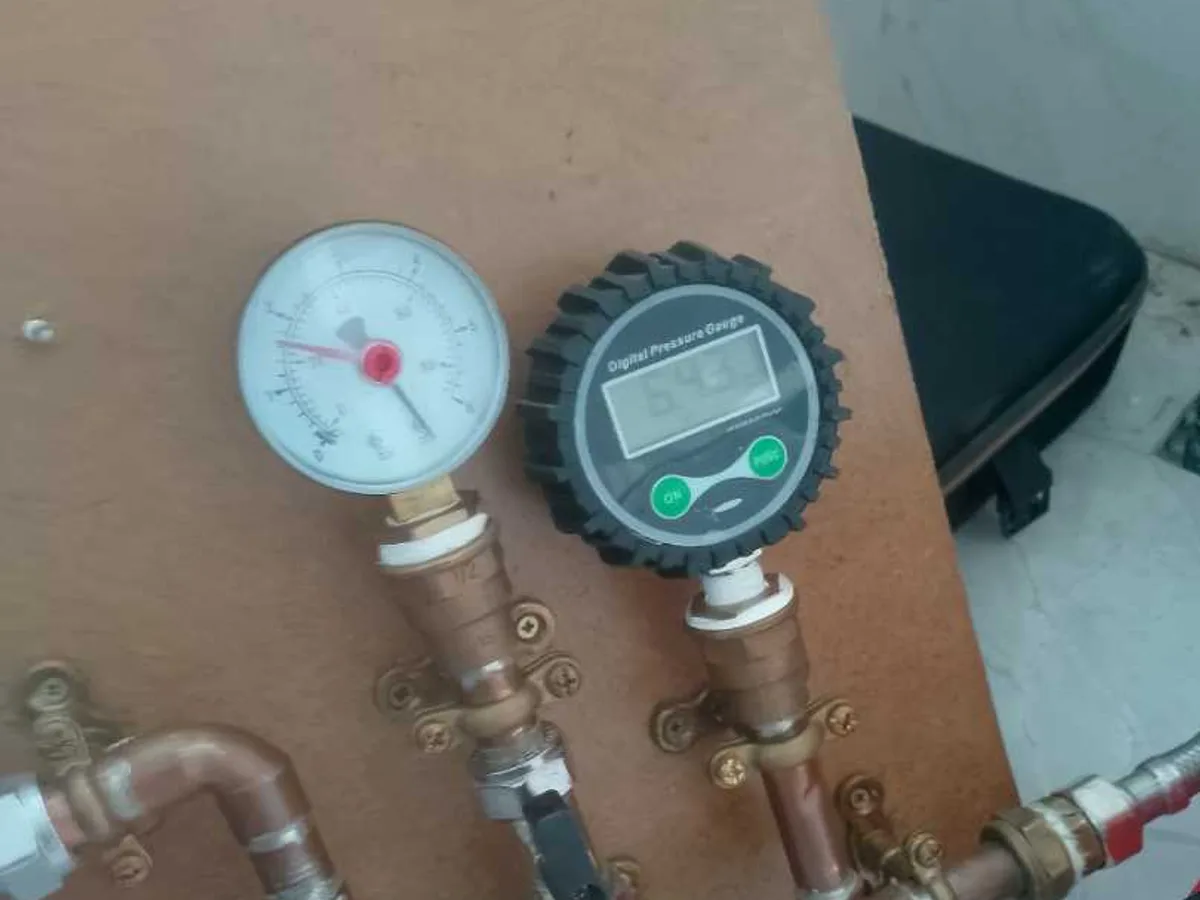
Pressure testing was then carried out on the cloakroom mains, which confirmed a continuing pressure loss matching the previous visit's findings.
Tracer gas was introduced into the system and the mains were emptied via the garage stop tap. A full tracer gas survey was conducted across the relevant ground area.
High gas readings were detected immediately beside the external meter, and acoustic testing was applied to the same location to corroborate the finding before any excavation took place. Tracer gas is a well-established tool in water mains leak detection precisely because it reaches the surface even through compacted ground, making it reliable when a leak is too deep or too small to produce audible signals alone.
Endoscope Camera. Used to trace the route of the incoming water mains beneath the hallway floor and confirm the pipe's position before lifting a floorboard.
Pressure Testing. Applied to the cloakroom mains supply to confirm pressure loss, corroborating the results of the previous visit and establishing that an active leak was present.
Tracer Gas. Introduced into the mains after emptying via the garage stop tap; high readings detected at the surface directly beside the external meter identified the leak location.
Acoustic Listening Equipment. Used at the location flagged by tracer gas to acoustically confirm the leak position beside the external meter before excavation began.
Visual Inspection. Carried out once the excavation was opened to identify the defective fitting and assess the nature of the failure.
Investigation Process
-
1Cloakroom basin removed
The downstairs cloakroom basin was removed to gain access to the secondary stop tap located behind it, which was needed to isolate and test the mains supply from that point.
-
2Camera survey of mains route
An endoscope camera was used to trace the incoming mains beneath the property. The pipe was found running from the hallway and a floorboard was lifted, but the tee-in point could not be located — likely concealed under the concrete kitchen floor.
-
3Pressure test carried out
Pressure testing equipment was connected to the cloakroom mains. The results confirmed pressure loss, consistent with the findings from the previous visit.
-
4Tracer gas introduced
Tracer gas was introduced into the system and the mains were emptied via the garage stop tap in preparation for the gas survey.
-
5Tracer gas survey conducted
A survey of the ground was carried out and high tracer gas readings were detected directly beside the external meter, indicating the likely leak position.
-
6Acoustic testing applied
Acoustic testing was performed at the location identified by tracer gas, confirming the same spot and providing sufficient confidence to proceed with excavation.
-
7Excavation and leak found
The area beside the external meter was excavated. The leak was found on a fitting that had been badly cross-threaded during installation, causing it to snap at the thread and fail.
-
8Repair carried out and tested
The defective fitting was removed and replaced with a 25mm–22mm reducing coupler. The repair was pressure-tested and confirmed sound, and the excavation was backfilled.
Result & Outcome

The leak was located beside the external water meter at the front of the property in SK9. Excavation revealed a fitting that had been badly cross-threaded during its original installation by the water board, causing it to snap at the thread and fail. This was not a case of pipe deterioration or ground movement — the fault was directly attributable to incorrect installation.
The defective fitting was removed and replaced with a 25mm–22mm reducing coupler. A pressure test following the repair confirmed the joint was sound, and the excavation was backfilled. The repair resolves the leak entirely, and the water mains supply is now holding pressure correctly.
For a water mains leak detection job of this type — where the mains route is partially inaccessible and the leak is close to the boundary — the combination of tracer gas and acoustic testing is the most efficient way to arrive at a precise dig location without unnecessary excavation. Given that the fault originated from a water board installation, the customer has been advised to contact the water board to discuss the matter.
Suspect a leak at your property?
ADI Leak Detection specialists investigate leaks like this across the UK every day. No find, no fee terms apply on qualifying jobs.