
Internal Cold Mains Leak Detection in Alexandria
An internal cold mains leak in Alexandria was located beneath hallway floorboards using acoustic listening, thermal imaging, a damp meter, visual inspection, sectional isolation, tracer gas, and an endoscope camera, with water mains leak detection confirming the source at a stop valve on a dead-leg section of pipework and identifying a secondary concern on a capped-off redundant waste pipe in the same area. Found by engineer Hamaad Janjua.




The original leak detection company, est. 2011
Facts
| Location | Alexandria |
|---|---|
| County | Dunbartonshire |
| Leak Type | Water Mains Leak Detection |
| Property Type | Residential property |
| Detection Method | Acoustic Listening Equipment, Thermal Imaging, Damp Meter, Visual Inspection, Sectional Isolation, Tracer Gas, Endoscope Camera |
| Outcome | Leak found beneath hallway floor on stop valve, repaired. |
Symptoms
A property in G83, situated within a block of eight, was the subject of a complaint from the neighbour living directly below — a constant drip had developed into her hallway ceiling, pointing to an active leak somewhere within or beneath the upper flat. The block presented significant infrastructure challenges: only two external stopcocks served all eight properties, and the customer held the only accessible internal stopcock, with no clear indication of which sections of pipework it controlled or how the mains route was configured through the building.
With no internal stop valves available in the other properties and no means of contacting or obtaining permission from neighbouring households, the scope of the investigation was necessarily focused on what could be safely accessed and tested within the customer's flat. Internal leak detection was the appropriate service given these constraints, and the investigation was structured accordingly — working through isolatable sections of the property's pipework to locate the source of the drip reported below.
Additional concerns were noted during the visit: a minor weep was observed on the cold pipe beneath the boiler, and a puddle was found under the sink, suggesting either a washing machine or hose fault or a problem with the sink waste pipework. Neither of these alone appeared sufficient to account for the volume of water reaching the neighbour's hallway.
Methods Used

Given the complexity of the external mains arrangement — no mapped route, no accessible stop valves in neighbouring properties, and no permission from other households — external mains pipe testing was ruled out. The investigation concentrated on the internal mains, which was tested and passed, before moving to a systematic inspection of the customer's property using acoustic testing, thermal imaging, and moisture meter surveys to trace the source of water reaching the floor below.
Two stopcocks within the property were identified, each isolating different zones, allowing sections of pipework to be checked independently. A moisture meter test produced a high reading in the hallway directly above where the neighbour was experiencing the drip — this focused attention on that area.
With the customer's permission, floorboards were lifted to carry out a direct inspection. The internal leak detection process identified a leak on what appeared to be a stop valve on a dead-leg section, alongside a capped-off redundant waste pipe, both concealed beneath the hallway floor.
Repairs were carried out on site, and a visual retest confirmed the repaired area as leak free.
Acoustic Listening Equipment. Used to listen for active leak noise through the floor structure, helping to direct attention toward the hallway area above the neighbour's drip.
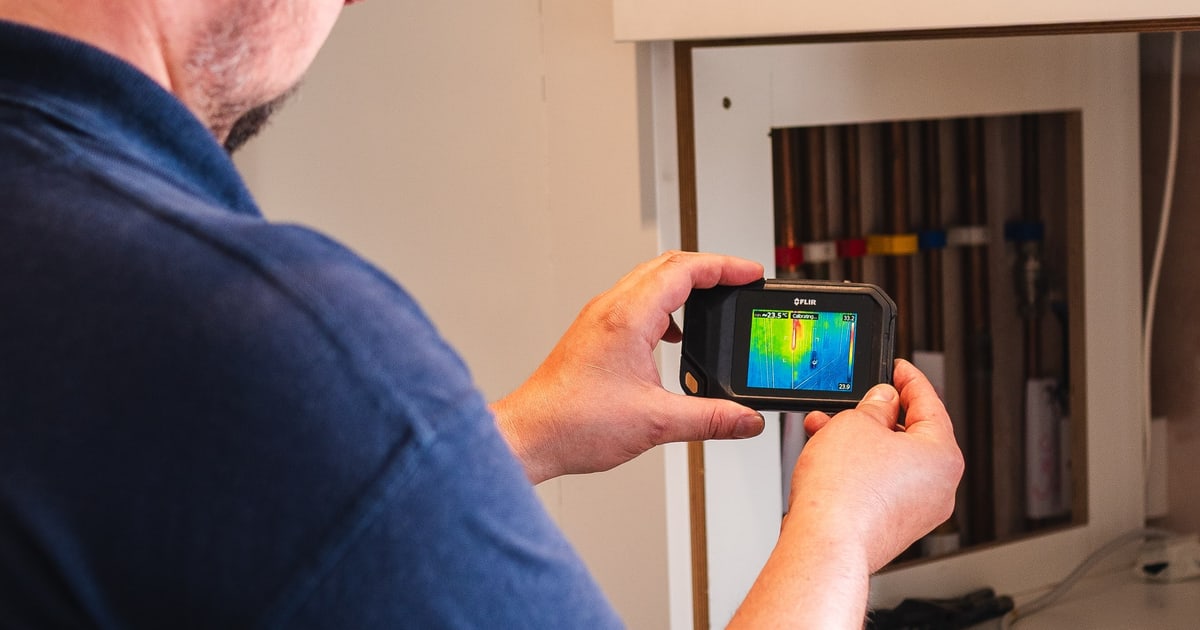
Thermal Imaging. Applied to identify temperature anomalies in the floor and surrounding surfaces that could indicate moisture movement or active water egress beneath the boards.
Damp Meter. Produced a high moisture reading in the hallway floor directly above the neighbour's reported drip, providing the clearest on-site indicator of leak location before floorboards were lifted.
Visual Inspection. Carried out after floorboards were lifted to directly identify the leaking stop valve and redundant capped waste pipe beneath the hallway floor.
Sectional Isolation. The two internal stopcocks were used to isolate different sections of the property's pipework, allowing the internal mains to be tested independently and ruling it out as the leak source.
Tracer Gas. Available on site as part of the detection toolkit for potential use on concealed pipework where other methods required supplementary confirmation.
Endoscope Camera. Available on site to inspect confined or inaccessible sections of pipework where direct visual access was limited.
Investigation Process
-
1Site assessment and infrastructure review
The block of eight properties was assessed on arrival. With only two external stopcocks serving all properties and no internal stop valves accessible in neighbouring flats, the scope of investigation was defined as internal to the customer's property.
-
2External mains testing ruled out
Due to the unknown route of the external mains pipe, absence of accessible stop valves, and lack of permission from other households, external mains pipe testing was not possible.
-
3Internal mains tested and passed
The internal mains within the customer's property was tested using sectional isolation. It passed, eliminating the mains supply as the source of the leak.
-
4Two internal stopcocks identified and zones mapped
Two stopcocks were located within the property, each isolating different areas. These were used to define testable zones for the remainder of the investigation.
-
5Minor weep identified beneath boiler
A small weep was observed on the cold pipe fitting beneath the boiler. This was noted but assessed as insufficient on its own to account for the drip affecting the property below.
-
6Puddle found under sink
A puddle of water was discovered beneath the sink, suggesting a possible fault with the washing machine, hose, or the sink waste pipework.
-
7Acoustic testing and damp meter survey undertaken
Acoustic testing was carried out across the property, and a moisture meter survey was conducted. A high damp reading was returned in the hallway floor, directly above the location of the neighbour's reported drip.
-
8Floorboards lifted in hallway
With the customer's permission, the hallway floorboards were lifted to allow direct inspection of the pipework beneath.
-
9Leak identified on stop valve and redundant waste pipe
A leak was found on what appeared to be a stop valve on a dead-leg section of pipework, alongside a capped-off redundant waste pipe, both located beneath the hallway floor and potentially connected to the neighbouring property.
-
10Repairs carried out and visually retested
Permission was granted and repairs were completed. Due to limited accessibility, a full pressure retest was not possible; however, a visual retest confirmed the repaired area was leak free.
Result & Outcome

The leak was located beneath the hallway floorboards — on a stop valve serving a dead-leg section of pipework, with a secondary concern identified on a capped-off redundant waste pipe in the same area. Both were concealed under the floor and, given their position directly above the neighbour's reported drip, consistent with the damp pattern that had been developing below. Pipework was cut back and new fittings installed on site.
The internal leak detection process resolved the immediate cause of the drip, and a visual retest following the repair confirmed no further water egress at that location. Full pressure testing was not possible due to access constraints, but the repaired area was assessed as satisfactory within the limits of what could be inspected.
Several further actions are recommended to prevent recurrence: the dead-leg section and redundant waste pipe should be fully cut back and capped as far back as possible; the minor weep on the cold pipe beneath the boiler and the washing machine fault should be addressed promptly; protective measures must be applied when the flooring is relaid, ideally by a professional joiner, given the proximity of pipework to floor level; and a single main stop valve should be installed within the property to allow full isolation of the water supply when required.
Suspect a leak at your property?
ADI Leak Detection specialists investigate leaks like this across the UK every day. No find, no fee terms apply on qualifying jobs.