
Water Mains Leak Detection in Coventry
A cold mains leak in Coventry was located using flow metering, pressure testing, tracer gas, thermal imaging, and a damp meter, with water mains leak detection confirming the source in the hallway outside the bathroom door where supply pipework had been physically damaged. The work was carried out by engineer Darren Smith.




The original leak detection company, est. 2011
Facts
| Location | Coventry |
|---|---|
| County | West Midlands |
| Leak Type | Water Mains Leak Detection |
| Property Type | Residential property |
| Detection Method | Flow Metering, Pressure Testing, Tracer Gas, Thermal Imaging, Damp Meter |
| Outcome | Hot supply pipe leak located in hallway and repaired. |
Symptoms
At a property in CV5, water was pooling in the cupboard beneath the staircase, and both the hallway and bathroom floors were uniformly damp. The source was not immediately obvious — the symptoms could have pointed to a supply pipe leak, a leaking WC cistern, or a failing heating system.
The combination boiler was losing pressure over a two-week period, which raised the possibility of a central heating leak. However, given the volume of water present on the floors, it was assessed as unlikely that such a slow pressure loss was responsible.
The engineer advised the customer that a pressure loss of at least 1.5 bar over 24 hours would be required before the heating system could be meaningfully investigated as the source.
This job required full internal leak detection to isolate and identify the source or sources of the leak before any repair could be planned.
Methods Used
The investigation began by establishing which system was losing water. The water meter was monitored with the internal stop valve open and then closed, confirming the leak was on the internal supply pipework rather than the external mains.
The hot water and heating circuits were then separated from the cold mains for individual pressure testing.
Pressure testing at 4 bar for 30 minutes was applied to the external mains, internal mains, and hot supply pipework in sequence. A leak from the ball valve in the WC cistern was identified first; once the servicing valve to the WC was closed, a separate fault was confirmed on the hot supply pipework.
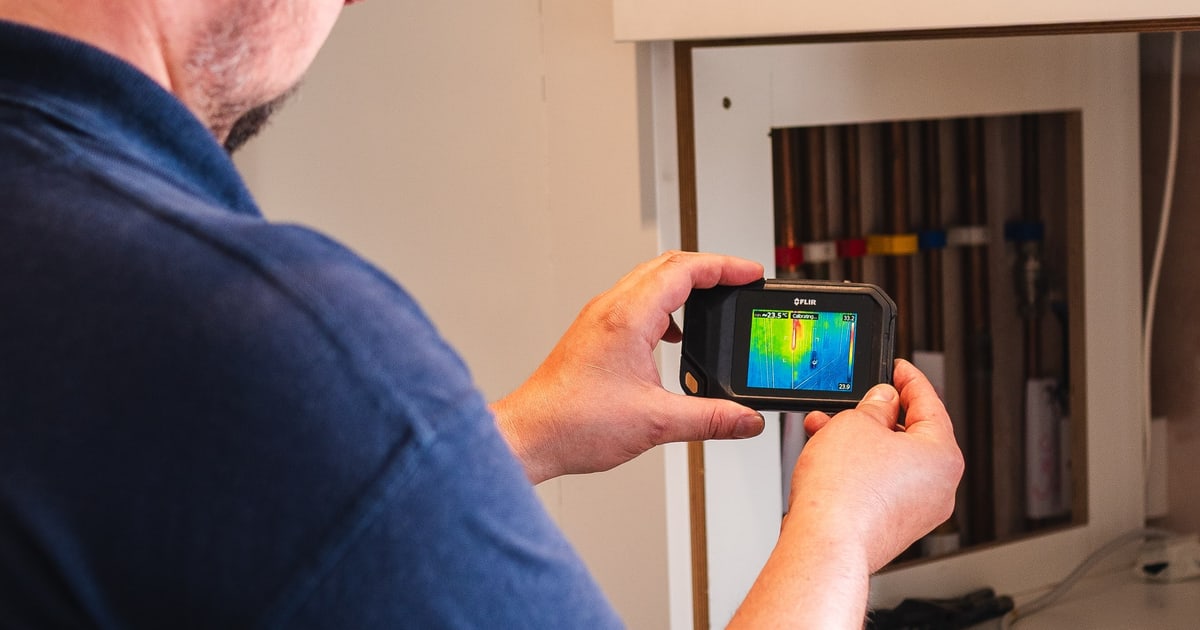
Tracer gas was introduced at the kitchen sink, and a gas trace was detected almost immediately in the hallway outside the bathroom door. Thermal imaging was then used to track the pipework route and pinpoint the precise location for excavation.
This methodical approach is what internal leak detection requires when multiple potential sources are present.
Flow Metering. Used to confirm continuous water usage at 6 litres per hour with the stop valve open, and zero usage when the valve was closed, establishing the leak was on the internal supply pipework.
Pressure Testing. Applied at 4 bar for 30 minutes to the external mains, internal mains, and hot supply pipework individually to isolate which circuit was leaking.
Tracer Gas. Introduced into the hot supply pipework at the kitchen sink; a gas trace was detected almost immediately in the hallway outside the bathroom door, indicating the leak was in that area.
Thermal Imaging. Used to track the route of the hot supply pipework through the structure and confirm the precise point for excavation.
Damp Meter. Used to assess the extent of moisture in the hallway and bathroom floors to support interpretation of the leak's location and spread.
Investigation Process
-
1Water meter monitored
The water meter was checked with the internal stop valve open and then closed. Continuous usage of 6 litres per hour dropped to zero when the valve was closed, confirming the leak was on the internal supply pipework.
-
2Heating system assessed
The combination boiler was noted to be losing pressure over two weeks. Given the volume of water on the floors, this was assessed as insufficient to be the primary cause, and the customer was advised of the threshold required to investigate the heating circuit further.
-
3Individual pressure tests carried out
The external mains, internal mains, and hot supply pipework were each pressure tested at 4 bar for 30 minutes to isolate the faulty circuit.
-
4WC cistern ball valve fault identified
A leak from the ball valve in the WC cistern was located during testing. The servicing valve to the WC was closed to isolate this fault and allow continued testing of the remaining circuits.
-
5Fault confirmed on hot supply pipework
With the WC isolated, pressure testing confirmed a separate leak on the hot supply pipework.
-
6Tracer gas introduced
Tracer gas was introduced into the hot supply pipework at the kitchen sink. A gas trace was detected almost immediately in the hallway outside the bathroom door.
-
7Thermal imaging used to track pipework
The pipework route was tracked using thermal imaging, confirming the location in the hallway and guiding the excavation.
-
8Area excavated, leak exposed
The area was excavated, exposing the leaking copper tube. The damage appeared to have been caused by physical impact during the original installation.
-
9Leaking section cut out and renewed
The damaged section of pipe was removed and replaced using two 15mm couplings, one 15mm elbow, and 2 metres of 15mm copper tube.
-
10Post-repair pressure test passed
A pressure test at 4 bar for 30 minutes was carried out on the repaired pipework with no pressure loss, confirming a sound repair.
-
11Supply reinstated and pipework flushed
The water supply was reinstated and the pipework was thoroughly flushed. The customer was advised to replace the ball valve in the WC cistern.
Result & Outcome
The leak was located in the hallway outside the bathroom door, where the hot supply pipework had been physically damaged during the original installation. The combination of tracer gas detection and thermal imaging pinpointed the location precisely enough to excavate directly to the pipe without unnecessary disruption.
The damaged section was cut out and replaced. A post-repair pressure test at 4 bar for 30 minutes confirmed no further loss of pressure. The supply was reinstated and the pipework flushed before the job was completed.
For this internal leak detection case, two separate faults were identified: the repaired pipe leak and an outstanding ball valve fault in the WC cistern. The customer has been advised to replace the WC cistern ball valve as a separate follow-up item. Once that is addressed, both sources of water loss at the property will have been resolved.
Suspect a leak at your property?
ADI Leak Detection specialists investigate leaks like this across the UK every day. No find, no fee terms apply on qualifying jobs.