
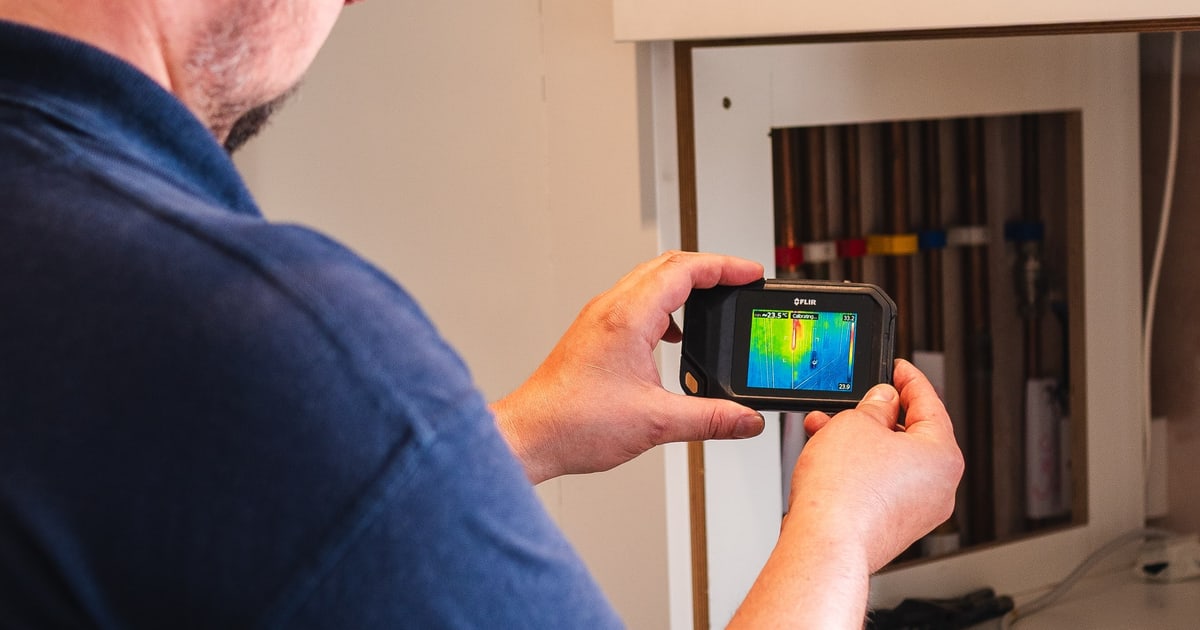
Internal Cold Mains Leak Detection in Gorleston-on-Sea
A cold water mains leak in Gorleston-on-Sea was located using a damp meter, pressure testing, tracer gas, and acoustic listening, with water mains leak detection confirming the fault to redundant pipework runs in the kitchen doorway area without any excavation or floor breaking. Found by engineer Ferenc Gulyas.




The original leak detection company, est. 2011
Facts
| Location | Gorleston-on-Sea |
|---|---|
| County | Norfolk |
| Leak Type | Water Mains Leak Detection |
| Property Type | Residential property |
| Detection Method | Damp Meter, Pressure Testing, Tracer Gas, Acoustic Listening Equipment |
| Outcome | Leak traced to redundant pipework in kitchen doorway; isolated and capped. |
Symptoms
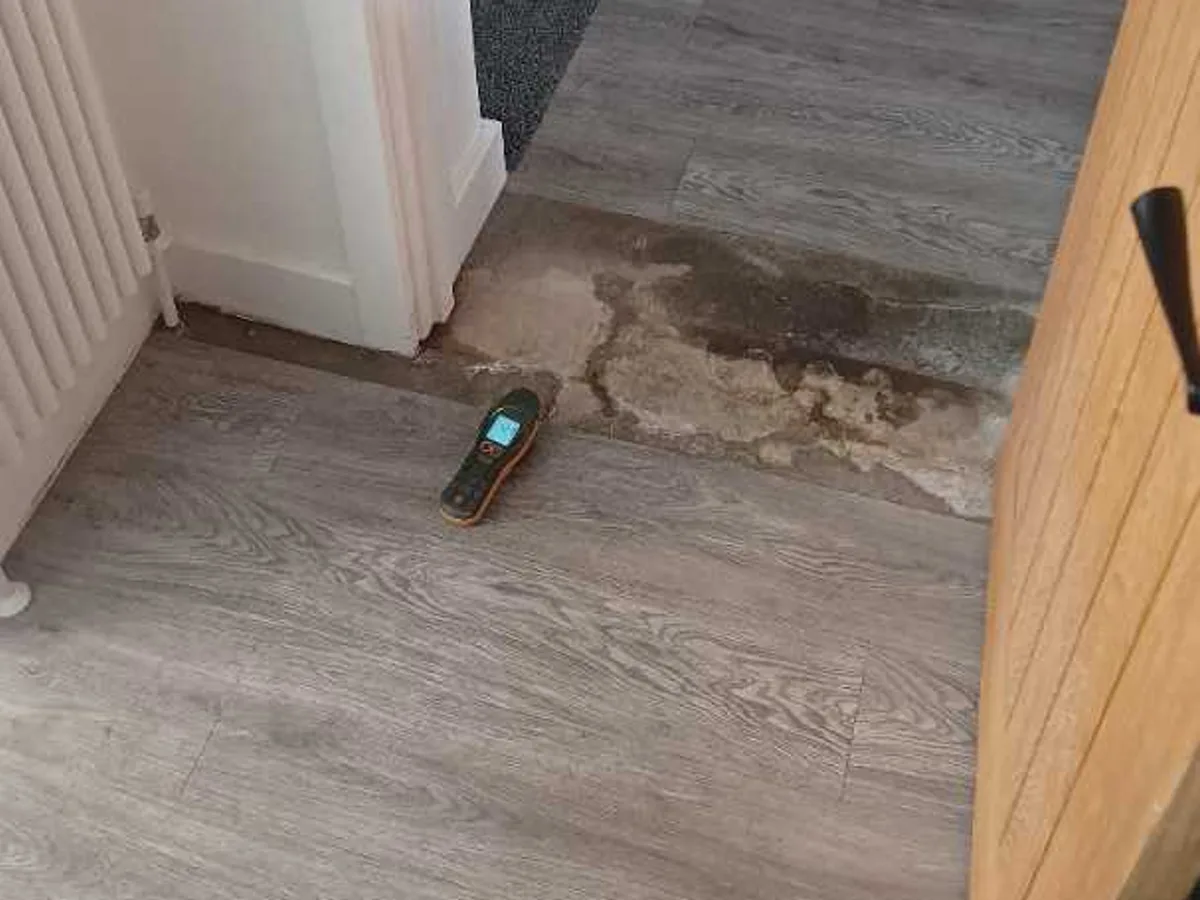
At a property in NR31, the customer noticed a damp area in the kitchen doorway along with visible water damage to the skirting boards in the kitchen. The vinyl flooring had already been lifted before the engineer arrived, exposing a wet concrete subfloor beneath.
The internal stopcock was located in the garage, alongside an unvented indirect hot water cylinder, and a water softener was positioned nearby. A kitchen extension had been completed a few years prior, adding complexity to the pipework layout.
The heating system was pressurised and had not lost pressure, which ruled out the heating circuit as a source. The property had two distinct cold water supplies: an unsoftened cold main feeding the utility kitchen sink, front outside tap, downstairs toilet, and water softener; and a softened cold water circuit feeding the upstairs bathrooms, downstairs basin, kitchen island, kitchen sink, back garden tap, and hot water cylinder.
This split system was a key factor in narrowing down the leak source during internal leak detection.
The wet subfloor and damaged skirting pointed clearly to a leak beneath or near the kitchen doorway, but the origin within the pipework network was not yet established.
Methods Used

The investigation began with a damp meter survey to map moisture levels across the affected area, which confirmed the concentration of dampness at the kitchen doorway leading to the utility room. Pressure testing was then applied methodically — first to the cold main pipework, which indicated a leak, and then to the hot water pipework independently, which passed cleanly.
This isolated the fault to the cold main circuit and directed the investigation accordingly.
Tracer gas was introduced into the suspect pipework, and the detector pinpointed a leak location at the kitchen doorway from the utility room. Acoustic equipment was deployed to corroborate this, and it returned a strong indication at the same location.
During this internal leak detection process, two pipework runs — one cold main, one hot water — were identified beneath the boiler cupboard in the utility room, extending toward the kitchen. Both were found to be redundant, as the active feeds for the kitchen sink and island ran via separate routes.
Isolating and capping these redundant pipes resolved the leak without any excavation.
Damp Meter. Used to survey moisture levels across the kitchen and doorway area, identifying the highest readings at the kitchen doorway leading to the utility room.
Pressure Testing. Applied separately to the cold main, hot water, and external main pipework to isolate which system contained the leak — the cold main failed while the others passed.
Tracer Gas. Introduced into the cold main pipework and detected at the kitchen doorway, providing a precise surface location for the leak point.
Acoustic Listening Equipment. Used to confirm the tracer gas finding, returning a strong acoustic signal at the kitchen doorway and corroborating the identified leak location.
Investigation Process
-
1Damp meter survey
A damp meter investigation was conducted across the kitchen and doorway area. The highest readings were recorded at the kitchen doorway leading to the utility room.
-
2Cold main pressure test
A pressure test kit was connected to the cold main water pipework. The test indicated a leak within this system.
-
3Hot water pressure test
A separate pressure test was carried out on the hot water pipework only. This passed, confirming no leak in the hot water circuit.
-
4Tracer gas investigation
Tracer gas was introduced into the cold main pipework. The detector identified a leak location at the kitchen doorway from the utility room.
-
5Acoustic investigation
Acoustic equipment was deployed at the identified area. It confirmed a strong indication of a leak in the doorway zone, corroborating the tracer gas result.
-
6Redundant pipework identified
Two pipework runs under the boiler cupboard in the utility room — one cold main, one hot water — were found to extend toward the kitchen but serve no active purpose, as the kitchen sink and island are fed via separate routes.
-
7Isolation and capping
The customer was informed of the findings and proposed solution. The two redundant pipeworks were isolated using 15mm isolation valves and capped.
-
8Full retest and external main test
All active cold and hot water pipework was retested and passed. A pressure test on the external main also passed, confirming no further leaks. Street water pressure was measured at 2.6 bar.
Result & Outcome

The leak was traced to two redundant pipework runs — one cold main, one hot water — running from the utility room boiler cupboard toward the kitchen. These pipes were no longer serving any active function, as the kitchen sink and island are fed via alternative routes. Tracer gas pinpointed the fault to the kitchen doorway area, and acoustic equipment confirmed it. No excavation or floor breaking was required.
Both redundant pipes were isolated with 15mm isolation valves and capped. Following this, a full retest of all active cold and hot water pipework was carried out and passed. The external main was also pressure tested and confirmed clear. This outcome is a straightforward resolution for what can otherwise be a complex internal leak detection case — no active supply was interrupted and no structural work was needed.
The wet concrete subfloor and damaged skirting will require time to dry. The recommendation is to run a dehumidifier in the kitchen to accelerate drying and to monitor the area for any returning dampness once drying is complete.
Suspect a leak at your property?
ADI Leak Detection specialists investigate leaks like this across the UK every day. No find, no fee terms apply on qualifying jobs.