
Internal Cold Mains Leak Detection in Pontefract
An internal cold mains leak in Pontefract was located using a damp meter, thermal imaging, endoscope camera, pressure testing, tracer gas, and borescope, with water mains leak detection confirming the source within a wall cavity between the bathroom and bedroom. Found by engineer Matthew Barron.




The original leak detection company, est. 2011
Facts
| Location | Pontefract |
|---|---|
| County | West Yorkshire |
| Leak Type | Water Mains Leak Detection |
| Property Type | Residential property |
| Detection Method | Damp Meter, Thermal Imaging, Endoscope Camera, Pressure Testing, Tracer Gas, Borescope |
| Outcome | Leak found at 22mm end cap in shared wall cavity, repaired. |
Symptoms
At a property in WF8, the customer noticed water damage in a bedroom cupboard and found the carpet in the bedroom was wet. There were visible signs of moisture damage in the affected area, yet the boiler had not dropped pressure — which meant the leak was not on the heating circuit and pointed toward the cold water supply pipework.
The customer arranged internal leak detection to establish the source of the moisture. The damage pattern suggested water had been escaping within or behind the wall structure shared between the bathroom and bedroom, but the exact point of escape was unknown without a full investigation.
Methods Used
The investigation followed a structured process of elimination, beginning with moisture mapping across the bathroom and bedroom floors to establish where elevated readings were present. Thermal imaging was then used to identify cold anomalies in the wall surfaces, and a pressure test on the internal cold feed confirmed an active leak — pressure dropped from 3.4 bar to 2.2 bar over 15 minutes.
Tracer gas was then introduced to the internal pipework and detected at the bedroom corner by the cupboard, narrowing the search to a specific area.
For an internal leak detection job of this kind, the combination of pressure testing and tracer gas is essential in pinpointing the leak before any opening-up work begins. A loft inspection located the relevant pipework run, and targeted access was made through the bedroom cupboard wall to expose the pipe.
This confirmed the leak point without unnecessary structural disturbance.
Damp Meter. Used to take moisture readings across the bedroom and bathroom floors, identifying elevated moisture levels in both rooms and inside the bedroom cupboard.
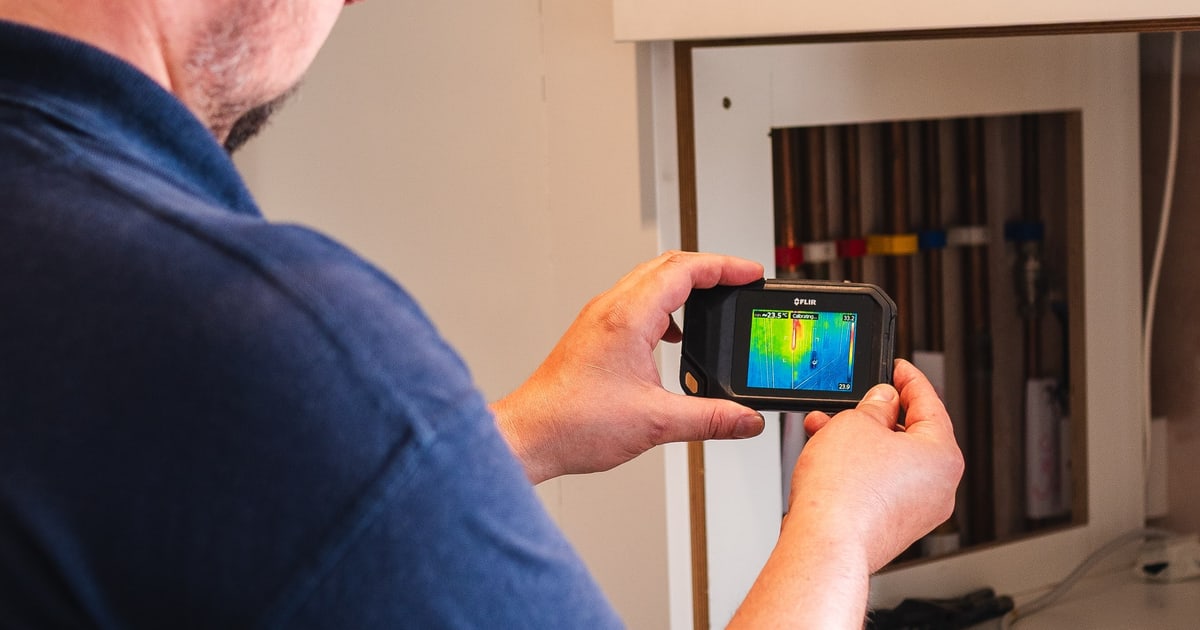
Thermal Imaging. Carried out a thermal CCTV survey of the wall surfaces, revealing cold anomalies consistent with water presence behind the structure.
Endoscope Camera. Inserted through a small hole drilled into the cupboard wall to inspect the cavity, where signs of water escape were directly observed.
Pressure Testing. Applied to the internal cold feed at 3.4 bar for 15 minutes; pressure fell to 2.2 bar, confirming an active leak on that circuit.
Tracer Gas. Introduced to the internal pipework and detected at the bedroom corner adjacent to the cupboard, directing the investigation to the precise area of the leak.
Borescope. Used during the loft inspection to examine the pipework run within the wall cavity shared between the bathroom and bedroom.
Investigation Process
-
1Initial Assessment
On arrival, the customer showed the engineer the area of water damage. The wet carpet and moisture damage in the bedroom cupboard were noted, along with the fact that the boiler pressure had not dropped.
-
2Moisture Mapping
Moisture readings were taken across the bedroom and bathroom floors. High levels of moisture were recorded in both rooms and inside the bedroom cupboard.
-
3Thermal Imaging Survey
A thermal CCTV survey was carried out across the affected walls and floor areas. Cold anomalies were identified, indicating water presence within the structure.
-
4Endoscope Inspection of Cupboard Wall
A small hole was drilled into the interior of the cupboard wall and an endoscope camera was used to inspect the cavity. Signs of water inside the wall cavity were confirmed.
-
5Pressure Test — Pre-Repair
The internal cold feed was pressure tested at 3.4 bar for 15 minutes. Pressure dropped to 2.2 bar, confirming an active leak on the cold water circuit.
-
6Tracer Gas Test
Tracer gas was introduced to the internal pipework and detected at the bedroom corner by the cupboard, identifying the leak zone within the shared wall.
-
7Shower Drainage Inspection
The shower cover was removed to inspect the drainage system. No signs of water escape were found at the drain, though water damage was noted towards the wall adjacent to the bedroom.
-
8Loft Inspection
A loft inspection was carried out to trace the pipework routing. Suspicious pipework was identified running within the cavity of the wall shared between the bathroom and bedroom.
-
9Wall Access and Leak Point Identified
Access was made to the wall through the bedroom cupboard and the pipework was exposed. The leak was found at a 22mm end cap where the pipe had been capped off.
-
10Repair Carried Out
The faulty 22mm end cap was replaced with a new one. This appeared to resolve the leak immediately.
-
11Pressure Test — Post-Repair
A post-repair pressure test was carried out at 3.4 bar for 20 minutes. Pressure held at 3.4 bar throughout, confirming no further loss on the circuit.
Result & Outcome

The leak was traced to a 22mm end cap on the cold water pipework running inside the wall cavity shared between the bathroom and bedroom. The cap had failed, allowing water to escape into the wall structure over time, causing the moisture damage observed in the bedroom and cupboard. Replacing the end cap resolved the leak, and a post-repair pressure test held at 3.4 bar for 20 minutes with no drop, confirming the repair was effective.
The precision achieved through internal leak detection — using tracer gas and pressure testing before any access was made — meant that opening-up work was limited to the bedroom cupboard wall, avoiding unnecessary damage elsewhere. The shower drainage and seals were also inspected and found not to be contributing to the moisture issue, though they were noted as requiring attention separately.
The property in WF8 will now require a drying and restoration programme for the bedroom and bathroom, repair to the cupboard wall, and remedial work to the bathroom sink drainage and shower silicone seals. These are secondary remediation tasks rather than leak-related findings, and are unconnected to the confirmed leak point.
Suspect a leak at your property?
ADI Leak Detection specialists investigate leaks like this across the UK every day. No find, no fee terms apply on qualifying jobs.