
Hot Water Leak Detection in Warwick
A hot water system leak in Warwick was located using thermal imaging, a damp meter, an endoscope camera, pressure testing, and visual inspection, with hot water leak detection confirming the source at the condensate elbow in the boiler cupboard where drips were falling directly onto the hot water pipe beneath. Found by engineer Paul Hope.




The original leak detection company, est. 2011
Facts
| Location | Warwick |
|---|---|
| County | Warwickshire |
| Leak Type | Hot Water Leak Detection |
| Property Type | Residential property |
| Detection Method | Damp Meter, Thermal Imaging, Endoscope Camera, Pressure Testing, Visual Inspection |
| Outcome | Leak found at condensate elbow in boiler cupboard, pipe replaced. |
Symptoms
At a property in CV34, the occupants had noticed a large patch forming on the kitchen ceiling along with water trickling down the wall in the direction of an electrical socket. These signs pointed to an active leak somewhere above or within the kitchen structure, though the precise source was not immediately apparent.
The visible damp and water movement raised concern about potential damage to the fabric of the building and the proximity of water to electrical fittings. A hot water leak detection appointment was arranged to locate the source before further deterioration occurred.
Because the symptoms spanned both the ceiling and a wall, and given that both hot water pipework and a condensate pipe ran in the area, the investigation needed to be systematic, ruling out each possible source in turn.
Methods Used
The investigation followed a structured sequence, beginning with the least invasive methods and progressing toward physical inspection only where necessary. The meter was monitored first to establish whether a continuous supply-side leak was present.
When those returned no findings, moisture mapping with a Protimeter identified the affected zone more precisely, and thermal imaging then pointed toward the condensate pipework rather than the pressurised hot or cold supplies.
For this hot water leak detection job, the combination of thermographic evidence and endoscopic inspection allowed the engineer to narrow the source to a specific elbow joint before any significant lifting of floors took place. A pressure test was also carried out on the hot and cold pipes, though a non-isolable shower mixer valve meant air escaped throughout, limiting that test's conclusions.
The customer agreed to a targeted floor lift in the boiler cupboard, which confirmed the leak visually with the hot water running.
Damp Meter. Protimeter readings were taken throughout the kitchen and bathroom, identifying a large area of maximum moisture along two kitchen walls and defining the extent of the wet zone.
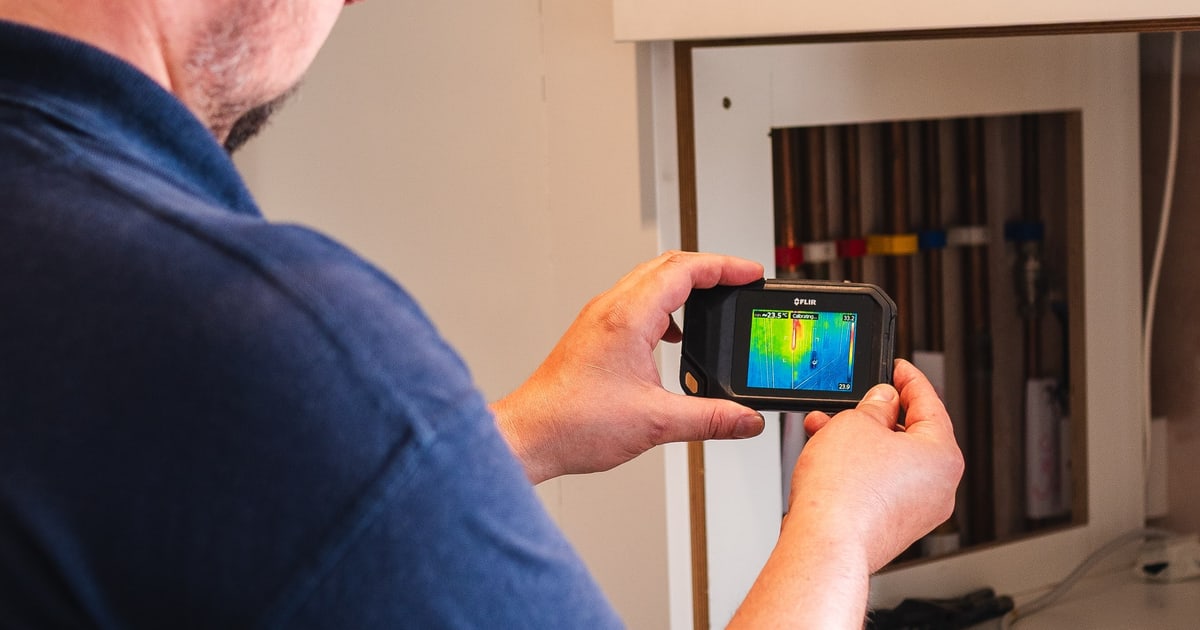
Thermal Imaging. A thermography survey revealed a small heat patch on the kitchen ceiling; the modest peak temperature of 24°C even after ten minutes of hot water running indicated the heat source was more likely the condensate pipework than a pressurised hot water pipe.
Endoscope Camera. The endoscopic camera was inserted to visually inspect the pipework in the area, where corrosion residue was identified on a copper pipe adjacent to the condensate elbow.
Pressure Testing. Four bar of air pressure was introduced via compressor and held for 45 minutes to test the hot and cold pipes, though a continuous drip from a non-isolable shower mixer valve caused air escape throughout the test period.
Visual Inspection. With a section of floor lifted in the boiler cupboard and the hot water running at the basin, several drips were directly observed falling from the condensate elbow onto the hot water pipe, confirming the leak location.
Investigation Process
-
1Meter Monitoring
The external meter was observed over ten minutes with no movement recorded, indicating no large continuous supply-side loss was occurring.
-
2Moisture Mapping
Protimeter readings across the kitchen and bathroom identified a large area of maximum moisture reading along two kitchen walls, defining the affected zone.
-
3Thermal Imaging Survey
A thermography survey found a small heat patch on the kitchen ceiling. The temperature reached only 24°C after ten minutes of hot water running, which suggested the condensate pipework rather than a pressurised hot water pipe as the source.
-
4Endoscopic Inspection
The endoscope camera was used in the area identified by thermal imaging, where corrosion residue was visible on a copper pipe adjacent to the condensate elbow.
-
5Pressure Test
Four bar of air pressure was applied to the hot and cold pipes and held for 45 minutes. A non-isolable shower mixer valve dripped continuously, causing air to escape and preventing a conclusive result.
-
6Floor Lift and Visual Confirmation
The customer agreed to have a section of floor in the boiler cupboard lifted. With hot water running at the basin, several drips were directly observed coming from the condensate elbow and falling onto the hot water pipe below.
-
7Repair Carried Out
The damaged sections of both the condensate pipe and the hot water pipe were cut out and replaced — the condensate run using 45-degree fittings and the hot water pipe using 15mm barrier pipe and fittings. The hot pipe repair was placed back under mains pressure and observed for one hour with no drips.
Result & Outcome
The leak was located at the condensate elbow in the boiler cupboard, where drips were falling directly onto the hot water pipe beneath. Both the damaged section of condensate pipework and the affected section of hot water pipe were cut out and replaced. The hot water pipe repair was held under mains pressure for one hour following the repair and remained dry throughout.
For a hot water leak detection case presenting with ceiling staining and water tracking toward electrical fittings, identifying the condensate pipe as the primary source — rather than a pressurised supply — was significant. It avoided unnecessary exploratory work and directed the repair precisely where it was needed.
One additional observation was made during the repair: when the condensate pipe was cut, a large volume of heavily silted water was released. This indicates the pipe does not maintain a continuous fall as it should, which is likely to cause recurring issues and is recommended for correction.
Suspect a leak at your property?
ADI Leak Detection specialists investigate leaks like this across the UK every day. No find, no fee terms apply on qualifying jobs.