
Hot Water System Leak Detection in Horsford
A hot water system leak in Horsford was located using a damp meter, thermal imaging, pressure testing, and tracer gas, completing hot water leak detection within the property. Found by engineer Ferenc Gulyas.




The original leak detection company, est. 2011
Facts
| Location | Horsford |
|---|---|
| Leak Type | Hot Water Leak Detection |
| Property Type | Residential property |
| Detection Method | Damp Meter, Thermal Imaging, Pressure Testing, Tracer Gas |
| Outcome | Small leaks in buried 15mm copper pipework located and repaired. |
Symptoms

The internal stopcock was located in the downstairs bathroom area. With the kitchen stripped back, the full scale of moisture penetration across both the floor and the shared wall was visible.
A job of this nature — hot water leak detection in a property where pipework runs beneath a concrete floor — requires a methodical approach to isolate which part of the system is responsible before any floor breaking takes place.
Methods Used

With the hot feed identified as the source, tracer gas was introduced to pinpoint the exact location. The detector identified gas readings in the bathroom area, which directed where the concrete floor needed to be opened.
The floor was exposed first in the kitchen, then in the bathroom, until the leaking section of pipework was physically accessible. This step-by-step approach is standard practice in hot water leak detection where pipework is buried beneath a concrete slab — it avoids unnecessary excavation and keeps the break-out targeted.
Damp Meter. Used to survey the kitchen floor and bathroom wall, identifying the highest moisture concentrations and mapping the spread of the leak.
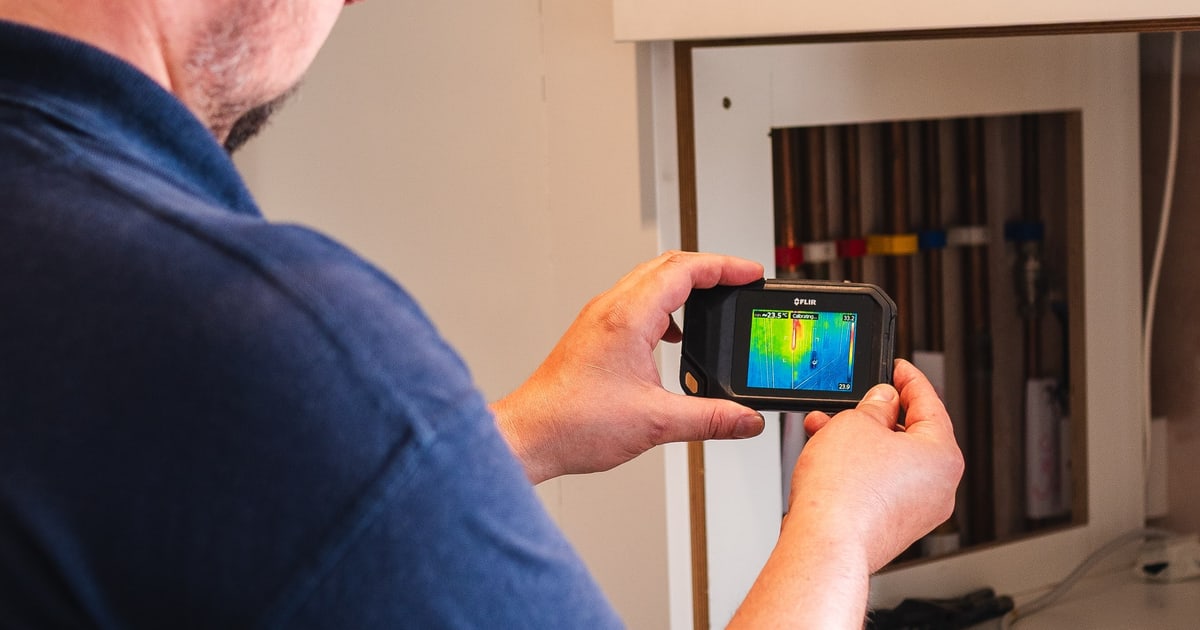
Thermal Imaging. Used to trace the route of the hot water pipework beneath the floor surface without opening anything up at this stage.
Pressure Testing. Run separately on the cold water pipework and the hot feed — cold passed, hot feed failed, isolating the leak to the hot water system.
Tracer Gas. Introduced into the hot feed pipework after pressure testing confirmed a fault; the detector identified gas readings in the bathroom area, pinpointing where the floor needed to be opened.
Investigation Process
-
1Damp meter survey
The engineer conducted a damp meter investigation across the kitchen floor and the shared bathroom wall. Elevated readings were recorded across almost the entire kitchen floor, with very high readings on the wall.
-
2Thermal imaging survey
A thermal imaging camera was used to identify the path of the hot water pipework running beneath the floor, informing where testing should be focused.
-
3Water meter check
The internal stopcock was closed and the water meter was observed. No water usage was recorded, indicating no active flow leak on the cold mains at that moment.
-
4Cold water pressure test
A pressure test was carried out on the cold water pipework only. The test passed, confirming the cold side was intact.
-
5Hot feed pressure test
A pressure test was carried out on the hot feed pipework. The test failed, confirming a leak was present somewhere on the hot water system.
-
6Tracer gas investigation
Tracer gas was introduced into the hot feed pipework. The detector identified gas readings in the bathroom area, directing the engineer to that zone for floor exposure.
-
7Concrete floor exposed
The concrete floor was opened first in the kitchen area, then extended into the bathroom to follow the pipework and access the leak location.
-
8Leak identified
A couple of very small leaks were found on a section of 15mm copper pipework in the bathroom area beneath the floor.
-
9Repair carried out
The leaking section of 15mm copper pipework was replaced with new copper pipe and soldering fittings. Pipework insulation was applied and waste materials were removed from site.
-
10Retest and confirmation
A pressure retest was carried out on the repaired section — it passed. A second tracer gas sweep returned no readings, confirming no further leak was present. Water pressure was restored throughout the property.
Result & Outcome

A dehumidifier was left running following completion of the work. Given the volume of moisture that had accumulated in both the floor slab and the wall, drying the structure will take time, and keeping the dehumidifier running is necessary to prevent residual damp from causing further damage.
Suspect a leak at your property?
ADI Leak Detection specialists investigate leaks like this across the UK every day. No find, no fee terms apply on qualifying jobs.