
Hot Water System Leak Detection in Newbury
A hot water system leak in Newbury was located using thermal imaging, tracer gas, a damp meter, an endoscope camera, and pressure testing, with hot water leak detection confirming the source at a concealed pipe and elbow joint within a duct behind the kitchen unit. Found by engineer Mark Jones.




The original leak detection company, est. 2011
Facts
| Location | Newbury |
|---|---|
| County | Berkshire |
| Leak Type | Hot Water Leak Detection |
| Property Type | Residential property |
| Detection Method | Thermal Imaging, Tracer Gas, Damp Meter, Endoscope Camera, Visual Inspection, Pressure Testing |
| Outcome | Leak found on hot feed pipe behind kitchen cupboard, repaired on site. |
Symptoms

The property in Newbury is a link-detached house spread across three floors, with heating and hot water supplied by an unvented system comprising a pressurised boiler and an unvented hot water cylinder. Concerns had developed around a possible leak, with visible signs of water damage beginning to emerge in the kitchen area — specifically at the base of a corner kitchen unit, where the base board was found to be wet and the surrounding wall showed staining and mould growth from that level downward.
The heating system pressure had also been noted as unusually high, though the system was only being topped up infrequently. This combination of moisture damage at the cupboard base and elevated system pressure pointed toward a leak somewhere within the pipework serving the kitchen, most likely on the hot water side.
Hot water leak detection was required to identify whether the source was within the heating circuit, the domestic hot water pipework, or both.
The affected area beneath and around the cupboard showed moisture readings consistent with a sustained, slow leak rather than an isolated incident. Staining and mould on the wall indicated the problem had been present for some time, gradually saturating the base of the unit and affecting approximately 2 square metres of the floor in the vicinity.
Methods Used

Given the nature of the property and the unvented systems involved, the investigation began with a review of the heating system pressure and a let-by test on the filling loop to determine whether the high pressure was indicative of a fault contributing to the leak. With that test returning no fault, attention shifted to the moisture damage in the kitchen.
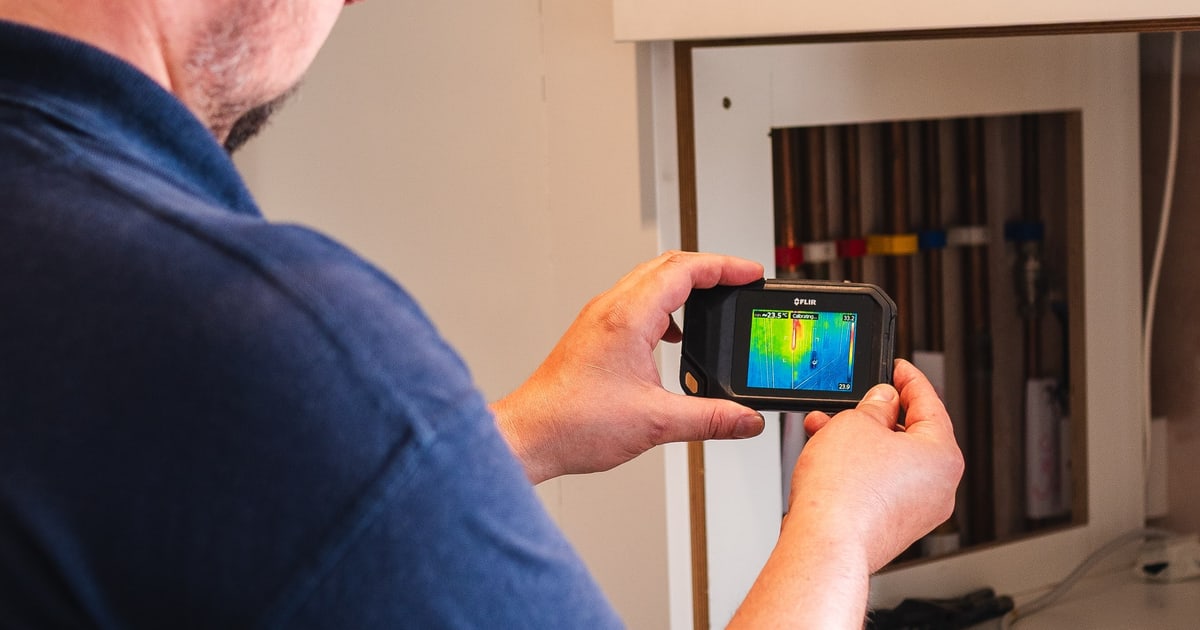
Thermal imaging was carried out while the heating system was running, though only very slight thermal images were recorded at that stage. Damp meter readings confirmed saturation across the full extent of the cupboard base, and slightly elevated moisture readings were found in the floor over roughly 2 square metres.
Hot water leak detection at this property required a methodical approach to confirm the source before any opening up was undertaken. An endoscope camera survey revealed copper pipes running through a duct in the leak area.
A section of the cupboard back was cut out to expose these pipes directly, at which point the leak was identified on the hot feed to the kitchen — a small but continuous failure on a 22 mm copper pipe at an elbow joint. The leak location, once confirmed visually, was precise and limited, allowing a targeted repair without extensive disruption.
Thermal Imaging. Used while the heating system was running to detect heat signatures from any leaking hot pipework in the kitchen area; only very slight thermal images were recorded at this stage.
Tracer Gas. Available as part of the leak detection toolkit for this job to trace concealed pipe routes where other methods returned inconclusive results.
Damp Meter. Used to measure moisture levels across the cupboard base and surrounding floor, confirming full saturation of the base board and elevated readings over approximately 2 square metres of flooring.
Endoscope Camera. Inserted into the duct area within the kitchen to identify and trace the copper pipes running through the concealed void before any cutting was carried out.
Visual Inspection. Conducted on arrival and throughout the investigation, identifying the wet cupboard base, wall staining, mould growth, and ultimately the leak itself once the cupboard back was opened up.
Pressure Testing. A let-by test was performed on the filling loop of the heating system to assess whether the high system pressure was linked to a fault on that circuit; no fault was indicated.
Investigation Process
-
1Arrival and heating system assessment
On arrival, the heating system had been running. System pressure was noted as very high, and a let-by test was conducted on the filling loop. No fault was indicated on the filling loop.
-
2Thermal imaging survey
Thermal imaging was carried out while the heating system was active. Only very slight thermal images were detected, insufficient on their own to pinpoint the leak source.
-
3Visual inspection and moisture testing
The corner kitchen unit base was inspected visually and found to be wet. Moisture testing confirmed the entire base was saturated, with staining and mould on the wall and elevated moisture readings in approximately 2 square metres of the surrounding floor.
-
4Endoscope camera survey
An endoscope camera was deployed into the duct area behind the kitchen unit, revealing copper pipes running through the void in the leak area.
-
5Opening up and leak identification
A section of the cupboard back panel was cut out to expose the copper pipes directly. The leak was identified on the hot feed to the kitchen at a 22 mm copper pipe and elbow joint.
-
6Repair carried out
A small section of 22 mm copper pipe and an elbow joint were replaced using 22 mm copper pipe and three fittings in total.
Result & Outcome

The leak was located on the hot feed to the kitchen, at a 22 mm copper pipe and elbow joint concealed within a duct behind the corner kitchen unit. The source was confirmed visually once a section of the cupboard back was cut away, following endoscope camera work that identified the pipe route. The repair was carried out on site using a short section of 22 mm copper pipe and three fittings, replacing the failed pipe section and elbow.
The extent of the moisture damage — a saturated cupboard base, wall staining, mould, and elevated floor readings over 2 square metres — indicates the leak had been present and slowly running for a considerable period before detection. As is common in hot water leak detection cases involving concealed pipework, the visible damage at the surface significantly understated the duration of the underlying fault.
Two recommendations were noted following the job: the base of the kitchen cupboard will need to be replaced given the level of saturation, and the expansion vessel on the heating system should be checked given the elevated system pressure recorded on arrival. Neither issue was caused by the repair, but both warrant attention to prevent further problems.
Suspect a leak at your property?
ADI Leak Detection specialists investigate leaks like this across the UK every day. No find, no fee terms apply on qualifying jobs.