
Hot Water Leak Detection in Slough
A hot water system leak in Slough was located using pressure testing, tracer gas, and targeted floor excavation, with hot water leak detection confirming the fault in the hot supply pipework buried beneath the hallway floor at the kitchen doorway. Found by engineer Darren Smith.




The original leak detection company, est. 2011
Facts
| Location | Slough |
|---|---|
| County | Berkshire |
| Leak Type | Hot Water Leak Detection |
| Property Type | Residential property |
| Detection Method | Pressure Testing, Thermal Imaging, Tracer Gas, Damp Meter |
| Outcome | Hot supply leak found at kitchen doorway, pipe replaced. |
Symptoms
A property in SL1 was experiencing persistent damp throughout the hallway, with wet floors in both the hallway and the downstairs WC. Access had already been made into the walls to expose the supply pipework and soil stack before the engineer arrived, indicating the issue had been present long enough to warrant preliminary investigation.
The heating and hot water system comprised a system boiler serving a radiator circuit, alongside an unvented hot water storage cylinder. Critically, there was no recorded instance of the boiler losing pressure, which helped narrow the source of the leak away from the heating circuit.
The spread of dampness and wet flooring pointed to a concealed leak within the buried pipework — a scenario that required structured hot water leak detection to isolate the affected section and identify the precise fault location before any repair could be carried out.
Methods Used
The investigation began with systematic pressure testing across three separate circuits — the external mains supply, the internal mains supply, and the hot water supply — each tested at 3 bar for 30 minutes. This immediately isolated the fault to the hot supply.
A valve was then installed to isolate the branch of hot pipework running beneath the hallway floor, and a repeat pressure test confirmed the leak was located within that specific branch.
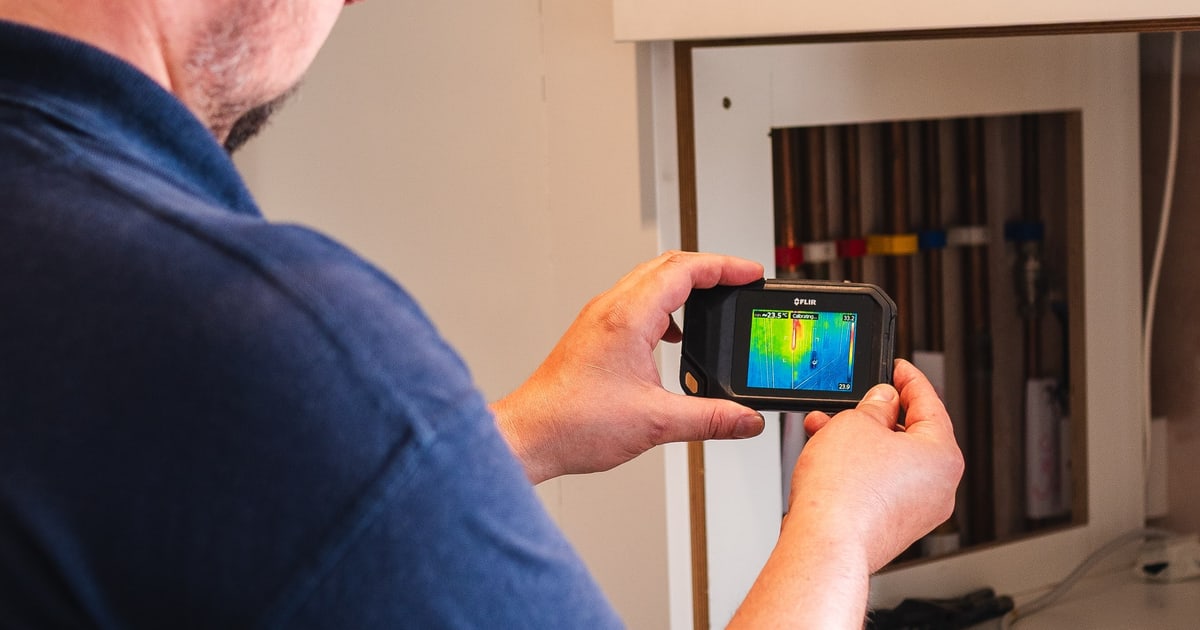
With the leak isolated to the hallway floor, thermal imaging was attempted to trace the buried pipework, but the pipes were too deep for a useful thermal signature. Tracer gas was then introduced into the hot supply, and a large gas trace was detected at the base of the soil stack.
This directed the excavation, which was carried out across several areas of the floor until the leaking pipe was found at the kitchen doorway. Hot water leak detection at this level of complexity — involving multiple test methods in sequence — is necessary precisely because buried pipework in a finished floor cannot be located by visual inspection alone.
Pressure Testing. Used to test the external mains, internal mains, and hot water supply circuits at 3 bar for 30 minutes each, isolating the fault to the hot supply branch beneath the hallway floor.
Thermal Imaging. Attempted to trace the buried hot pipework in the hallway floor, but the pipes were too deep to produce a usable thermal signature.
Tracer Gas. Introduced into the isolated hot supply pipework; a large gas trace was detected at the base of the soil stack, directing the excavation to the correct area of floor.
Damp Meter. Used to assess and confirm the extent of dampness throughout the hallway, consistent with an active concealed leak beneath the floor.
Investigation Process
-
1Initial assessment
The engineer assessed wet floors throughout the hallway and downstairs WC, with damp present across the hallway. Wall access to supply pipework and the soil stack had already been made prior to attendance.
-
2System identification
The hot water and heating system was confirmed as a system boiler with a radiator circuit and an unvented hot water storage cylinder. No pressure loss from the boiler had been recorded, indicating the heating circuit was not the source.
-
3Pressure testing — circuit isolation
The external mains supply, internal mains supply, and hot water supply pipework were each pressure tested at 3 bar for 30 minutes. The test confirmed a leak on the hot supply.
-
4Valve installation and repeat pressure test
A 15mm quarter-turn valve was installed on the hot supply to isolate the branch of pipework running through the hallway floor. A further pressure test confirmed the leak was within that branch.
-
5Thermal imaging attempted
Thermal imaging was used in an attempt to trace the hot pipework beneath the hallway floor, but the pipework was buried too deep to produce a detectable thermal signature.
-
6Tracer gas detection
Tracer gas was introduced into the isolated hot supply pipework. A large gas trace was detected at the base of the soil stack, indicating the leak position within that area of floor.
-
7Floor excavation and leak found
The floor was excavated in several targeted areas to locate the pipework. The leak was found in the floor at the kitchen doorway.
-
8Repair carried out
The leaking section of pipe was cut out and replaced using a 15mm slip coupling, coupling, and 0.5m of 15mm tube.
-
9Post-repair pressure test
The repaired hot supply pipework was pressure tested at 3 bar for 30 minutes with no loss of pressure, confirming the repair was successful.
-
10Reinstatement
The pipework was flushed and all excavated areas were back-filled.
Result & Outcome
The leak was located in the hot supply pipework at the kitchen doorway, buried beneath the hallway floor. It was found through a combination of pressure testing to isolate the circuit, tracer gas to direct the excavation, and targeted floor excavation to expose the pipe.
Once located, the leaking section was cut out and replaced. A post-repair pressure test at 3 bar for 30 minutes with no loss of pressure confirmed the repair was complete. The pipework was flushed and the excavated areas back-filled before the engineer left site.
For a job of this type, hot water leak detection requires working through multiple methods in sequence — pressure testing, thermal imaging, tracer gas — because no single technique is sufficient when the pipework is buried deep beneath a finished floor. The result here was a precise location, a clean repair, and a confirmed pressure-tight system.
Suspect a leak at your property?
ADI Leak Detection specialists investigate leaks like this across the UK every day. No find, no fee terms apply on qualifying jobs.