
Drainage Leak Detection in Kilmarnock
A rainwater drainage leak in Kilmarnock was located using thermal imaging, tracer dye, an endoscope camera, and a damp meter, with drainage leak detection confirming a partial blockage in the waste pipes as the source of the problem. Found by engineer Hamaad Janjua.




The original leak detection company, est. 2011
Facts
| Location | Kilmarnock |
|---|---|
| County | Ayrshire |
| Leak Type | Drainage Leak Detection |
| Property Type | Residential property |
| Detection Method | Thermal Imaging, Tracer Dye, Endoscope Camera, Damp Meter |
| Outcome | Leak found at waste pipe fitting in kitchen ceiling void, pipe replaced. |
Symptoms

There were no visible signs of leakage in the bathrooms directly above the affected kitchen ceiling, which made pinpointing the source difficult without a formal assessment. The intermittent and use-dependent nature of the leak pointed clearly toward the waste pipework serving the upstairs showers, rather than a supply pipe or fitting under constant pressure.
A drainage leak detection assessment was required to identify exactly where the waste system was failing.
Methods Used

This staged approach — thermal imaging, tracer dye, then direct visual inspection — is standard practice in drainage leak detection and ensured the repair area was kept as small as possible. The endoscope confirmed the leak was at a waste pipe fitting connection, and also revealed that the shower waste was partially blocked, with water not draining freely from the trap.
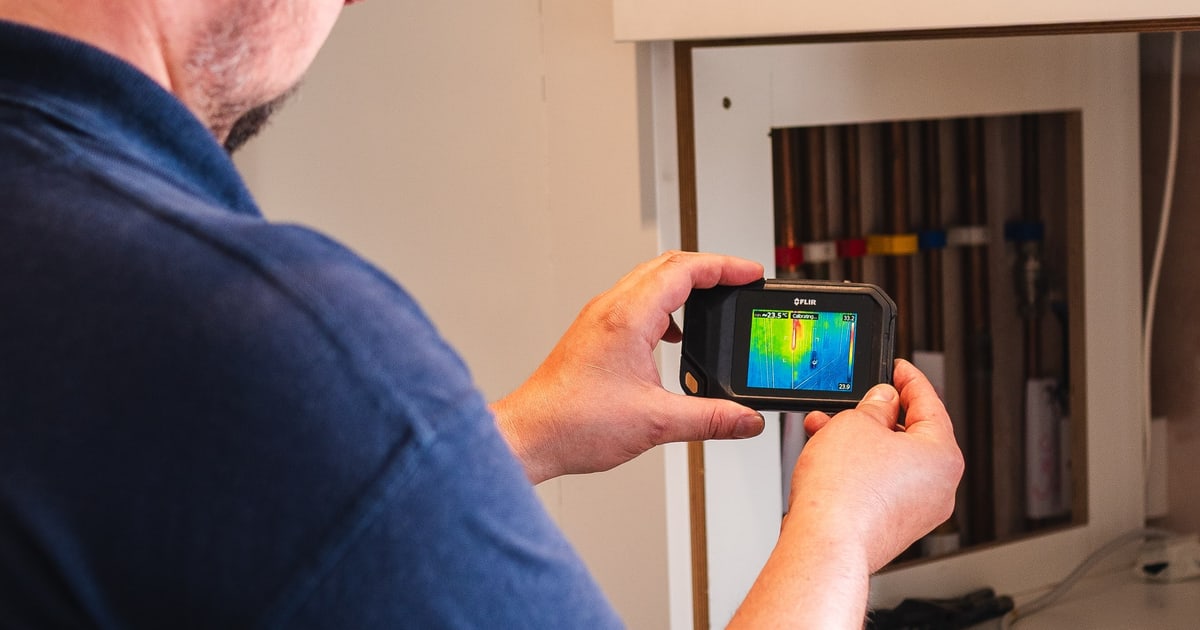
Thermal Imaging. Used to scan the ceiling and surrounding areas for temperature variations that might indicate where moisture was tracking through the structure.
Tracer Dye. Introduced into the upstairs shower waste pipes; green dye was subsequently observed dripping through the kitchen ceiling, confirming the leak was in the waste system.
Endoscope Camera. Inserted through the small ceiling opening to inspect the waste pipework directly, identifying the specific fitting connection where the leak was occurring.
Damp Meter. Used to assess the extent of moisture in the ceiling materials around the suspected leak area.
Investigation Process
-
1Initial Assessment
The engineer attended the property in KA2 and reviewed the reported symptoms — water leaking through the kitchen ceiling only during upstairs shower use, with no visible signs of leakage in the bathrooms above.
-
2Thermal Imaging
Thermal imaging checks were carried out across the ceiling and surrounding structure to identify any areas of heat or moisture variation consistent with a waste pipe leak.
-
3Tracer Dye Introduction
Tracer dye was introduced into the waste pipes of the upstairs showers. Green dye was subsequently observed dripping through the kitchen ceiling, confirming the leak was within the waste system.
-
4Ceiling Opening and Endoscope Inspection
With the customer's permission, a small opening was made in the kitchen ceiling. An endoscope camera was used to inspect the waste pipework, revealing a leak at a waste pipe fitting connection. Partial blockage at the shower waste trap was also noted.
-
5Pipe Repair
The affected section of waste pipe was cut out and replaced with a new pipe section and fittings.
-
6Retest and Confirmation
Following the repair, the system was retested and confirmed to be functioning correctly at the time of the visit.
Result & Outcome

The engineer has recommended that the waste pipes be professionally cleared and that care is taken going forward about what enters the shower traps. The partial blockage observed during the inspection remains a risk for future leaks if left unaddressed.
Suspect a leak at your property?
ADI Leak Detection specialists investigate leaks like this across the UK every day. No find, no fee terms apply on qualifying jobs.