
Drainage Leak Detection in Camberley
A rainwater drainage leak in Camberley was located using a damp meter, thermal imaging, leak dye, and visual inspection, with drainage leak detection confirming the source as the shower waste trap beneath the shower cubicle. Found by engineer Kyle Storkey.




The original leak detection company, est. 2011
Facts
| Location | Camberley |
|---|---|
| County | Surrey |
| Leak Type | Drainage Leak Detection |
| Property Type | Residential property |
| Detection Method | Damp Meter, Thermal Imaging, Leak Dye, Visual Inspection |
| Outcome | Leak found at shower waste trap, drying programme required. |
Symptoms

A property in GU15 was showing signs of water damage to the downstairs bathroom, with damp patches visible on the walls and discolouration to the tile grouting. When an access panel behind the toilet was removed, dark staining was found on the wooden flooring beneath, indicating moisture had been present for some time.
Boiler pressure was checked and confirmed stable, with no recharging taking place, ruling out a pressurised system leak as the source.
The pattern of moisture and staining pointed toward the bathroom as the origin, but the exact source required a structured drainage leak detection survey to pinpoint. The visible symptoms alone were not sufficient to identify whether the issue stemmed from supply pipework, drainage, or the shower installation itself.
Methods Used

The drainage leak detection survey began with moisture mapping across the walls and floors of the downstairs bathroom, which identified elevated readings and thermal saturation points. Attention shifted to the shower installation, where access to the shower panel was made and water was found pooling beneath the waste.
Dye testing to the shower waste confirmed the exact source.
The combination of thermal imaging, moisture mapping, and dye testing allowed each possible source to be systematically assessed and either confirmed or eliminated, producing a precise result without unnecessary intervention.
Damp Meter. Used to map moisture levels across the walls and floors of the downstairs bathroom, identifying elevated readings that directed further investigation.
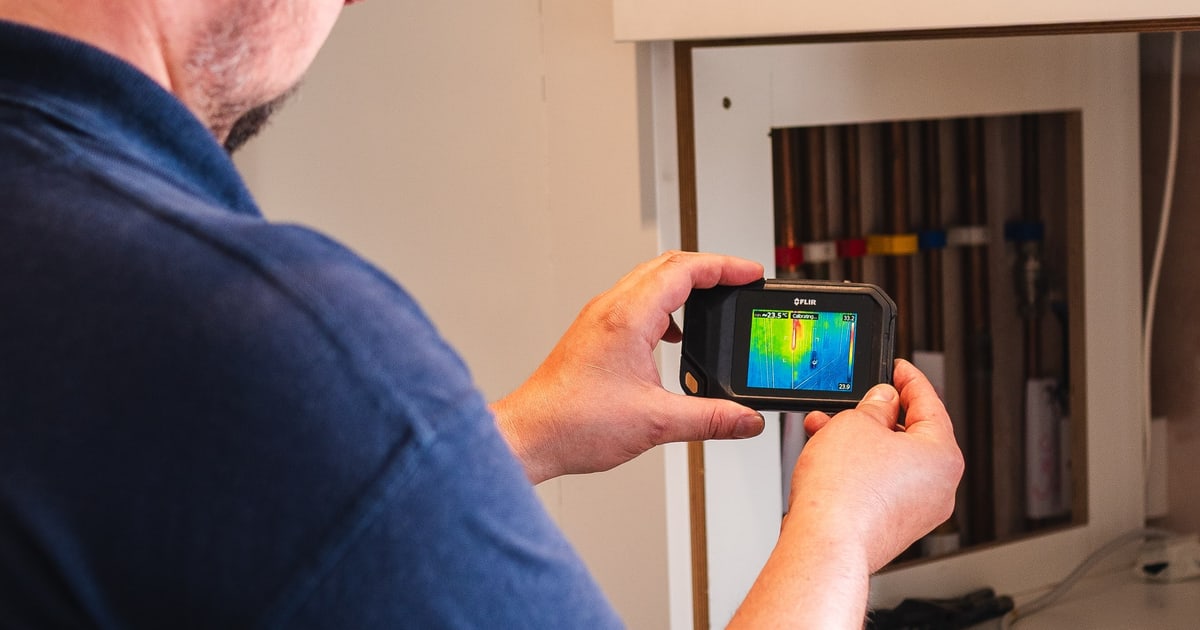
Thermal Imaging. Applied to the bathroom to identify saturation points within the structure that were not visible to the naked eye.
Leak Dye. Introduced to the shower waste to trace the flow path and confirm the shower waste trap as the source of the leak.
Visual Inspection. Included removal of the shower panel and the toilet access panel, revealing water pooling below the waste and dark staining to the wooden flooring respectively.
Investigation Process
-
1Initial Visual Inspection
Damp patches were observed on the walls of the downstairs bathroom and discolouration was noted to the tile grouting. The access panel behind the toilet was removed, revealing dark staining on the wooden flooring beneath.
-
2Boiler Pressure Check
Boiler pressure was checked and confirmed stable, with no recharging being carried out by the owner, ruling out a pressurised heating or supply system as a contributing cause.
-
3Moisture Mapping
A damp meter was used to map moisture levels across the walls and floors of the downstairs bathroom, returning elevated readings throughout the affected area.
-
4Thermal Imaging
Thermal imaging was carried out in the bathroom and identified saturation points within the structure, consistent with sustained water ingress.
-
5Shower Panel Access
Access was made to the shower panel, where water was found pooling below the waste outlet — a clear indicator of a drainage fault at that location.
-
6Dye Testing
Dye was introduced to the shower waste to trace the leak path. The test confirmed the leak source was the shower waste trap, specifically a 40mm waste trap.
-
7Temporary Measure — Tile Tenting
Tiles in the shower cubicle had blown away from the wall. To prevent secondary damage and allow the owner to continue using the shower, the tiles were tented in place as a temporary measure pending full reinstatement.
Result & Outcome

The drainage leak detection survey identified the leak source as the shower waste trap — a 40mm waste trap beneath the shower cubicle. Dye testing provided direct confirmation, with the dye tracing the path of water loss to that specific fitting. The pooling of water below the waste, found when the shower panel was accessed, was consistent with the moisture and staining damage observed across the bathroom.
High moisture readings recorded throughout the downstairs bathroom and the adjacent room mean a stripout and drying programme is required before any reinstatement work can begin. Once the structure has dried to acceptable levels, reinstatement and redecorating can proceed. As a temporary measure, the blown tiles in the shower cubicle have been tented to prevent further secondary damage while the property is being dried out.
The repair itself is straightforward — replacement of the faulty waste trap — but the extent of moisture ingress means the drying programme is a necessary step before the bathroom is reinstated. The drainage leak detection process has given the property owner a precise scope of what needs to be done and in what order.
Suspect a leak at your property?
ADI Leak Detection specialists investigate leaks like this across the UK every day. No find, no fee terms apply on qualifying jobs.