
Central Heating Leak Detection in Wyke
A central heating leak in Wyke was located using pressure testing, tracer gas, acoustic listening, and a damp meter, with central heating leak detection identifying a punctured copper pipe behind a wall where a screw had pierced the pipework during a previous radiator bracket installation. Found by engineer Matthew Barron.




The original leak detection company, est. 2011
Facts
| Location | Wyke |
|---|---|
| Leak Type | Central Heating Leak Detection |
| Property Type | Residential property |
| Detection Method | Pressure Testing, Tracer Gas, Acoustic Listening Equipment, Damp Meter |
| Outcome | Leak found behind wall, caused by screw through copper pipe. |
Symptoms

The owner of a property in BD12 reported that his boiler was losing pressure, pointing to a leak somewhere on the heating system. British Gas had recently installed two new radiators at the property, and they had also notified the customer that a leak was present on the heating pipework.
With pressure continuing to drop, a specialist central heating leak detection survey was arranged to locate the source.
The boiler's inability to maintain pressure indicated an active loss of water from the closed heating circuit. Without identifying the precise location of the leak, any repair would be speculative and the system would remain compromised.
Methods Used

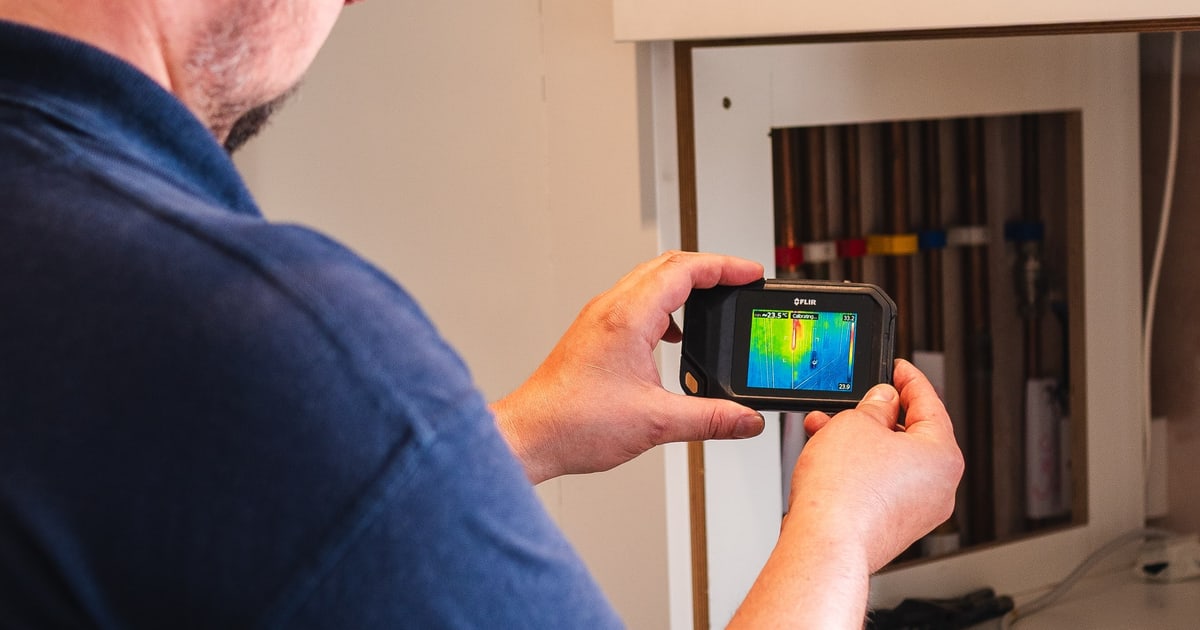
Given the nature of the reported pressure loss, a systematic central heating leak detection approach was taken. The heating system was first pressure tested to confirm a leak was present.
When the test failed, tracer gas was introduced to the heating pipework and the entire property was inspected for gas traces. Tracer gas was detected in the room situated between the two bedrooms, narrowing the search to that area.
Acoustic equipment was then used on the pipework connected to the radiator in that room, where water movement was detected. Access was made to both walls in the area to expose and visually confirm the source of the leak.
Once the leak was physically located, the cause became clear. When British Gas had remounted the radiator bracket during the recent installation, a screw had been driven directly through the copper pipe behind the wall.
A repair was completed, and the system was pressure tested again to verify the fix.
Pressure Testing. Used at the start of the job to confirm an active leak on the heating circuit, and again after the repair to verify the system held at 2.4 bar for 20 minutes with no pressure drop.
Tracer Gas. Injected into the heating pipework to trace the leak path; gas was detected in the room between the two bedrooms, directing the investigation to that specific area.
Acoustic Listening Equipment. Applied to the pipework connected to the radiator in the identified room, detecting active water movement that pinpointed which section of pipe was leaking.
Damp Meter. Used during the property inspection to assess moisture levels in the walls and support the findings from the tracer gas and acoustic survey.
Investigation Process
-
1Initial Pressure Test
On arrival, a pressure test was carried out on the heating system. The test failed, confirming an active leak on the heating pipework.
-
2Tracer Gas Introduced
Tracer gas was injected into the heating circuit and the property was inspected room by room. Gas was detected in the room located between the two bedrooms.
-
3Acoustic Survey
Acoustic equipment was used on the pipework connected to the radiator in the identified room. Water movement was detected, confirming an active escape at that location.
-
4Wall Access and Leak Located
Access was made to both walls in the room to expose the pipework. The leak was found to be caused by a screw that had been driven through the copper pipe when British Gas remounted the radiator bracket during a recent installation.
-
5Repair Completed
The damaged section of copper pipe was repaired using two 15mm equal kwik fit couplings, two 15mm inserts, and a replacement piece of 15mm plastic pipe.
-
6Post-Repair Pressure Test
The heating system was pressure tested at 2.4 bar for 20 minutes. Pressure remained at 2.4 bar throughout, confirming no remaining leaks on the pipework.
-
7Radiators Bled
All radiators on the heating system were bled following the repair. However, the heating system would not switch on, which requires further investigation.
Result & Outcome

The leak was located behind the wall in the room between the two bedrooms, on the copper pipe connected to the radiator. A screw installed by British Gas when remounting the radiator bracket had punctured the pipe, causing the sustained pressure loss. This central heating leak detection survey identified a cause that would not have been apparent without non-invasive testing to direct the wall access precisely.
Following the repair, the heating system was pressure tested at 2.4 bar for 20 minutes with no drop recorded, confirming the circuit is now watertight. Both walls that were accessed to reach the pipework will need to be made good. Separately, the heating system would not switch on after the repair and radiator bleeding, so the boiler and controls will need to be checked by a heating engineer before the system can be returned to full use.
Suspect a leak at your property?
ADI Leak Detection specialists investigate leaks like this across the UK every day. No find, no fee terms apply on qualifying jobs.