
Central Heating Leak Detection in Cumbernauld
A central heating leak in Cumbernauld was located using a damp meter, thermal imaging, pressure testing, acoustic listening, and a borescope, completing central heating leak detection and identifying the source beneath the flooring. Found by engineer Hamaad Janjua.




The original leak detection company, est. 2011
Facts
| Location | Cumbernauld |
|---|---|
| County | Lanarkshire |
| Leak Type | Central Heating Leak Detection |
| Property Type | Residential property |
| Detection Method | Damp Meter, Thermal Imaging, Pressure Testing, Acoustic Listening Equipment, Borescope |
| Outcome | Cracked pipework under hallway floor, repaired and retested. |
Symptoms

With nothing to see at surface level, central heating leak detection was the only way to establish where the system was losing pressure. The fault was not going to resolve itself, and without locating the source, any repair attempt would be guesswork.
Methods Used

With two independent methods pointing to the hallway, and following the customer's agreement, the floorboards were lifted to expose the pipework below. The investigation confirmed significant damage: the pipework was cracked and fittings had popped off in multiple locations.
Damp Meter. Used in the initial sweep to check for elevated moisture readings at floor and wall surfaces before any floor access was attempted.
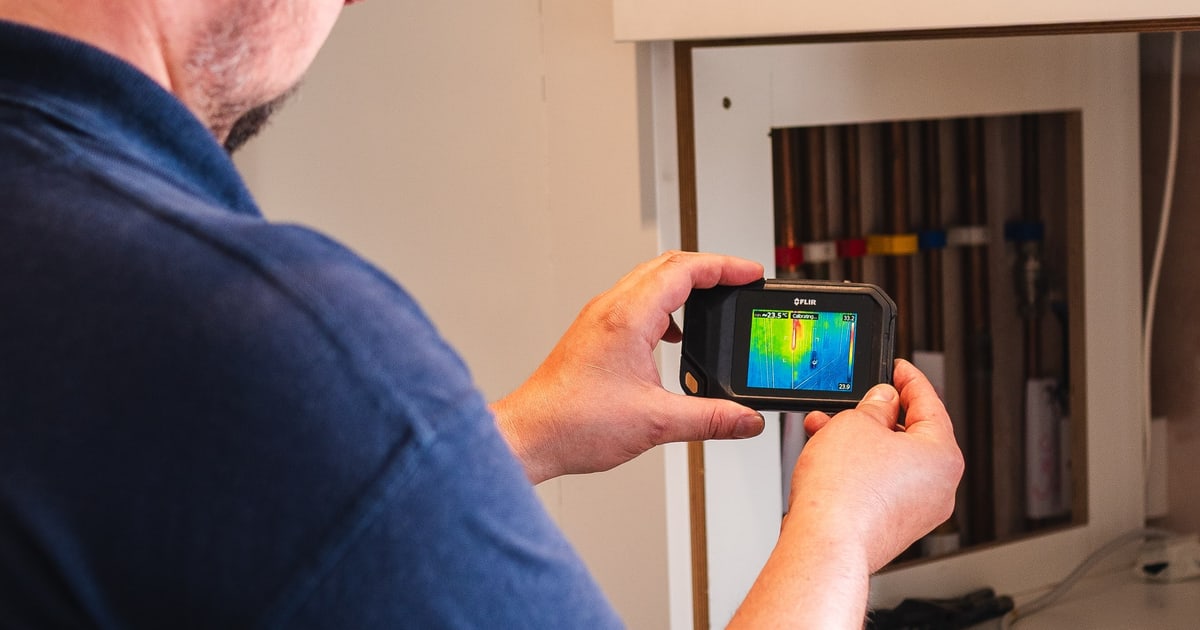
Thermal Imaging. Carried out alongside moisture testing to detect any temperature anomalies beneath the floor surface that might indicate escaping heated water.
Pressure Testing. Introduced gas pressure into the system, which returned a positive result localised to the hallway, narrowing the search area significantly.
Acoustic Listening Equipment. Deployed in the hallway after pressure testing, picking up loud acoustic signals from beneath the floor consistent with a pressure escape at the pipework.
Borescope. Available for inspecting confined or inaccessible voids as part of the investigation toolkit used on this job.
Investigation Process
-
1Initial surface checks
Moisture meter testing and thermal imaging were carried out across the flat to identify any subsurface anomalies without lifting floors.
-
2Pressure test applied
Gas pressure was introduced into the central heating system and a positive pressure result was detected in the hallway.
-
3Acoustic equipment deployed
Acoustic detection equipment was used in the hallway and picked up loud noise from beneath the floor, corroborating the pressure test result.
-
4Customer permission obtained
Before any floor access was attempted, the customer was consulted and gave permission for the floorboards to be lifted.
-
5Floorboards lifted, damage found
With the hallway floorboards removed, the pipework was found to be cracked and fittings had popped off in several places.
-
6Repair carried out
The damaged section of pipework was cut out and replaced with a new section, along with new fittings and inserts.
-
7System retested and refilled
A retest was carried out after the repair and passed. The system was refilled and all seven radiators were checked to confirm heat was coming through correctly.
Result & Outcome

The engineer's recommendation following the repair is to use thinner base sheets when the flooring is relaid. The existing pipework sits close to the top of the floor, and reducing the thickness of the base material will avoid contact with or strain on the pipework, lowering the risk of the same type of damage recurring.
Suspect a leak at your property?
ADI Leak Detection specialists investigate leaks like this across the UK every day. No find, no fee terms apply on qualifying jobs.