
Central Heating Leak Detection in Bursledon
A central heating leak in Bursledon was located using thermal imaging, a damp meter, tracer gas, and pressure testing, with central heating leak detection confirming the source at the filling loop valve and metal braided hose connection near the Megaflo cylinder. Found by engineer Artur Sowa.




The original leak detection company, est. 2011
Facts
| Location | Bursledon |
|---|---|
| County | Hampshire |
| Leak Type | Central Heating Leak Detection |
| Property Type | Residential property |
| Detection Method | Thermal Imaging, Damp Meter, Tracer Gas, Pressure Testing |
| Outcome | Leak found at filling loop valve near Megaflo cylinder, repaired. |
Symptoms

At a property in SO31, visible dampness and physical damage were observed on the flooring between the kitchen and living room areas. The customer had also noticed a consistent drop in heating system pressure over the preceding week, pointing to an active leak somewhere within the central heating circuit.
This kind of sustained pressure loss is a reliable indicator that water is escaping the sealed system, but locating the exact source without specialist equipment is not straightforward — particularly where the leak is near concealed pipework or components. A central heating leak detection investigation was required to pinpoint the fault without unnecessary disruption to the property.
The combination of floor damage and ongoing pressure drop suggested the leak had been present for some time, making accurate detection and prompt repair essential to prevent further deterioration.
Methods Used

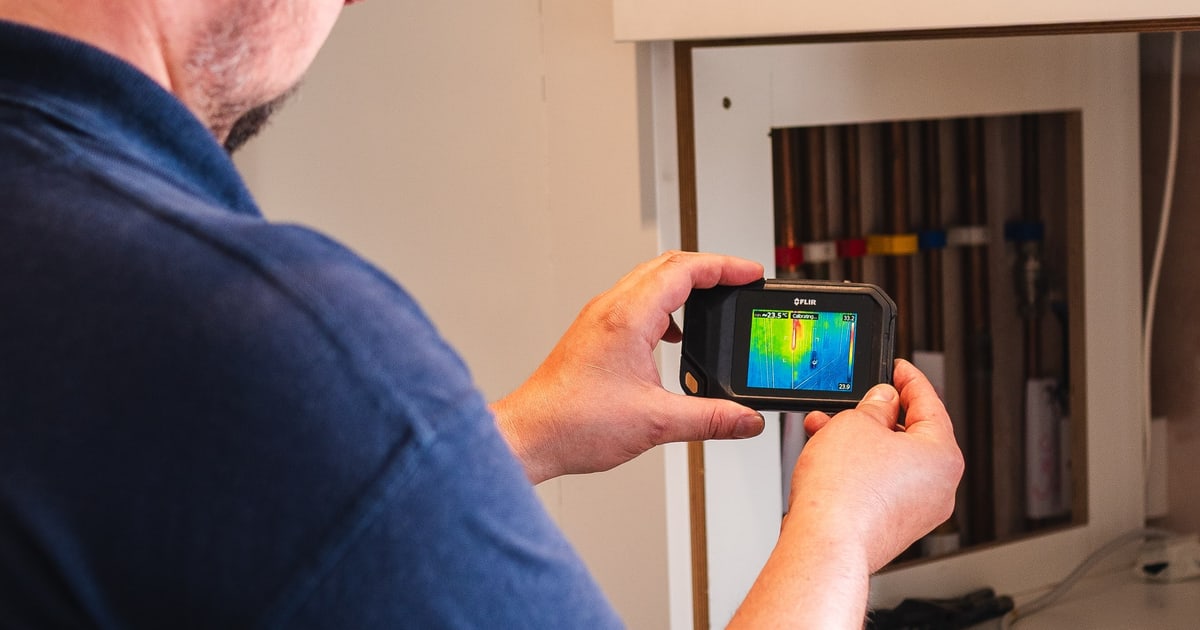
The investigation began with a damp meter survey and thermal imaging inspection across the affected areas, allowing the engineer to map moisture presence and identify temperature anomalies that might indicate where water was tracking through the structure. These initial steps helped narrow the focus before proceeding to more precise methods.
As part of the central heating leak detection process, preparations were made to introduce tracer gas into the heating system. During this preparation stage, a leak was identified at the filling loop valve — specifically at the metal braided hose connection.
The system was repaired at that point, and the tracer gas test was then completed to confirm no additional leaks were present. A strong tracer gas reading was detected near the Megaflo cylinder, confirming the filling loop valve as the sole source of the fault.
A pressure test was subsequently carried out to verify the integrity of the repaired system.
Thermal Imaging. Used during the initial inspection to detect temperature anomalies across the floor and surrounding areas, helping identify where moisture was present beneath the surface.
Damp Meter. Applied across the flooring between the kitchen and living room to measure moisture levels and confirm the extent of water ingress at the affected area.
Tracer Gas. Introduced into the heating system after the filling loop repair to confirm no additional leaks remained, with a strong reading detected near the Megaflo cylinder pinpointing the original fault location.
Pressure Testing. Conducted on the heating system following the repair to verify that no pressure drop occurred over the test duration, confirming the system was fully sealed.
Investigation Process
-
1Initial Damp and Thermal Survey
On arrival, the engineer carried out a damp meter survey and thermal imaging inspection across the affected flooring area between the kitchen and living room to identify moisture presence and temperature anomalies.
-
2Leak Identified at Filling Loop Valve
During preparation for the tracer gas test, a leak was found at the heating system's filling loop valve, originating from the metal braided hose connection.
-
3Filling Loop Valve and Hose Replaced
The heating system was isolated and a small amount of water drained. The defective filling loop valve and metal braided hose were removed and replaced with new components, after which the system was refilled and bled.
-
4Tracer Gas Test Completed
With the repair in place, the tracer gas test was completed. A strong reading was detected in the vicinity of the Megaflo cylinder, confirming the filling loop valve as the precise source of the leak.
-
5Pressure Test Passed
A final pressure test of the heating system was conducted and passed, with no pressure drop recorded over the test duration, confirming the repair had fully resolved the fault.
Result & Outcome

The leak was traced to the filling loop valve on the heating system, specifically at the connection point of the metal braided hose, located in the vicinity of the Megaflo cylinder. This was confirmed first through visual identification during tracer gas preparation and then verified by a strong tracer gas reading at that location.
The defective valve and hose were replaced during the same visit. A pressure test carried out after the repair recorded no pressure drop, providing clear confirmation that the heating system was fully sealed and the fault had been resolved.
For a central heating leak detection case like this, reaching a confirmed repair outcome within the same visit — with both tracer gas verification and a passed pressure test — means the customer has documentary evidence the system is sound, and no further investigative work is required.
Suspect a leak at your property?
ADI Leak Detection specialists investigate leaks like this across the UK every day. No find, no fee terms apply on qualifying jobs.