
Central Heating Leak Detection in Windsor
A central heating leak in Windsor was located using thermal imaging, a damp meter, tracer gas, pressure testing, and visual inspection, with central heating leak detection confirming a faulty Pressure Relief Valve and a passing thermostatic valve on the front door radiator. Found by engineer Kyle Storkey.




The original leak detection company, est. 2011
Facts
| Location | Windsor |
|---|---|
| County | Berkshire |
| Leak Type | Central Heating Leak Detection |
| Property Type | Residential property |
| Detection Method | Thermal Imaging, Damp Meter, Tracer Gas, Pressure Testing, Visual Inspection |
| Outcome | Pressure loss traced to faulty Pressure Relief Valve, replaced. |
Symptoms

The absence of any damp or water-damaged areas made pinpointing the source difficult without specialist investigation. A central heating leak detection survey was arranged to trace the origin of the pressure loss using a structured, multi-stage approach.
Methods Used

Attention then turned to the Pressure Relief Valve, where water escape was confirmed at the PRV outlet. A tracer gas survey followed, with the system drained and gas introduced through the main bedroom radiator to 1 bar.
Gas escape was detected from the PRV outlet, confirming it as the source. The PRV outlet pipe was cut and capped, and the system was pressure tested at both 1 bar for 30 minutes and 2 bar for 45 minutes — no drop in pressure was recorded at either stage, confirming the pipework itself was sound.
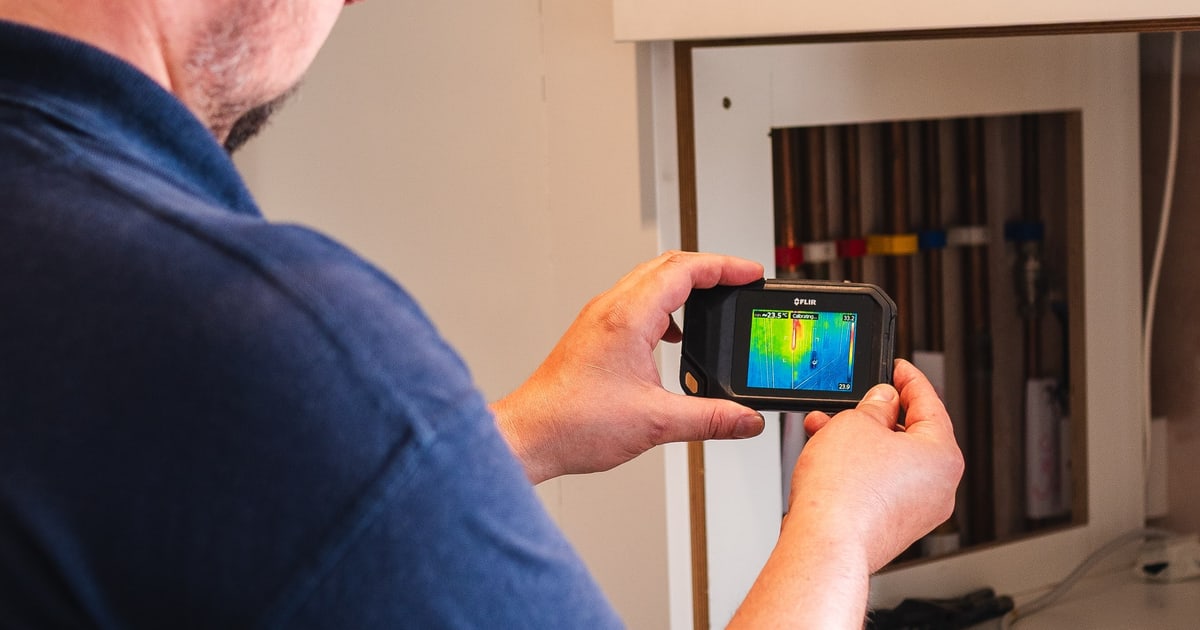
Thermal Imaging. Used to locate and trace the network of central heating pipework throughout the property; no thermal anomalies were identified.
Damp Meter. Moisture mapping was carried out across the property to check for elevated readings; none were found.
Tracer Gas. Gas was introduced into the central heating system via the main bedroom radiator and taken to 1 bar; escape was detected at the PRV outlet, identifying it as the fault.
Pressure Testing. Following isolation of the PRV outlet, the system held pressure at both 1 bar for 30 minutes and 2 bar for 45 minutes, confirming no leak in the pipework itself.
Visual Inspection. Direct inspection of the PRV outlet confirmed water escape prior to tracer gas testing.
Investigation Process
-
1Boiler and system assessment
The engineer accessed the boiler in the loft and noted the pressure reading at 1 bar. The history of constant recharging by the homeowner was noted, but no water-damaged areas were found within the property.
-
2Thermal imaging survey
Thermal imaging was carried out throughout the property to locate the pipework network. No thermal anomalies were identified.
-
3Moisture mapping
A moisture mapping survey was conducted across the property. No elevated moisture readings were recorded.
-
4PRV outlet inspection
A visual inspection of the Pressure Relief Valve outlet was carried out and water escape was confirmed at that point.
-
5Tracer gas survey
The central heating system was drained down and tracer gas was introduced through the main bedroom radiator to 1 bar. Gas escape was detected at the PRV outlet.
-
6PRV outlet isolated for pressure testing
The PRV outlet pipe was cut and capped to isolate it. The system was then pressure tested at 1 bar for 30 minutes and subsequently at 2 bar for 45 minutes — no pressure drop was recorded at either stage.
-
7Repairs carried out
A new Pressure Relief Valve was installed. The thermostatic valve on the front door radiator was also replaced, as it was found to be passing.
Result & Outcome

A new Pressure Relief Valve was installed, and the thermostatic valve on the front door radiator — which was also found to be passing — was replaced at the same visit. Ongoing monitoring of the boiler pressure is recommended to confirm the system holds following the repairs.
Suspect a leak at your property?
ADI Leak Detection specialists investigate leaks like this across the UK every day. No find, no fee terms apply on qualifying jobs.